
Watch your money multiply with a savings account interest calculator
Your Money Is Growing — But Is It Growing Fast Enough?
A savings account interest calculator is a free tool that shows you exactly how much your savings will grow over time — based on your starting balance, monthly contributions, interest rate, and compounding frequency.
Here’s a quick answer to get you started:
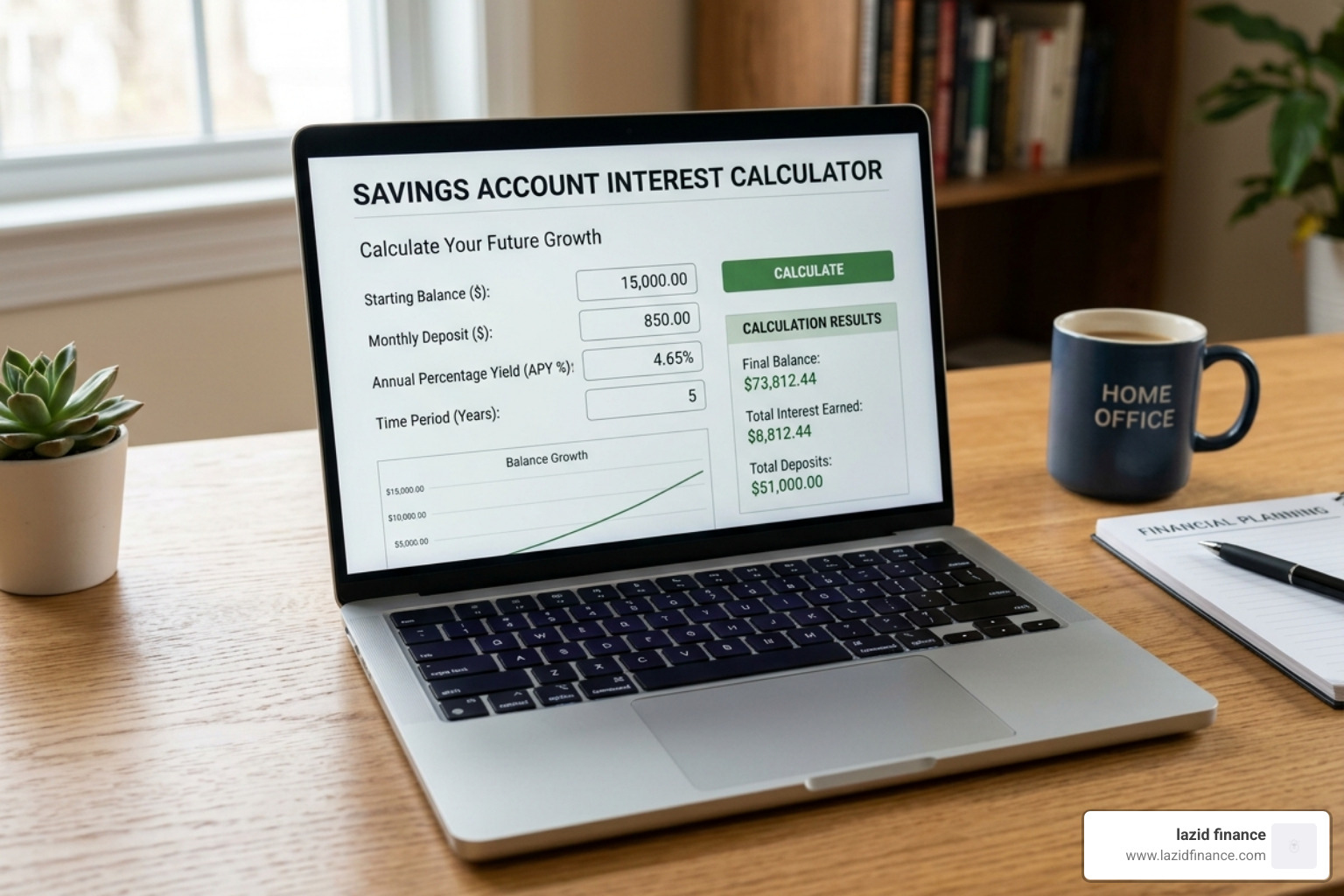
How to use a savings account interest calculator:
- Enter your starting balance — the amount you have saved right now
- Add your monthly contribution — how much you plan to deposit each month
- Input your APY — the annual percentage yield your account offers
- Set your time period — how many months or years you want to project
- Get your result — the calculator shows your total balance, total contributions, and total interest earned
Example results at a glance:
| Starting Balance | Monthly Deposit | APY | Time | Total Earned |
|---|---|---|---|---|
| $0 | $135/month | 5% | 3 years | ~$5,200 |
| $1,000 | $200/month | 4% | 2 years | ~$6,067 |
| $10,000 | $0 | 0.01% | 1 year | ~$1 |
| $10,000 | $0 | 5% | 1 year | ~$500+ |
The difference between a low-rate account and a high-yield one isn’t small. It’s the difference between earning one dollar and earning five hundred on the same $10,000 — in the same year.
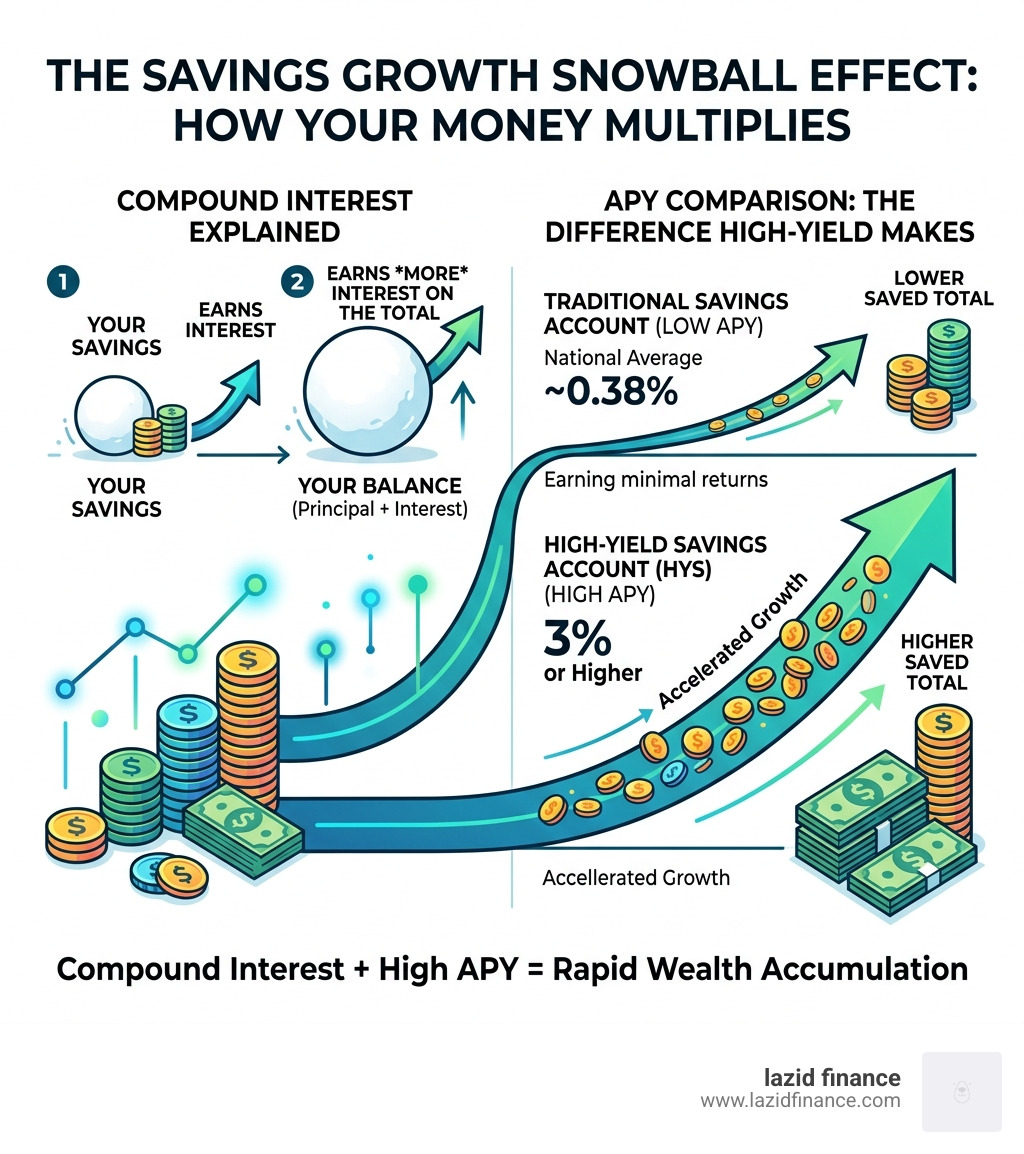
Most people have no idea their savings are barely moving. The national average APY for a conventional savings account sits at just 0.38% (FDIC, July 2025). Meanwhile, high-yield savings accounts are offering 3% or higher.
That gap matters — a lot. And a savings interest calculator makes it visible in seconds.
How a savings account interest calculator works
At its core, a savings account interest calculator is a mathematical engine designed to take the guesswork out of financial planning. Instead of scribbling formulas on a napkin, you provide a few key pieces of information, and the tool projects your wealth accumulation into the future. It doesn’t just add up your deposits; it calculates the “magic” of interest building upon itself.
When we use these tools, we are essentially looking at a future value (FV) projection. The calculator uses a specific formula to determine how much your money will be worth after a set period. For those who love the math, the formula often looks like this: FV = [P * (((1 + r)^n – 1) / r)] + [I * (1 + r)^n]
In this equation:
- FV is the future value.
- P is your monthly deposit.
- r is the interest rate (expressed as a decimal).
- n is the number of months.
- I is your initial balance.
But don’t worry—you don’t need to memorize that. Our goal at Lazid Finance is to provide intelligent financial tools for conscious decisions, and that means making the complex simple. The calculator does the heavy lifting, allowing you to focus on consistency and habit building. Seeing your potential balance grow from $1,000 to over $11,000 in just two years (by increasing monthly contributions from $200 to $400 at 4% APY) is a powerful motivator to keep saving.
Key inputs for your savings account interest calculator
To get the most accurate projection, you need to be precise with your inputs. Here are the four pillars of any savings account interest calculator:
- Starting Balance: This is your initial deposit. It could be $0 if you are starting a fresh goal, or it could be the $8,000 median balance held by American households (Federal Reserve, 2022).
- Contribution Frequency: How often are you adding money? Most people save monthly, but some tools allow for weekly or annual additions. Even small, consistent amounts—like $33.75 a week—can lead to over $5,200 in three years at a 5% rate.
- Annual Interest (APY): This is the rate your bank pays you. It’s vital to use the Annual Percentage Yield (APY) rather than the nominal interest rate because the APY accounts for compounding.
- Time Period: How long do you plan to leave the money alone? Projections can range from a few months for a vacation fund to decades for retirement planning.
Using a savings account interest calculator for different financial goals
We don’t just save for the sake of having numbers in a bank account; we save for the lives we want to lead. A savings account interest calculator is the ultimate roadmap for these milestones.
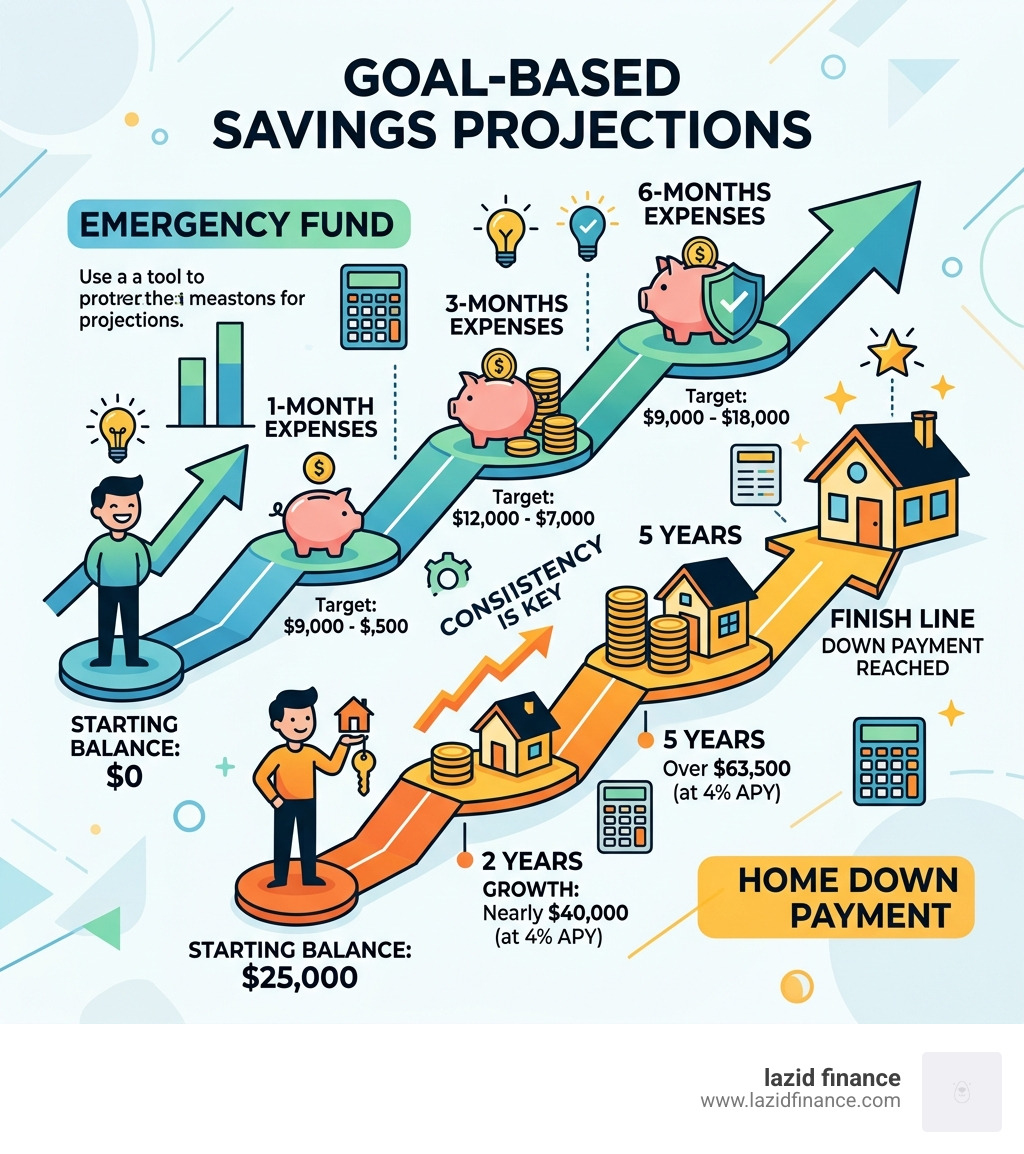
- Emergency Funds: Financial experts suggest aiming for three to six months of essential expenses. If your monthly bills are $3,000, your target is $9,000 to $18,000. The calculator tells you exactly how long it will take to reach that safety net based on what you can afford to set aside today.
- Home Down Payments: This is often a long-term play. For example, starting with $25,000 and adding $500 monthly at a 4% APY could result in nearly $40,000 in just two years, or over $63,500 in five years.
- Vacation & Weddings: These are short-to-medium-term goals. If you need $5,000 for a wedding in two years, the calculator can show you that a $200 monthly contribution at a 4% APY will get you there, earning you about $267 in “free” interest along the way.
- College & Holidays: Whether it’s $50 for holiday gifts or $500 for a 529 plan, seeing the milestones helps maintain the discipline needed to reach the finish line.
The mechanics of compounding and APY
If interest is the “paycheck” your money earns, compounding is the “raise” it gets every period. Compounding happens when the interest you earn is added back into your principal balance. The next time interest is calculated, it’s calculated on that new, larger amount.

Understanding compound interest in a savings account interest calculator
Think of compound interest as a wealth snowball. At the top of the hill, the ball is small. But as it rolls down (representing time), it picks up more snow (interest). Because the ball is now larger, it picks up even more snow on the next rotation. This is exponential growth.
The frequency of this compounding matters significantly. Banks typically compound interest in one of three ways:
- Daily: The most beneficial for savers. Interest is calculated every day and added to the balance.
- Monthly: Very common. Interest is added once a month.
- Quarterly or Annually: Less common for modern high-yield accounts, and generally results in slightly lower total earnings.
While the difference between daily and monthly compounding on a small balance might only be a few cents, over many years and with larger balances, it can amount to hundreds or thousands of dollars in variance.
APY vs. simple interest rate
One common mistake when using a savings account interest calculator is confusing the “interest rate” with the “APY.”
- Simple Interest Rate: This is the nominal rate. It tells you how much interest you earn on your principal only. It ignores the effect of compounding.
- APY (Annual Percentage Yield): This is the “truth in savings” rate. It reflects the total amount of interest you will actually earn in one year, taking into account how often the interest compounds.
When you see a high-yield account offering 5.00% APY, that number already includes the “interest on interest.” This makes it much easier to compare different banks. If Bank A offers 4.90% compounded daily and Bank B offers 5.00% compounded annually, the APY allows you to see at a glance which one actually puts more money in your pocket.
| Compounding Frequency | $10,000 at 5% (1 Year) | Total Interest |
|---|---|---|
| Annual | $10,500.00 | $500.00 |
| Quarterly | $10,509.45 | $509.45 |
| Monthly | $10,511.62 | $511.62 |
| Daily | $10,512.67 | $512.67 |
Comparing savings vehicles and growth factors
Not all “savings” accounts are created equal. Depending on your goals, you might choose different vehicles, each with its own set of pros and cons.
- Traditional Savings Accounts: These are usually found at big-name “brick and mortar” banks. They offer convenience but often have abysmal rates. As of July 2025, many still offer a measly 0.01% APY. On a $10,000 balance, that’s just $1 a year—hardly enough to buy a candy bar.
- High-Yield Savings Accounts (HYSA): Usually offered by online banks with lower overhead, these accounts currently offer rates of 3.00% to 5.00% or higher. They are generally the best place for emergency funds because they offer high liquidity (you can get your money quickly) and high returns.
- Money Market Accounts (MMA): These are a hybrid between checking and savings. They often come with a debit card or check-writing abilities. While they often pay higher rates than traditional savings, they may invest in short-term debt securities, which carries a tiny bit more complexity, though they are still typically FDIC-insured.
- Certificates of Deposit (CDs): If you know you won’t need your money for a set period (6 months to 5 years), a CD might offer a higher fixed rate. The catch? If you take the money out early, you’ll pay a penalty.
Factors that can slow your growth:
- Inflation: If your savings account earns 4% but inflation is at 5%, your “real” purchasing power is actually shrinking. This is why chasing the highest APY is so important.
- Taxes: The IRS views interest as income. You will likely receive a 1099-INT form at the end of the year if you earn more than $10 in interest.
- Fees: Monthly maintenance fees can quickly wipe out any interest you earn. Always look for “no-fee” accounts.
Safety First: Regardless of the vehicle, ensure your institution is FDIC-insured (for banks) or NCUA-insured (for credit unions). This protects your deposits up to $250,000 per depositor, per account category, in the event the bank fails.
Frequently Asked Questions about savings interest
How much interest can I earn on $10,000?
The amount of interest you earn on $10,000 depends entirely on your APY.
- At a 0.01% APY (common at large traditional banks), you earn a mere $1 after one year.
- At the national average of 0.38%, you earn $38.
- At a high-yield rate of 5.00%, you earn over $500 in a single year.
This stark contrast shows why using a savings account interest calculator is vital—it highlights the “opportunity cost” of staying with a low-interest bank.
How much should I save in an emergency fund?
A general rule of thumb is to keep three to six months of basic living expenses in a liquid savings account. While the Federal Reserve notes the average American emergency fund is around $2,000, your personal number should be based on your specific rent, utilities, food, and insurance costs. This fund acts as your financial safety net against job loss or medical emergencies.
What is the best way to maximize my savings?
Maximizing your savings requires a combination of the right tools and the right habits:
- Automate Transfers: Set up a recurring transfer from your checking to your savings on payday. If you don’t see the money, you won’t spend it.
- Use the 50/30/20 Rule: Allocate 50% of your income to needs, 30% to wants, and 20% to savings and debt repayment.
- Zero-Based Budgeting: Give every dollar a job. If you have $100 left at the end of the month, move it to your high-yield account immediately.
- Chase the Yield: Don’t be afraid to move your money to an online bank offering a significantly higher APY.
Conclusion
Building wealth isn’t just about how much you earn; it’s about how much you keep and how hard that money works for you. At Lazid Finance, we believe in providing the intelligent financial tools necessary for you to make conscious, mindful choices about your future.
A savings account interest calculator is more than just a tool—it’s a window into your financial potential. By understanding the power of compounding and choosing high-yield vehicles over traditional ones, you can turn a modest monthly contribution into a substantial financial cushion.
Ready to see how your goals stack up? Start planning with Lazid Finance and take the first step toward financial wellness today. Our smart finance solutions are tailored for your mindful choices, ensuring that every dollar you save moves you closer to the life you want.

