
The easiest way to save for a house in today’s market
Why Saving for a House Feels Hard (And How to Make It Easy)
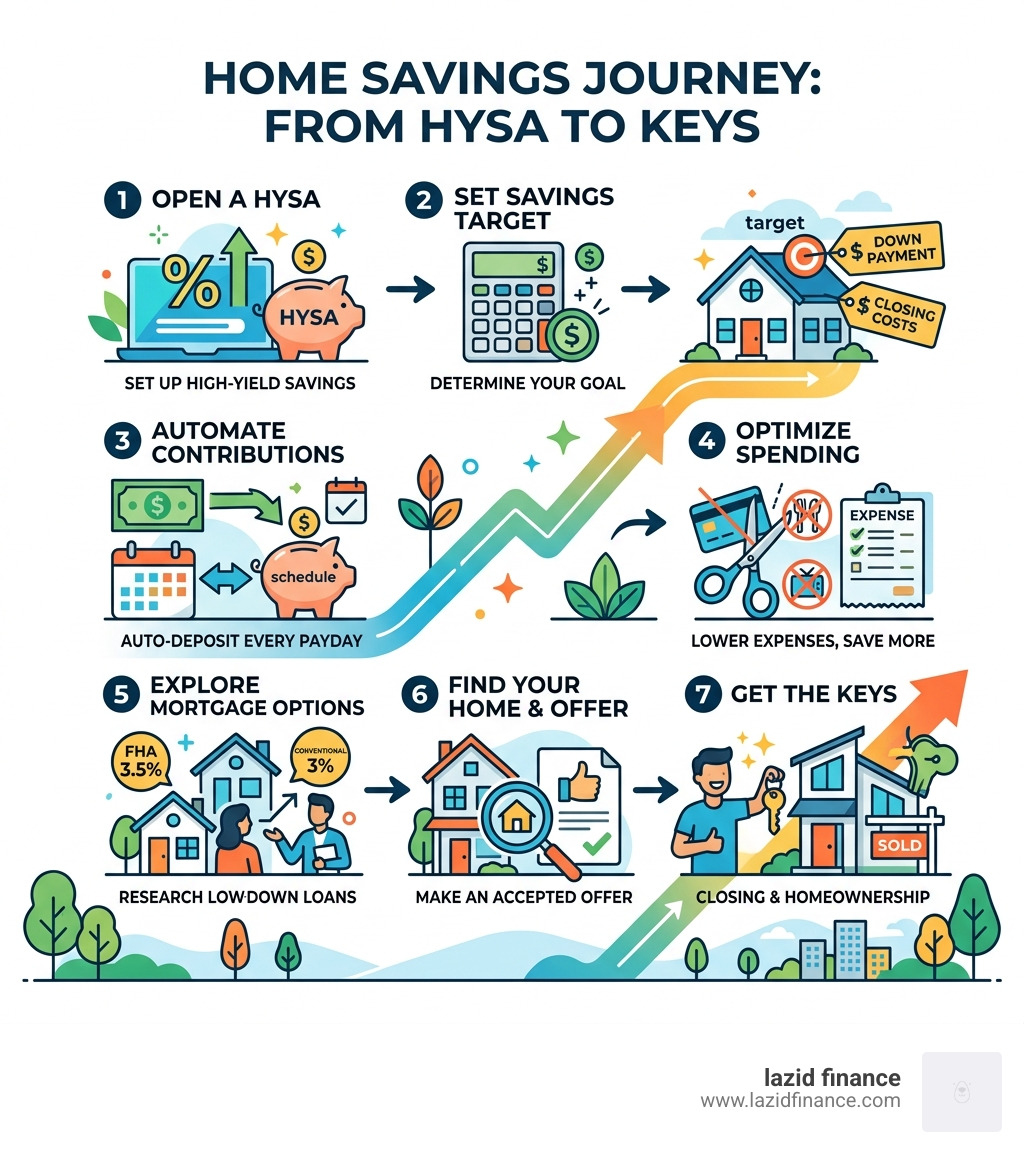
The easiest way to save for a house comes down to five core steps most people overlook:
- Set a realistic target — including down payment, closing costs, and moving expenses
- Open a dedicated high-yield savings account — earning around 4-4.2% APY in April 2026
- Automate your contributions — transfer money on payday before you can spend it
- Lower your biggest expenses — subscriptions, dining out, and housing costs
- Explore low-down-payment loans — FHA (3.5%), conventional (3%), VA and USDA (0%)
Here is the truth most people don’t know: you don’t need 20% down to buy a house.
In 2025, first-time buyers put down a median of just 9% — roughly $35,856 on a median-priced home. The 20% figure is a myth that has kept millions of people renting longer than they need to.
The real barrier isn’t the size of the down payment. It’s the lack of a clear, simple plan.
With the median U.S. home price sitting around $429,000 in April 2026, the numbers can feel overwhelming at first glance. But a deliberate strategy — the right savings account, automated transfers, a few targeted spending cuts — can get most people to their goal in 3 to 5 years. Some buyers get there in under 24 months.
This guide breaks it all down into simple, actionable steps.
Debunking the 20% Myth: How Much You Really Need

One of the most significant hurdles for aspiring homeowners is the “20% Rule.” We have all heard it: if you want to buy a house, you need to save 20% of the purchase price. In April 2026, with median home prices at $429,000, that would mean a staggering $85,800. For most of us, that feels less like a savings goal and more like a distant dream.
However, the data tells a different story. In 2025, the median down payment for first-time buyers was actually 9%, which comes out to roughly $35,856. When we look at various loan programs, the barrier to entry drops even further. Conventional loans often allow for as little as 3% down, while FHA loans require 3.5%. For those who qualify for VA or USDA loans, the down payment requirement is often 0%.
Understanding the Full Cost of Entry
The easiest way to save for a house is to know exactly what you are saving for. It is not just the down payment. We recommend budgeting for three distinct categories:
- The Down Payment: As discussed, this typically ranges from 3% to 10% for most first-time buyers.
- Closing Costs: These are the fees paid at the end of the transaction, covering things like appraisals, title insurance, and loan origination. Expect to pay between 2% and 5% of the home’s purchase price. On a $400,000 home, this could be $8,000 to $20,000.
- Moving and Buffer Fund: Do not forget the cost of the actual move and the inevitable “first-week” repairs. Budgeting $3,000 to $5,000 for this ensures you aren’t house-poor the moment you get the keys.
By aiming for a lower down payment, you can build home equity sooner. While a smaller down payment usually means paying Private Mortgage Insurance (PMI), many buyers find that the appreciation of the home’s value outpaces the cost of the insurance. To get a deeper dive into these numbers, check out this How To Save for a House: A Step-by-Step Guide.
The Easiest Way to Save for a House: Automation and High-Yield Tools

If we want to make saving effortless, we have to stop using our primary checking accounts for our house fund. The easiest way to save for a house is to move your money to a place where it can grow safely and remain untouched by your daily spending habits.
The Power of the High-Yield Savings Account (HYSA)
In April 2026, the financial landscape is favorable for savers. Top-tier High-Yield Savings Accounts are offering around 4.2% APY. Compare that to a traditional brick-and-mortar savings account that might offer a measly 0.01%.
Let’s look at the math: If you have $30,000 sitting in a standard account, you might earn $3 in interest over a year. In a 4.2% HYSA, that same $30,000 earns $1,260 in a year. That is over $100 a month in “free” money toward your closing costs just for picking the right tool. These accounts are FDIC-insured, meaning your money is safe up to $250,000. For more on choosing the right vehicle, see How to save for a house or down payment – Fidelity Investments.
Why Automation is the Easiest Way to Save for a House
Willpower is a finite resource. If you wait until the end of the month to see what is “left over” to save, the answer will almost always be zero. Behavioral finance teaches us that we are much more successful when we remove the decision-making process entirely.
We suggest a “set and forget” strategy:
- Direct Deposit Split: Ask your employer to send a specific dollar amount or percentage of your paycheck directly to your HYSA.
- Automated Transfers: Set up a recurring transfer from your checking to your house fund for the day after your payday.
- The “Windfall” Rule: Commit to putting 50% of every tax refund, work bonus, or cash gift into the house fund within 48 hours of receiving it.
When the money never hits your main account, you don’t miss it. It becomes a non-negotiable “bill” you pay to your future self.
Simple Lifestyle Shifts and Strategic Planning
You don’t have to live on ramen noodles to buy a home, but a few strategic shifts can drastically accelerate your timeline. The easiest way to save for a house often involves looking at your recurring expenses.
The Subscription Audit and Small Wins
The average American household spends about $273 a month on subscription services. By auditing these and cutting the ones you don’t use daily, you could easily save $150 a month. Over a year, that is $1,800. Combine that with cutting back on takeout just twice a month, and you are looking at nearly $3,000 a year in effortless savings.
Strategic Income Boosts
If you want to buy in 1-2 years instead of 5, you may need to increase the “inflow.” This doesn’t mean taking a second full-time job. Simple side hustles like pet sitting, freelance consulting, or selling unused electronics can bring in an extra $200-$500 a month.
Leveraging Low-Down-Payment Programs
We are lucky to live in a time when there are numerous programs designed to help people get into homes with less cash upfront.
| Loan Type | Minimum Down Payment | Best For… |
|---|---|---|
| Conventional | 3% | Buyers with strong credit scores |
| FHA | 3.5% | Buyers with lower credit scores or smaller reserves |
| VA | 0% | Veterans, active-duty service members, and spouses |
| USDA | 0% | Buyers in designated rural or suburban areas |
Getting prequalified for a mortgage early in the process is a smart move. It gives you a clear picture of your budget and shows sellers you are a serious contender.
Calculating Your Easiest Way to Save for a House
To find your monthly goal, use this simple formula: (Target Down Payment + Estimated Closing Costs + Moving Buffer) ÷ Number of Months until Purchase = Your Monthly Savings Goal.
For example, if you need $30,000 in 24 months, you need to save $1,250 per month. If that number feels too high, you can either extend your timeline or look for a lower-priced starter home. Remember the 36% rule: your total debt payments (including your future mortgage) should ideally not exceed 36% of your gross monthly income.
Frequently Asked Questions about Saving for a Home
Should I pause retirement contributions to save for a house?
This is a common dilemma. We generally advise against pausing contributions if your employer offers a 401(k) match—that is a 100% return on your money that you shouldn’t walk away from. However, if you are already getting the match and want to accelerate your house fund for 12 months, temporarily redirecting additional retirement savings into your HYSA can be a viable strategy. Just remember to turn those contributions back on once you have the keys!
What common mistakes derail a house savings plan?
The biggest “dream killer” is lifestyle inflation. When you get a raise at work, the easiest way to save for a house is to pretend that raise never happened and send the extra cash straight to your house fund. Other common mistakes include keeping house funds in a standard checking account (where they are too easy to spend) and taking on new debt—like a car loan—right before applying for a mortgage.
How long does it realistically take to save for a house?
While the national average is about 7 years for those without a plan, our research shows that those using a deliberate, automated strategy typically reach their goal in 3 to 5 years. If you are willing to downsize your current lifestyle or take on a side hustle, an “accelerated” timeline of 18 to 24 months is entirely possible for a 3.5% down payment.
Conclusion
Saving for a house in April 2026 doesn’t have to be an uphill battle. By debunking the 20% myth, utilizing high-yield tools, and automating your progress, you can turn a daunting financial milestone into a series of manageable steps.
At Lazid Finance, we believe in providing intelligent financial tools for conscious decisions. Our smart finance solutions are tailored for mindful choices, helping you navigate the path to homeownership with clarity and confidence. The easiest way to save for a house is to start today, even if it’s with a small amount. Consistency and the right strategy will always beat intensity in the long run.
Ready to take control of your financial future? Start your journey with Lazid Finance and let us help you build the equity you deserve.

