
Calculate Your Way to a Smarter Net Worth
The Single Number That Reveals Your True Financial Health
A smart net worth calculator does more than simple math — it gives you a real-time snapshot of your financial position, projects where you’re headed, and helps you make smarter decisions about saving, spending, and investing.
Here’s how to calculate your net worth right now:
- Add up all your assets — cash, savings, investments, retirement accounts, real estate, and vehicles
- Add up all your liabilities — mortgage balance, student loans, credit card debt, auto loans, and any other money you owe
- Subtract liabilities from assets — the result is your net worth
Net Worth = Total Assets − Total Liabilities
A positive number means you own more than you owe. A negative number — common for younger adults with student loans — simply means you have work to do.
What separates a smart calculator from a basic one is what happens next: pattern detection, 10-year projections, financial health scoring, and personalized insights that tell you why your number looks the way it does.
Your income tells you how much money flows in each month. Your net worth tells you how much of it you’ve actually kept.

Understanding the Net Worth Formula: Assets vs. Liabilities
When we talk about financial health at Lazid Finance, we often compare income to a “flow” and net worth to a “stock.” Think of income like the water coming out of a faucet and net worth like the amount of water currently held in the bathtub. You could have a high-pressure faucet (high income), but if the drain is wide open (high spending and debt), the tub will never fill up.
To get an accurate reading of your wealth stock, you need to be meticulous about what you own and what you owe. Using a Smart Net Worth Calculator – Lazid Finance helps automate this categorization, ensuring you don’t miss the small details that can significantly shift your financial position.
Identifying Your Total Assets
Assets are anything of value that you own which could, in theory, be converted into cash. For a truly “smart” calculation, we categorize these to understand how accessible your wealth is.
- Cash and Cash Equivalents: This includes your checking and savings accounts, physical cash, and your emergency fund.
- Retirement Funds: Your 401(k), 403(b), and IRAs (both traditional and Roth) are major pillars. Remember to use the current balance, not just what you’ve contributed.
- Real Estate Equity: Include the current market value of your primary residence, rental properties, or any land you own.
- Investment Portfolios: This covers brokerage accounts, stocks, bonds, mutual funds, and ETFs.
- Cryptocurrency: In 2026, digital assets are a standard part of many portfolios. Use the current market rate for your Bitcoin, Ethereum, or other holdings.
- Business Equity: If you own a business or have a stake in a partnership, the estimated market value of that ownership is a significant asset.
- Personal Property: Items with high resale value like vehicles, jewelry, or rare collectibles. However, be conservative here; your ten-year-old couch probably isn’t the asset you think it is!
Categorizing Your Total Liabilities
Liabilities are your financial obligations—the “drains” on your bathtub. It is essential to use the current outstanding balance, not the original loan amount.
- Mortgage Balances: The remaining principal on your home or any other real estate loans.
- Student Loans: Whether federal or private, these are often the largest liabilities for younger professionals.
- Credit Card Debt: Even if you plan to pay it off at the end of the month, the current balance is a liability.
- Auto Loans: The remaining amount owed on your cars, trucks, or motorcycles.
- Medical Bills: Any outstanding balances for healthcare services.
- Personal Loans: Money owed to banks or even family members.
- Outstanding Tax Debt: Any money owed to the IRS or local tax authorities.
How to Use a Smart Net Worth Calculator for Future Projections
The real magic happens when we move beyond the “now.” A basic calculator gives you a static number, but a smart net worth calculator acts as a financial time machine. It uses your current data to forecast where you will be in five, ten, or twenty years based on your current savings rate and estimated market returns.

Maximizing Insights with a Smart Net Worth Calculator
When you use our intelligent tools, you aren’t just looking at a total. You are looking at the “why” behind the wealth.
- 10-Year Projections: By looking at growth estimates, you can see if you are on track for retirement or if you need to adjust your contributions today.
- Shrinkage Patterns: The calculator can identify if certain liabilities (like high-interest credit cards) are eating your wealth faster than your assets can grow.
- Real-Time Updates: As market conditions change in April 2026, a smart tool can adjust your portfolio value automatically.
- Asset Allocation: It visualizes how much of your wealth is tied up in “risky” assets like stocks versus “stable” assets like real estate.
- Milestone Tracking: Set goals—like reaching a six-figure net worth—and let the tool tell you exactly which month you’re likely to hit it.
Why a Smart Net Worth Calculator Beats Basic Spreadsheets
We love a good spreadsheet as much as the next finance nerd, but they have limitations. Manual entry is prone to human error, and spreadsheets don’t easily account for the complex interplay of compound interest and inflation.
- Pattern Detection: AI-driven tools can spot trends that a human might miss, such as a creeping debt-to-asset ratio.
- Data Privacy: Modern smart tools often use in-browser processing. This means your sensitive financial data stays on your device and isn’t sent to a central server, offering a level of privacy that cloud-based spreadsheets can’t always guarantee.
- Interactive Visuals: Seeing your progress in a colorful chart is far more motivating than staring at Row 452 of a grayscale Excel sheet.
- PDF Reporting: Need to show your financial health to a banker or a spouse? Smart tools generate professional reports at the click of a button.
Net Worth Benchmarks: Where Do You Stand in 2026?
Comparison can be the thief of joy, but in personal finance, it’s a vital navigation tool. Knowing the median net worth for your age group helps you understand if you are ahead of the curve or need to pick up the pace.
When looking at data from the Federal Reserve and other financial institutions, we distinguish between the “average” and the “median.” Averages are often skewed by billionaires, while the median represents the “middle” person — a much more realistic benchmark for most of us.
Median Net Worth by Age Group
Based on current 2026 data and recent Federal Reserve surveys, here is how the typical American’s net worth stacks up by age:
| Age Group | Median Net Worth | Average Net Worth |
|---|---|---|
| Under 35 | $13,900 | $76,300 |
| 35-44 | $91,300 | $436,200 |
| 45-54 | $168,600 | $833,200 |
| 55-64 | $212,500 | $1,175,900 |
| 65-74 | $266,400 | $1,217,700 |
| 75+ | $254,800 | $977,600 |

Wealth inequality means the “average” is significantly higher than the “median.” If you are under 35 and have a net worth of $14,000, you are doing better than half of your peers!
Financial Milestones and Targets
While medians are helpful, we should also aim for specific wealth targets to ensure a comfortable retirement. A common “rule of thumb” is to aim for a net worth equal to your annual salary by age 30.
- By Age 40: Aim for 3x your annual income.
- By Age 50: Aim for 6x your annual income.
- Retirement Readiness: Most experts suggest a “Financial Independence Number” of 25x your annual expenses. This is based on the 4% rule, which suggests you can safely withdraw 4% of your portfolio each year in retirement without running out of money.
Advanced Metrics for a Healthy Financial Profile
A smart net worth calculator doesn’t just stop at one big number. It breaks that number down into metrics that tell the story of your financial resilience.
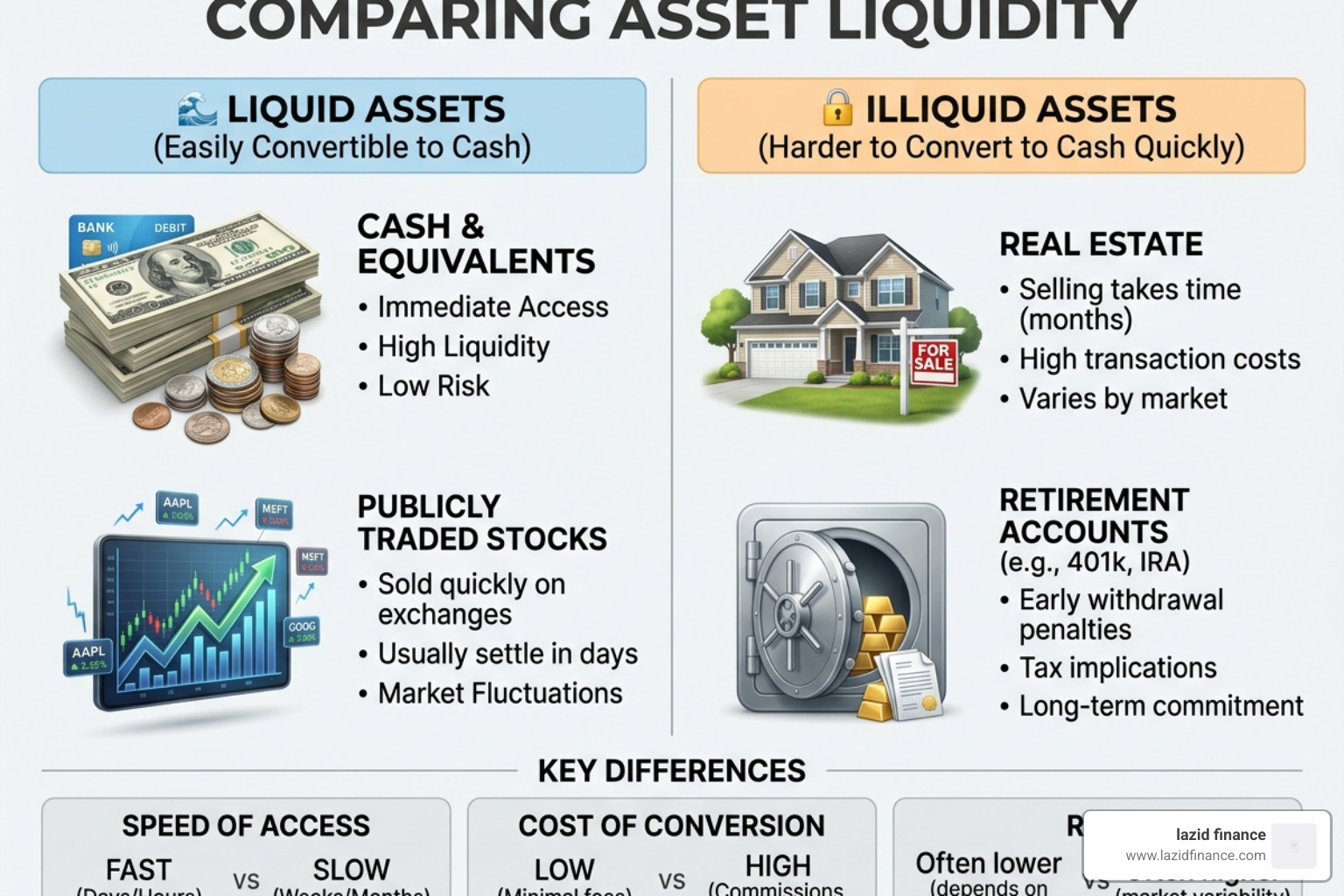
The Importance of Liquid Net Worth
Total net worth can be deceiving. You could be “house-rich and cash-poor.” If you have $500,000 in home equity but only $500 in your bank account, you have a high net worth but very little financial flexibility.
Liquid net worth includes only assets that can be converted to cash quickly without a significant loss in value (cash, brokerage accounts, etc.). This is your true financial cushion. It’s what you rely on during market fluctuations or unexpected job losses. We recommend keeping a healthy balance of liquid assets to ensure you aren’t forced to sell your home or raid your retirement accounts during an emergency.
Calculating Your Debt-to-Asset Ratio
This is a key metric used by bankers to assess your financial health. It measures how much of your lifestyle is funded by debt versus what you actually own.
Debt-to-Asset Ratio = Total Liabilities ÷ Total Assets
A healthy ratio is typically below 0.5. This means you own at least twice as much as you owe. If your ratio is above 1.0, you have a negative net worth—your debts outweigh your assets. Tracking this ratio over time is a great way to see if you are becoming more or less leveraged. You can Analyze Your Financial Health with Lazid Finance Tools to get an instant reading of your current ratio.
Strategies to Increase Your Wealth Over Time
Increasing your net worth is a two-front war: you must increase your assets while simultaneously decreasing your liabilities. It requires conscious decisions and a bit of patience.
Aggressive Debt Payoff and Management
Not all debt is created equal, but all debt is a drain on your net worth. We believe that paying off high-interest debt—like credit cards with 20%+ APR—is the single best investment you can make. It provides a “guaranteed return” equal to the interest rate you are no longer paying.
- The Avalanche Method: Focus on the debt with the highest interest rate first.
- The Snowball Method: Focus on the smallest balance first to build psychological momentum.
- Mortgage Equity: Making just one extra principal payment a year can shave years off your mortgage and add tens of thousands to your net worth in home equity.
Consistent Investing and Income Growth
On the asset side, consistency is more important than timing.
- Maximize Employer Matching: If your company offers a 401(k) match, that is a 100% return on your investment. Never leave that money on the table.
- Tax-Advantaged Accounts: Use IRAs and HSAs to let your money grow without the drag of annual taxes.
- Low-Cost Index Funds: Instead of trying to pick the next “hot” stock, we suggest broad market index funds that capture the growth of the entire economy.
- Avoid Lifestyle Inflation: As your income grows, try to keep your expenses stable. If you get a $5,000 raise and put it all into your investments, your net worth will skyrocket. If you use it to lease a more expensive car, your net worth stays flat.
- Income Diversification: In April 2026, side hustles and skill development are easier than ever. Increasing your “top-line” income gives you more “fuel” to pour into your net worth engine.
Frequently Asked Questions about Net Worth
Why is net worth more important than income?
Income is a temporary flow; net worth is permanent stability. You can earn $300,000 a year, but if you spend $310,000, you are technically getting poorer every day. Net worth accounts for your debt, your savings, and your investments, giving a complete picture of your ability to weather a crisis or retire comfortably. Wealthy people focus on what they keep, not just what they make.
How often should I calculate my net worth?
For most people, a quarterly calculation is the “sweet spot.” It’s frequent enough to catch problems early but not so frequent that you get stressed by daily market volatility. If you are aggressively paying off debt or pursuing a specific milestone, a monthly check-in can provide the motivation you need to stay on track.
What are common mistakes to avoid when calculating net worth?
The most common mistake is overestimating the value of personal property (like cars or furniture) and underestimating liabilities (like “hidden” debts or family loans). Another mistake is forgetting to account for the tax hit on “pre-tax” retirement accounts like a Traditional 401(k). For a truly accurate number, be conservative with your asset values and brutal with your liability list.
Conclusion
Building wealth isn’t about luck; it’s about financial mindfulness and making conscious decisions every single day. By using a smart net worth calculator, you take the guesswork out of your future. You move from “hoping” you’ll be okay to “knowing” exactly where you stand.
At Lazid Finance, we provide the intelligent tools you need to navigate the complexities of the 2026 economy. Whether you are just starting your journey with a negative net worth or you are fine-tuning a multi-million dollar portfolio, tracking your progress is the first step toward true financial freedom.
Unlock your financial potential with smart tools and start calculating your way to a smarter future today.

