
To Pay or Not to Pay Your Student Loans Early
Should I Pay Off My Student Loan? Here’s the Short Answer
Should I pay off student loan debt early? The honest answer: it depends — but here’s a quick framework to guide your decision right now.
When you SHOULD pay off student loans early:
- You have a fully funded emergency fund (3-6 months of expenses)
- You have no high-interest debt like credit cards
- You’re already capturing your employer’s full 401(k) match
- You have private loans with high interest rates and no forgiveness options
- You have a stable, high income with room in your budget
When you should NOT rush to pay off student loans:
- You carry credit card debt (average rate: 20%+)
- You have little or no emergency savings
- You qualify for federal forgiveness programs like PSLF or IDR
- You could earn higher returns by investing the extra money instead
- You need liquidity for a major life event (buying a home, starting a family)
So you’ve got student loan debt hanging over you, and you’re wondering whether to throw every spare dollar at it or do something smarter with your money. That tension is real — and incredibly common.
The U.S. is sitting on nearly $2 trillion in student loan debt. For many borrowers, monthly payments eat into savings, delay home ownership, and create a constant low-grade financial anxiety. It makes sense to want it gone.
But paying it off fast isn’t always the winning move.
Personal finance writer and CNBC contributor Dani Romero captured this tension well in her own life: even with enough cash on hand to eliminate her student loan entirely, she chose not to — because liquidity for near-term goals and unexpected expenses mattered more than the guaranteed interest savings.
That story isn’t unusual. The math of debt repayment rarely tells the whole story. Your loan type, interest rate, income, life goals, and even your risk tolerance all shape what the right answer looks like for you.
This guide walks you through every angle — so you can make a decision you’ll feel confident about, not just one that looks good on a spreadsheet.
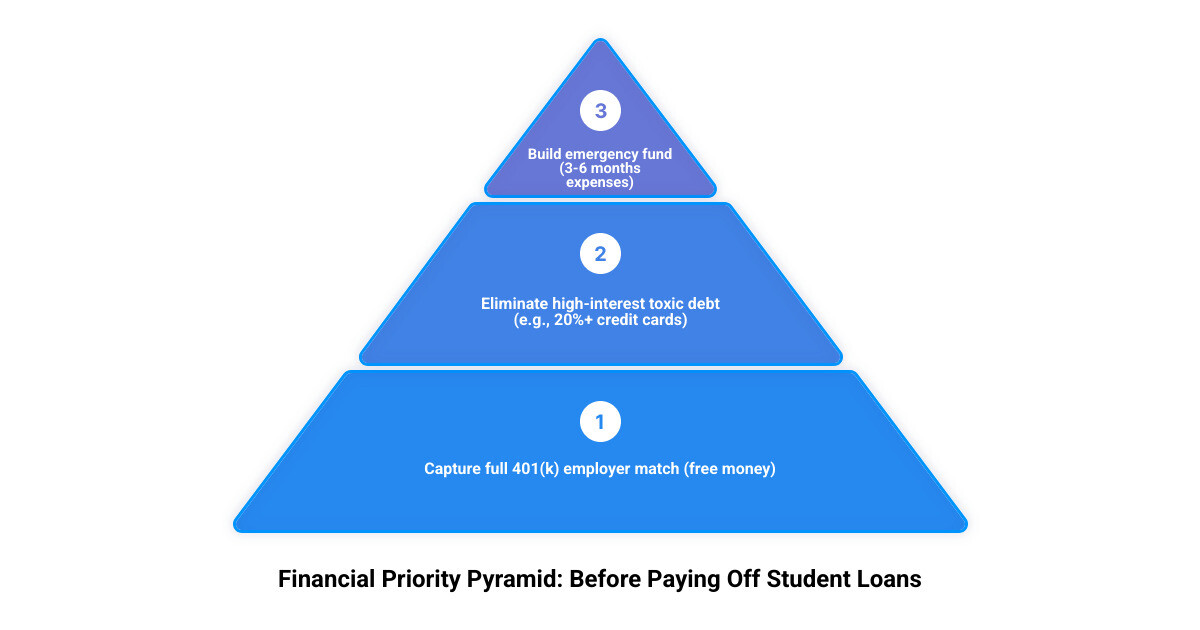
The Financial Hierarchy: When Should I Pay Off Student Loan Debt?
At Lazid Finance, we believe in making conscious choices based on a solid foundation. Before you send an extra $500 to your loan servicer, we need to talk about the “Financial Priority Pyramid.” Think of this as your roadmap to stability. You wouldn’t put a roof on a house before you’ve poured the concrete foundation, right?
The first level of that foundation is your emergency fund. Following that is the elimination of “toxic” debt, and then comes the capture of free money (employer matches). Only after these steps are secured should the question of should i pay off student loan balances early become your primary focus.
According to research on Paying Off Student Loans Early: Pros & Cons – College Finance, prioritizing holistic goals over isolated debt elimination is the key to long-term wealth.
Should I pay off student loan balances before building an emergency fund?
In a word: No.
Liquidity is your best friend in an unpredictable world. An emergency fund is the buffer between you and a high-interest credit card when your car breaks down or your HVAC system decides to retire in the middle of a July heatwave.
A 2024 Bankrate survey found that 36 percent of U.S. adults have more credit card debt than emergency savings. This is a dangerous position to be in. If you pour all your extra cash into your student loans and then face a job loss or medical bill, you can’t “withdraw” that money from your student loan servicer. It’s gone.
We recommend maintaining 3 to 6 months of living expenses in a high-yield savings account. This ensures that if life throws a curveball, you have the cash reserves to handle it without spiraling back into high-interest debt. Financial safety should always come before aggressive debt repayment.
Prioritizing high-interest debt over student loans
If you have credit card debt, that is your financial house on fire. The average credit card interest rate is currently over 20 percent. Compare that to the undergraduate Direct Loan rate of 6.53% for the 2024–2025 cycle.
Mathematically, it makes zero sense to pay off a 6% student loan while carrying a balance on a 22% credit card. We call this “interest arbitrage” in reverse—you’re losing money every second you prioritize the lower-interest debt.
Use the debt avalanche method:
- List all your debts.
- Pay the minimum on everything.
- Throw every extra cent at the debt with the highest interest rate (usually credit cards).
- Once that’s gone, move to the next highest.
Once your “toxic” debt is cleared and you’re getting your full employer 401(k) match (which is essentially a 50% or 100% immediate return on your money), then we can talk about those student loans.

Federal vs. Private Loans: How Your Debt Type Changes the Math
Not all student loans are created equal. In fact, the “math” for a federal loan is completely different from the math for a private loan. Federal loans come with a suite of protections and “safety nets” that disappear the moment you pay them off or refinance them into a private loan.
| Feature | Federal Student Loans | Private Student Loans |
|---|---|---|
| Interest Rates | Fixed (set by Congress) | Often Variable (based on credit) |
| Repayment Plans | Income-Driven (IDR) available | Usually Fixed/Standard only |
| Forgiveness | PSLF, IDR Forgiveness | Extremely Rare |
| Death/Disability | Usually Discharged | Depends on Lender |
| Prepayment Penalty | Never | Sometimes (check terms) |
For more details on these distinctions, you can review the Loan Repayment 101 – Federal Student Aid guide.
Impact of forgiveness programs like PSLF and IDR
If you are a teacher, nurse, or work for a 501(c)(3) non-profit, you might be eligible for Public Service Loan Forgiveness (PSLF). After 120 qualifying monthly payments (10 years), your remaining balance is forgiven—tax-free.
If you are on this path, paying off student loans early is actually a financial mistake. Every extra dollar you pay is a dollar that could have been forgiven by the government. Your goal in PSLF is to pay as little as legally possible to maximize the amount forgiven at the end.
Similarly, Income-Driven Repayment (IDR) plans like the SAVE plan offer forgiveness after 20 or 25 years. While this forgiveness can sometimes be treated as taxable income (the “tax bomb”), it still often results in paying less over the life of the loan than if you had aggressively paid it off early.
Why private loans are the priority for early payoff
Private loans are the “wild west” of student debt. They usually carry higher interest rates—sometimes reaching double digits—and they offer almost no protections if you lose your job.
If you’re asking should i pay off student loan debt, and your loans are private, the answer is almost always a resounding yes. Paying off a private loan with an 8% or 10% interest rate is the equivalent of getting a guaranteed, risk-free 8% or 10% return on your money. You won’t find that in the stock market or a savings account.
Furthermore, clearing these loans improves your debt-to-income (DTI) ratio, which is a massive factor if you plan on applying for a mortgage or a car loan in the near future.
The Great Debate: Paying Off Student Loans vs. Investing
This is the classic “head vs. heart” struggle. Your heart wants the “peace of mind” that comes with being debt-free. Your head sees the historical 10% average annual return of the S&P 500 and wonders if you’re leaving money on the table.
As noted in Pay Off Student Loans or Invest | The White Coat Investor, the decision often comes down to a threshold. Many experts suggest a 6% interest rate rule:
- If your loan interest is above 6%, prioritize paying it off. It’s a high, guaranteed return.
- If your loan interest is below 4%, consider investing instead. The market will likely outperform the debt cost over the long term.
- If it’s between 4% and 6%, it’s a toss-up based on your personal risk tolerance.

Should I pay off student loan debt or invest in the stock market?
When you invest, you are betting on future growth. When you pay off debt, you are securing a “guaranteed return” equal to the interest rate.
If you have a $30,000 loan at 6.53% interest, paying it off today is exactly the same as putting $30,000 into an investment that is guaranteed to grow by 6.53% every year, tax-free. In a volatile market, that “guaranteed” part is very attractive.
However, we must consider compound growth. If you are in your 20s, every dollar you put into a Roth IRA or 401(k) has decades to grow. Missing out on those early years of compounding can cost you hundreds of thousands of dollars by retirement. This is why we advocate for a “split the difference” approach if your rates are moderate: pay the minimums, but also contribute to your retirement.
Understanding the loss of tax benefits and deductions
The IRS allows you to deduct up to $2,500 of student loan interest from your taxable income each year, even if you don’t itemize. This is an “above-the-line” deduction, which means it lowers your Adjusted Gross Income (AGI).
There are MAGI (Modified Adjusted Gross Income) limits, however. For the 2024 tax year, the deduction begins to phase out at $80,000 for single filers and $165,000 for those married filing jointly.
When you pay off your loan, you lose this deduction. But let’s be real: you shouldn’t keep a debt just for a tax break. Paying $1,000 in interest to save $220 on your taxes still leaves you $780 poorer. As we say at Lazid Finance, don’t let the tax tail wag the financial dog.

Strategies to Accelerate Your Student Loan Payoff
If you’ve run the numbers and decided that “yes, should i pay off student loan debt early” is your path, let’s talk about how to do it efficiently without burning out.
- Biweekly Payments: Instead of one monthly payment, pay half every two weeks. Because there are 52 weeks in a year, you’ll end up making 26 half-payments—which equals 13 full monthly payments. That extra payment goes straight to the principal.
- Lump Sums: Use “windfalls” like tax refunds, work bonuses, or birthday cash. Applying a $1,000 tax refund to the principal can shave months off your repayment timeline.
- Target the Principal: Always ensure your servicer applies extra payments to the principal balance, not just “pushing back the due date” for next month.
Using a side hustle to pay off student loans faster
The gig economy has made it easier than ever to find extra income. Whether it’s freelancing, pet sitting, or consulting, using “dedicated” side hustle money for your loans creates incredible financial momentum.
The trick is to avoid lifestyle creep. If you start making an extra $500 a month and immediately upgrade your car or start eating out more, you haven’t actually helped your debt situation. At Lazid Finance, we recommend setting up a separate “Debt Crusher” account where your side hustle income goes directly to your loan servicer.
Refinancing as a tool for lower interest rates
If you have private loans with high interest rates (8%+), refinancing could save you thousands. By taking out a new loan with a lower interest rate to pay off the old ones, you reduce the amount of interest accruing daily.
A massive warning for federal borrowers: If you refinance federal loans into a private loan, you lose access to PSLF, IDR plans, and federal deferment options forever. Only refinance federal loans if you have a very stable, high income, a great credit score, and you are 100% certain you don’t need federal protections.
Frequently Asked Questions about Student Loan Payoff
How does paying off student loans early affect my credit score?
Surprisingly, you might see a temporary dip in your credit score when you pay off a loan. This happens because you are closing an active account, which can slightly reduce your “credit mix” and the average age of your accounts.
However, don’t panic! This dip is usually minor and recovers quickly. In the long run, having a lower debt-to-income ratio makes you a much more attractive borrower for things like mortgages. The financial benefit of being debt-free far outweighs a 10-point temporary fluctuation in your score.
Is it better to pay off student loans or save for a house?
This is a major concern for the nearly 37% of first-time home buyers who carry student debt. According to the National Association of REALTORS, student debt is one of the biggest hurdles to saving for a down payment.
If your interest rates are low (under 4%), it is often better to save for the house. You need cash for a down payment and closing costs. However, if your monthly student loan payment is so high that it pushes your DTI ratio above 43%, you might not qualify for a mortgage at all. In that case, paying off a specific loan to eliminate the monthly payment is a strategic move.
What are the risks of aggressive student loan repayment?
The biggest risk is the liquidity trap. If you put every spare cent into your loans and then lose your job, you can’t get that money back. You might be “debt-free” but unable to pay rent or buy groceries.
There is also the opportunity cost. If you spend 10 years aggressively paying off 3% interest loans while the stock market is returning 10%, you have effectively “lost” 7% a year in potential growth. Finally, if you have federal loans, aggressive repayment means you might forfeit future government forgiveness or relief programs.
Conclusion
Deciding should i pay off student loan debt early isn’t just about math; it’s about your personal values, your need for security, and your long-term vision.
The student loan crisis disproportionately burdens women and Black borrowers, making these financial decisions even more critical for building generational wealth. Black borrowers carry an average of $25,000 more in debt than their white counterparts, often with lower household incomes to support it. For these borrowers, the choice between liquidity and debt freedom is a high-stakes balancing act.
At Lazid Finance, we are committed to providing you with the tools to make conscious, mindful financial choices. Whether you choose to crush your debt today or invest for tomorrow, ensure your foundation—your emergency fund and high-interest debt—is solid first.
Your net worth is the goal, but your peace of mind is the priority. For more Smart finance solutions for mindful choices, stay tuned to our latest guides and tools.

