
Project Your Future Using a Conscious Net Worth Projection Tool
Why a Conscious Long Term Finance Strategist Changes How You Build Wealth
A conscious long term finance strategist is someone who aligns every financial decision with their personal values, long-term goals, and a clear vision of the life they want to build — rather than just chasing numbers on a spreadsheet.
Quick answer for those short on time:
| What they do | How it differs |
|---|---|
| Align spending with personal values | Not just cutting costs |
| Plan for legacy and long-term impact | Not just short-term savings |
| Use intentional, automated systems | Not restrictive line-item budgets |
| Build wealth through mindset + strategy | Not discipline through guilt |
Most people think managing money means tracking every dollar or saying no to everything fun. It doesn’t.
The conscious approach, popularized by personal finance author Ramit Sethi, flips that idea entirely: spend freely on what you love, and cut ruthlessly on what you don’t. The result isn’t restriction — it’s clarity.
And clarity, it turns out, is what actually builds wealth over time.
This review looks at how tools like Lazid Finance’s net worth projection system support this approach — helping you see your financial future, not just your financial present.
What Defines a Conscious Long Term Finance Strategist?
In the traditional world of finance, success is often measured by a single metric: the bottom line. But as we move further into April 2026, the definition of wealth is evolving. A conscious long term finance strategist looks at money as a tool for stewardship rather than just accumulation. They approach financial planning with a focus on intentionality, ensuring that capital serves life, not the other way around.
Traditional advisors might tell you to save 15% of your income and call it a day. A conscious strategist asks, “What kind of legacy do you want to leave?” This shift from transaction to transformation is Why financial consciousness is the key to long-term clarity. It is about moving away from mindless consumption and toward a holistic view of wealth that includes your time, health, and relationships.
This philosophy is deeply rooted in the concept of regenerative economics. Pioneers like John Fullerton argue that our financial systems should mimic universal patterns of health and renewal. When we apply this to our personal lives, we stop looking for “get rich quick” schemes and start building financial structures that are sustainable for decades. We aren’t just looking for growth; we’re looking for ethical leadership in how we manage our own resources.
The Role of a Conscious Long Term Finance Strategist in Wealth Building
Building wealth isn’t just a math problem; it’s a mindset challenge. A strategist in this field helps individuals move from a “scarcity mindset”—where every dollar spent feels like a loss—to an “abundance mindset.” This doesn’t mean spending recklessly; it means understanding that wealth grows through steady, disciplined choices and the belief that there is enough to share and grow.
Experts like Dr. Dawn Carpenter, an applied financial ethicist, highlight the importance of “contributive justice.” This framework suggests that our work and our wealth should give life meaning and honor human dignity across our entire lifespan. When we view ourselves as stewards of our wealth, we take responsibility for our mindset. We realize that sustainable wealth is built through small, repeated habits rather than sudden wins. It’s a marathon, not a sprint, and a conscious long term finance strategist helps you maintain the pace.
How a Conscious Long Term Finance Strategist Aligns Values with Goals
The ultimate goal of a conscious strategy is to achieve what is often called a “Rich Life.” This isn’t necessarily about owning a private jet; it’s about having the freedom to spend on the things that bring you genuine joy while ruthlessly cutting back on the things that don’t.
To achieve this, we must align our daily spending with our long-term vision. As Lawrence Ford often discusses, bridging business with ancient wisdom allows us to see money as a lever for societal change. By creating value-aligned categories for our spending, we reduce decision fatigue. We no longer have to wonder if we “should” buy something; we simply check if it fits the roadmap we’ve already designed. This intentionality ensures that our future-oriented mindset isn’t just a dream, but a practical reality.
Core Principles of a Conscious Spending Plan

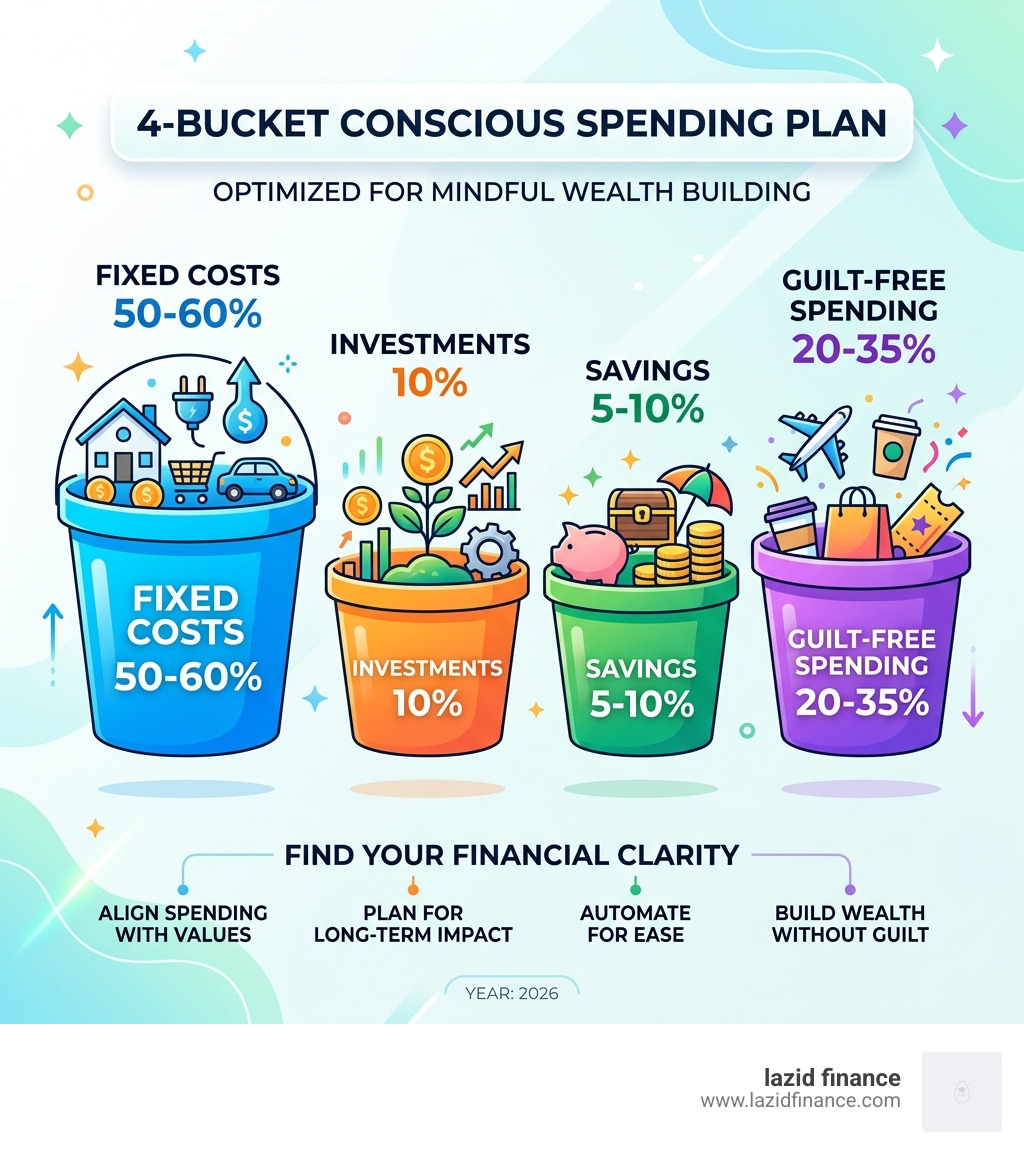
If traditional budgeting is like a restrictive calorie-counting diet, a conscious spending plan (CSP) is like a sustainable nutrition plan. It’s not about deprivation; it’s about allocation. The core principles of a CSP involve dividing your take-home pay into four main “buckets” that ensure you cover your needs, invest in your future, and enjoy your life today.
| Category | Target Percentage | Purpose |
|---|---|---|
| Fixed Costs | 50-60% | Rent/Mortgage, utilities, debt, insurance, groceries. |
| Investments | 10% | Long-term growth (401k, Roth IRA, index funds). |
| Savings Goals | 5-10% | Short-term needs (vacations, gifts, emergency fund). |
| Guilt-Free Spending | 20-35% | Dining out, hobbies, movies, “fun” money. |
The beauty of this system is its flexibility. For example, if you live in a high-cost city like New York or London, your fixed costs might hit 65%. That’s okay, as long as you adjust your guilt-free spending to compensate. The goal is to avoid the “91% fixed cost” trap that leaves many families feeling broke despite earning high salaries.
Automating for Effortless Financial Clarity
The secret sauce to making a conscious spending plan work is automation. We want to remove the need for willpower. When your paycheck hits your account, your systems should already know where that money is going.
This is where “people-first” financial support, like the concepts found at Conscious Accounting, becomes vital. By setting up direct deposits and automated transfers, you ensure that your 10% investment and 5-10% savings are tucked away before you even see them.
We recommend putting your savings into a high-yield savings account (HYSA). This serves as your emergency fund—ideally covering 3-6 months of living expenses—providing a safety net that allows you to take calculated risks in your career or investments. When your cash-flow design is automated, managing money feels empowering rather than like a chore.
Practical Steps to Implement Your Financial Roadmap

Ready to become your own conscious long term finance strategist? Follow these steps to build a roadmap that actually sticks:
- Track Your Patterns: For one or two months, simply observe where your money goes. Don’t judge it; just record it. You might find you’re spending $2,000 a year on subscriptions you don’t even use.
- Define Your Values: What actually makes you happy? If it’s travel, make that a primary category. If it’s high-end coffee, keep it! But if you don’t care about cars, cut that cost ruthlessly.
- The Step-By-Step Setup: Follow a Step By Step Process to create your four buckets. Assign a percentage to each based on your current income.
- Automate Everything: Set up your transfers to happen on the 2nd of every month (or whenever you get paid).
- Implement a “Spending Pause”: For any non-essential purchase over $100, wait 48 hours. Ask yourself: “Does this align with my Rich Life?”
- Celebrate Milestones: When you hit your first $10,000 in savings or pay off a credit card, celebrate! Financial growth should be fun.
Remember to fine-tune your categories every six months. Your life in 2026 will look different than it did in 2024, and your spending plan should reflect that evolution.
Benefits of Projecting Your Future with Mindful Tools
Using a net worth projection tool isn’t just about seeing a line go up; it’s about the psychological benefits of knowing you’re on the right path. When you can visualize your future, your relationship with money changes.
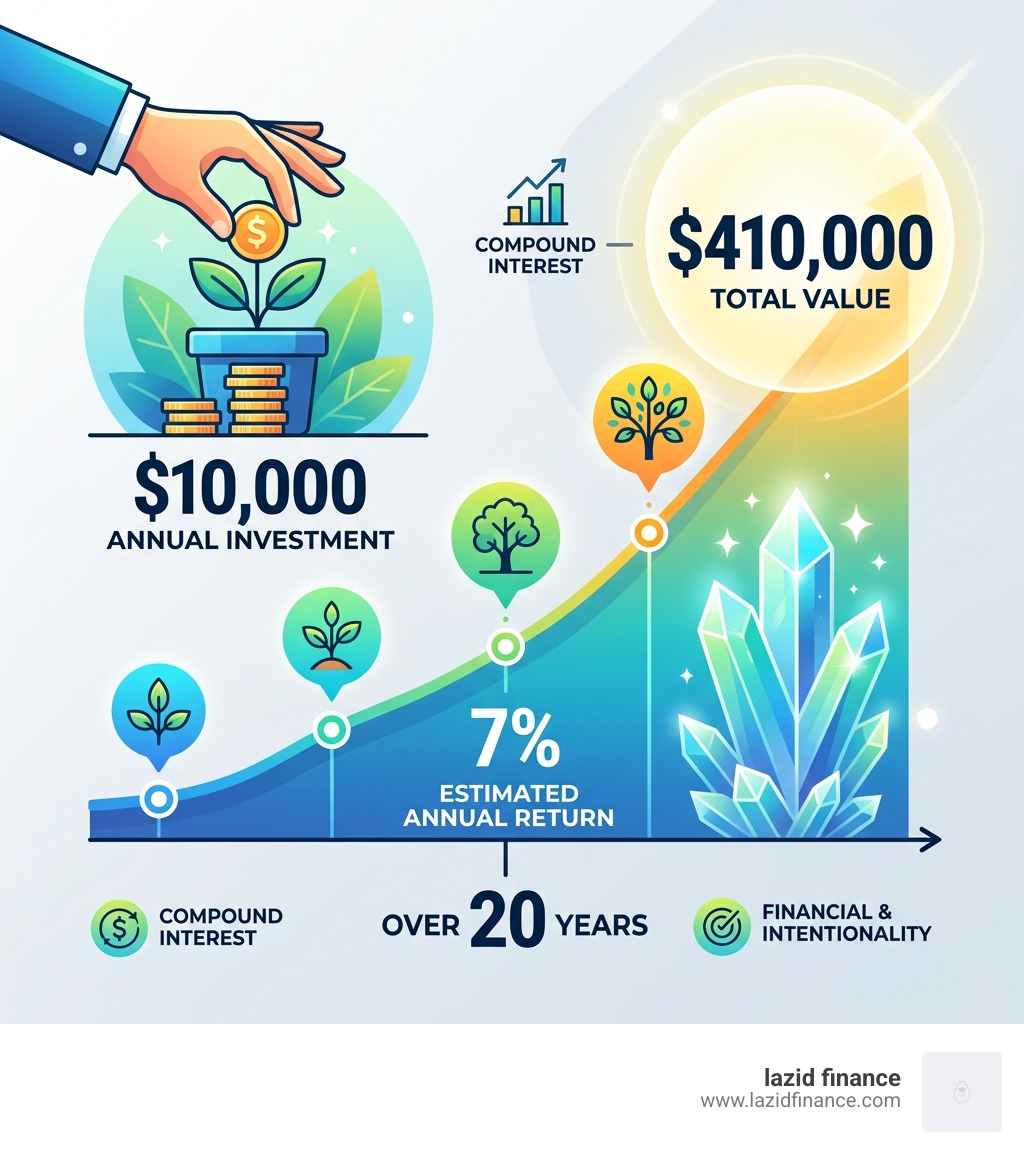
- Impulse Control: When you know that an extra $200 invested today could mean $2,000 in your retirement fund, the “impulse buy” loses its power.
- Reduced Buyer’s Remorse: Because your “Guilt-Free Spending” bucket is pre-approved, you can spend that money without the nagging feeling that you should be doing something “smarter” with it.
- Adaptability for Life Transitions: Whether it’s a wedding (which averages $28,000 these days) or a career shift, a conscious plan allows you to make trade-offs based on values, not panic.
- Social Impact: As Lawrence Ford notes, conscious finance allows us to use our wealth to support causes we care about, creating a “quadruple benefit” for ourselves, our families, the planet, and society.
By projecting your future, you gain the clarity needed to make bold moves today. You aren’t just saving money; you’re buying your future freedom.
Frequently Asked Questions about Conscious Finance
How does a conscious spending plan differ from a traditional budget?
Traditional budgeting is often backward-looking and restrictive—it’s about “where did my money go?” and “why did I spend that?” A conscious spending plan is forward-looking and intentional. It’s about “where do I want my money to go?” Instead of tracking every cent of a $5 latte, you focus on the “Big Wins” like housing, investments, and automation.
What are the target percentages for a conscious long-term finance strategist?
While everyone’s situation is unique, the gold standard used by many strategists is:
- Fixed Costs: 50-60%
- Investments: 10% (minimum)
- Savings Goals: 5-10%
- Guilt-Free Spending: 20-35%
How do I adjust my plan for major life changes like marriage or career shifts?
A conscious plan is a living document. If you get married, sit down with your partner to align your “Rich Life” visions. If your income increases, don’t just let “lifestyle creep” take over. Instead, apply the same percentages to your new salary. If you earn an extra $1,000, $100 goes to investments, $100 to savings, and $300 to your guilt-free fun!
Conclusion
At Lazid Finance, we believe that managing your money shouldn’t feel like a punishment. Our mission is to provide intelligent financial tools that empower you to make mindful choices. By adopting the mindset of a conscious long term finance strategist, you move beyond the stress of monthly bills and into a world of long-term clarity and purpose.
Building wealth is not about how much you keep away from yourself; it’s about how intentionally you direct your resources to build a life you love. Whether you are just starting your journey or are looking to optimize a high net worth, the principles of conscious spending and automated investing remain the same.
Stop guessing about your financial future and start designing it. Use our smart finance solutions to align your dreams with your bank account.
Project your future with Lazid Finance.

