
Analyze Your Habits Using a Conscious Expense Trend Analyzer
Why Conscious Wealth Building Tools Are Worth Your Attention Right Now
Conscious wealth building tools are software, frameworks, and financial instruments that help you grow money in alignment with your values — not just your bottom line.
If you want a quick answer, here are the top conscious wealth building tools to know about:
| Tool | What It Does | Best For |
|---|---|---|
| Conscious Expense Trend Analyzer | Tracks spending patterns against your values | Daily money awareness |
| ESG Investment Platforms | Screens investments by ethics and impact | Values-aligned portfolios |
| High-Yield Savings Accounts | Earns 10-12x standard savings rates | Emergency funds and short-term goals |
| Life Insurance (with ILIT) | Builds tax-efficient generational wealth | Estate planning and protection |
| Budgeting + Automation Tools | Automates saving and goal tracking | Consistent wealth habits |
| Estate Planning Software | Manages wills, trusts, and asset transfer | Generational wealth preservation |
Most people think wealth building is just about earning more and spending less. But that’s only part of the picture.
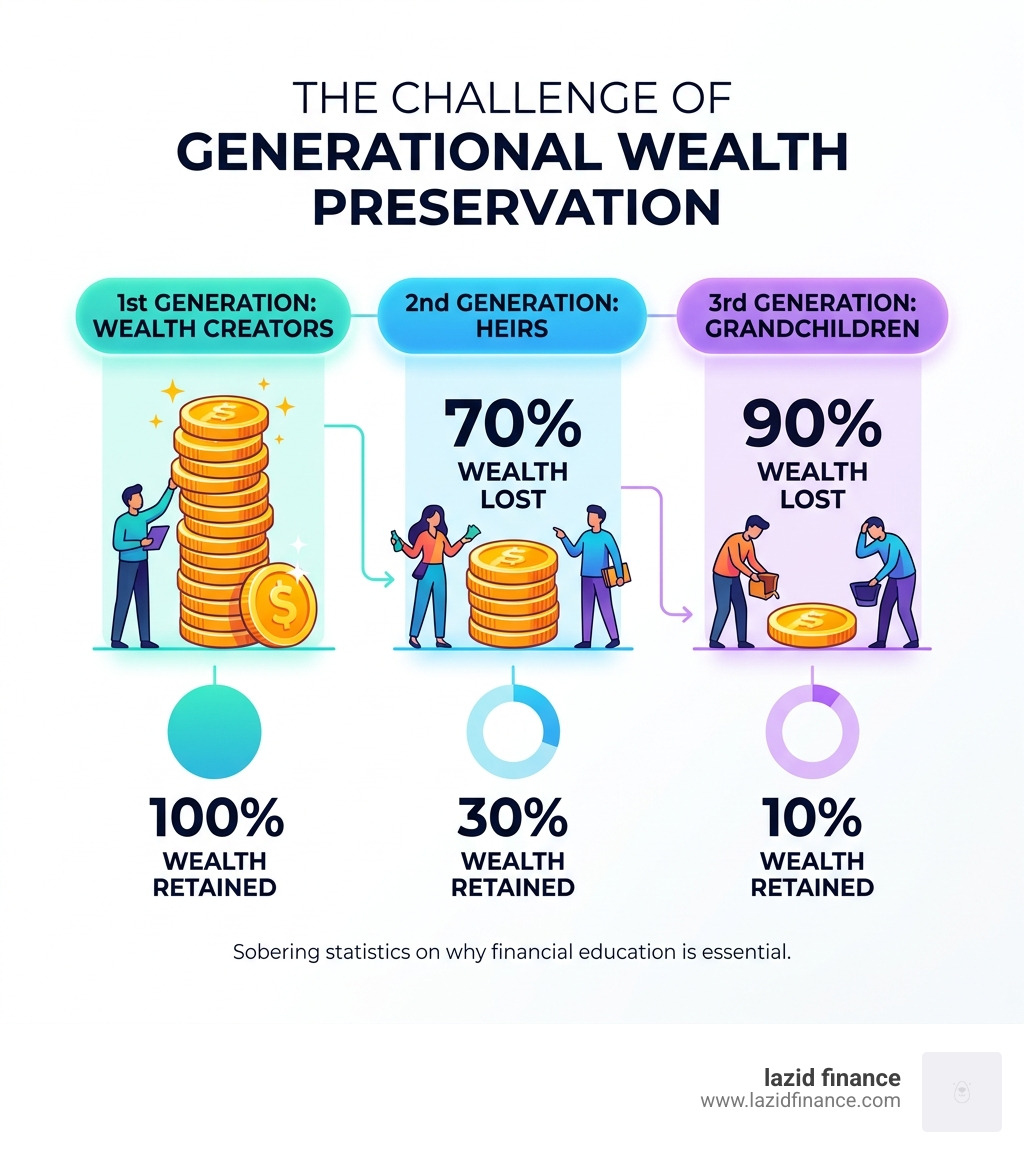
The harder truth? How you build wealth matters just as much as how much you accumulate. Up to 70% of family wealth disappears by the second generation, and up to 90% by the third. That’s not just bad luck — it’s a gap in intentionality, literacy, and the right tools.
Conscious wealth building bridges that gap. It combines practical financial strategy with self-awareness, values alignment, and long-term thinking. Think of it as the difference between chasing numbers and building a life.
This guide walks you through the best tools available in 2026 to do exactly that — starting with Lazid Finance’s Conscious Expense Trend Analyzer.
Defining Conscious Wealth Building vs. Traditional Accumulation
To understand why we need specialized conscious wealth building tools, we first have to look at the shift from traditional accumulation to wealth consciousness. Traditional wealth building is often rooted in a “scarcity mindset”—the idea that there is only so much to go around, leading to a relentless chase for “more” without a clear “why.”
In contrast, an abundance mindset views money as energy and a flowing resource. When we lean into Expanding Wealth Consciousness, we stop seeing money as a source of fear and start seeing it as a tool for growth and fulfillment.
Scarcity vs. Abundance
Traditional finance focuses on the “how”—the tactics of saving and investing. Conscious wealth focuses on the “who” and the “why.” It requires us to face our “money shadows”—those unconscious beliefs we inherited from our parents or early life experiences that dictate our financial behavior. By addressing these shadows, we move from a place of ignorance or accidental harm to intentionality.
Purpose-Driven Finance
Mindful wealth is about alignment. It’s the realization that you can be prosperous and fulfilled without needing to become a minimalist or give everything away. It’s about ensuring your financial decisions support the life you want to live and the contribution you want to make. This approach transforms wealth from a static number on a screen into a dynamic force for good.
Essential Conscious Wealth Building Tools for Sustainable Growth
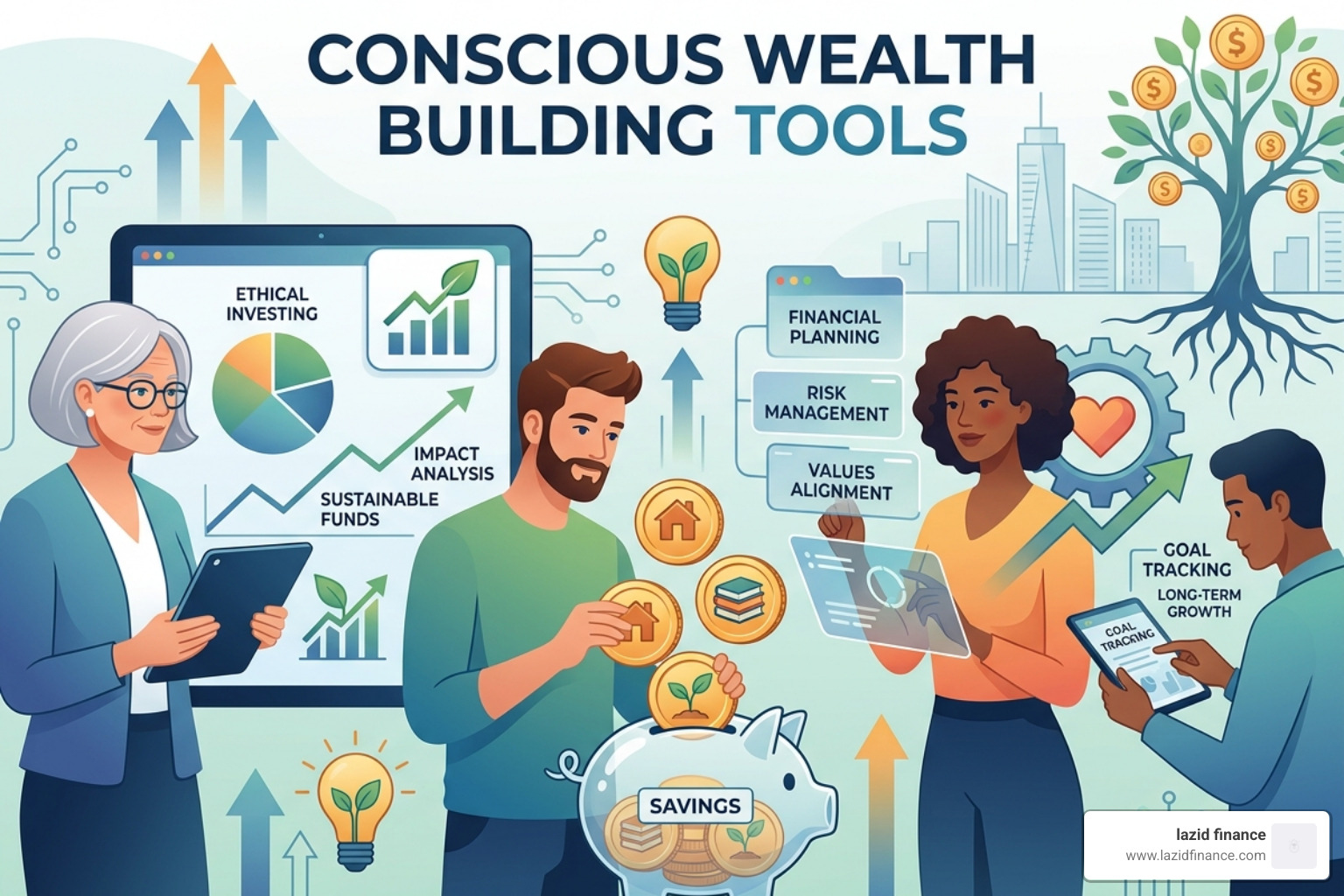
Building wealth consciously requires a different set of filters. As we move into April 2026, the market has shifted significantly toward ethical and sustainable options. In fact, ESG (Environmental, Social, and Governance) assets were on track to exceed $53 trillion by 2025, proving that “doing good” is no longer a niche strategy—it is the strategy.
The Three Ps: Profit, People, Planet
When evaluating conscious wealth building tools, we use the “Three Ps” framework:
- Profit: Is the investment financially stable and capable of generating returns? (Sustainable funds often match or exceed traditional returns).
- People: How does the company treat its employees? Do they prioritize diversity and fair wages?
- Planet: What is the environmental footprint? Are they moving the needle on sustainability?
Conscious Wealth Investing Strategies
Conscious Wealth Investing emphasizes transparency. Traditional firms often complicate the investing process, dissolving transparency and making it hard to see where your money actually goes. Conscious tools prioritize ownership and impact-based decisions.
| Feature | Traditional Investment Tools | Conscious Wealth Building Tools |
|---|---|---|
| Primary Goal | Maximize ROI at any cost | Sustainable growth + positive impact |
| Transparency | Often opaque (hidden fees/holdings) | High (clear view of company ethics) |
| Risk View | Market volatility only | Includes ethical and climate risks |
| Values | Neutral/Ignored | Central to the strategy |
Life Insurance as a Conscious Wealth Building Tool
One of the most misunderstood conscious wealth building tools is life insurance. While often viewed simply as a death benefit, it actually serves as a “Swiss Army knife” for wealth building, estate planning, and tax efficiency.
The Financial Swiss Army Knife
When structured correctly—often through an Irrevocable Life Insurance Trust (ILIT)—life insurance provides liquidity to pay estate taxes, ensuring that heirs don’t have to sell off family assets or businesses at a loss during a period of grief.
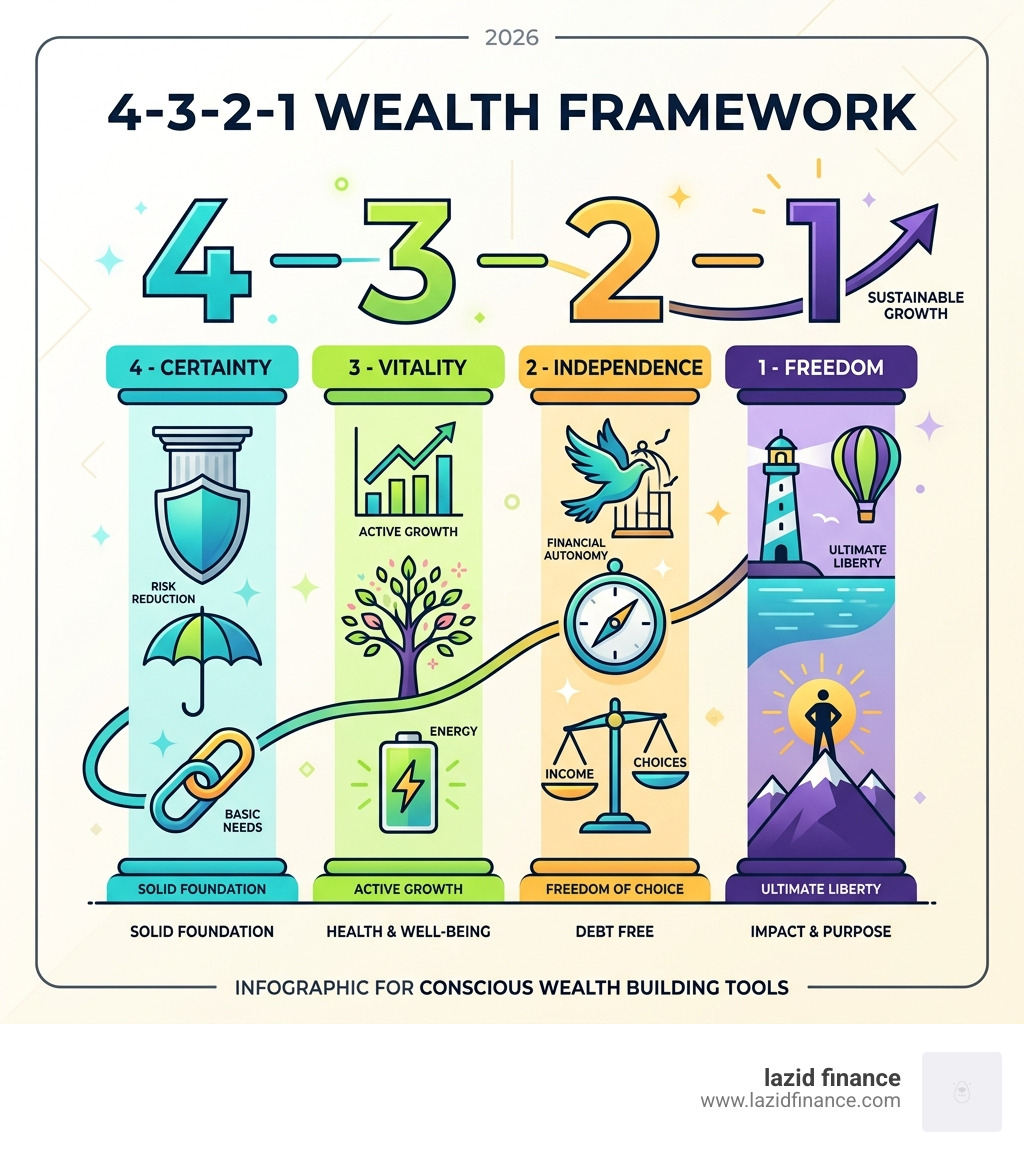
The 4-3-2-1 Wealth Framework
According to The 4-3-2-1 Wealth Framework Explained – Paradigm Life, life insurance fits into the “Protection” pillar. This framework simplifies wealth into four dimensions: Certainty, Vitality, Independence, and Freedom. Life insurance provides the certainty that allows you to take more intentional risks in other areas of your life, knowing your legacy is secure.
Generational Transfer and Cash Value
Permanent life insurance policies allow for cash value accumulation that can be accessed tax-free during your lifetime. This can fund education, business ventures, or supplemental retirement income, acting as a versatile tool for generational wealth transfer and asset protection.
Digital Platforms and Conscious Wealth Building Tools
In 2026, technology is the great equalizer in personal finance. We no longer need a team of private bankers to access high-level strategies. Digital platforms like those offered by Morgan Stanley provide the real-time tracking and automation necessary for modern management.
Expense Analyzers and Trend Tracking
At Lazid Finance, we believe that awareness is the first step toward change. A Conscious Expense Trend Analyzer doesn’t just tell you where you spent your money; it helps you analyze why. By categorizing expenses based on your values, you can see if your daily habits align with your long-term goals.
The ONE Statement Approach
Rather than juggling dozens of disparate reports, conscious wealth building utilizes the “ONE Statement” approach. This is a single snapshot of a family’s priorities, values, and intentions. It moves the conversation from “How much do we have?” to “What is our money doing for us and the world?”
Transforming Money into Conscious Wealth®
For those looking to go deeper, educational resources like the Transforming Money into Conscious Wealth® | Course help families navigate the complex dynamics of shared financial goals. These tools are essential for preventing the “shirtsleeves to shirtsleeves” phenomenon where wealth is lost within three generations.
The 7-Step Framework for Mindful Money Management
Building wealth is a marathon, not a sprint. It requires a disciplined, step-by-step approach that aligns with conscious principles. Here is the 7-step ladder we recommend:
- Maximize Income: Your income is your most powerful wealth-building tool. Invest in your human capital—your skills and education—to increase your earning potential.
- Debt Management: Debt is like acid to wealth. While some leverage can be useful, high-interest debt must be eliminated aggressively to free up your income for investing.
- Goal Setting: Define what “enough” looks like for you. Use Mindful Wealth: The Ultimate Guide | FPW to set specific, measurable, and values-aligned goals.
- Saving and High-Yield Accounts: Automate your savings. High-yield savings accounts in 2026 offer 10 to 12 times the interest of standard accounts, making them essential for emergency funds.
- Investing: Diversify across asset classes using the Three Ps. Utilize index funds or ETFs for low-fee, broad market exposure.
- Asset Protection: Use insurance and legal structures to safeguard what you’ve built.
- Tax Optimization: Use tax-advantaged accounts (like IRAs or 401ks) and gifting strategies to keep more of what you earn.
To learn more about our philosophy on these steps, visit our Sobre Nós page.

Safeguarding Generational Wealth Across Decades
The statistics are sobering: 70% of family wealth is lost by the second generation, and 90% by the third. This usually happens not because of bad investments, but because of a lack of communication and financial literacy.
Estate Planning Essentials
Proper estate planning is more than just a will. While a will is a great start, it often goes through probate, which is public, slow, and expensive.
- Revocable Living Trusts: These allow assets to pass to heirs without court involvement.
- Irrevocable Trusts: These can protect assets from creditors and reduce estate taxes.
- Generation-Skipping Trusts: These allow wealth to pass directly to grandchildren, avoiding a “double hit” of estate taxes.
Financial Literacy and Family Dynamics
Tools like the Conscious Wealth Conversations card game can facilitate difficult discussions about money and purpose within a family. Educating the next generation is the only way to ensure the “wealth” being passed down includes values and wisdom, not just cash.
Philanthropy and Entrepreneurship
Incorporating philanthropy into your wealth plan instills a sense of social responsibility in heirs. Similarly, encouraging entrepreneurship—paired with solid succession planning—can create a lasting legacy that provides opportunities for generations to come. For more insights on this, check out the best financial tools for families to build generational wealth.
Frequently Asked Questions about Conscious Wealth
Why is income considered the most powerful wealth-building tool?
Your income is the primary engine that fuels your investments and savings. Unlike assets that can fluctuate in value, your ability to earn is a renewable resource. When you avoid surrendering your income to debt interest, you retain 100% of your most potent tool to build a life of abundance.
How do the Three Ps guide ethical investment choices?
The Three Ps (Profit, People, Planet) act as a filter. They ensure that you aren’t sacrificing your integrity for a paycheck. By looking at how a company treats its staff and the environment alongside its financial performance, you invest in a world you actually want to live in.
What myths exist about building generational wealth?
The biggest myth is that generational wealth is only for the “ultra-rich.” In reality, anyone can build a legacy through the power of time and compounding. Warren Buffett made 99% of his fortune after the age of 65. The key isn’t starting with millions; it’s starting early and staying disciplined with 7 Money Tools for Building Wealth.
Conclusion: Building a Legacy with Lazid Finance
At Lazid Finance, we believe that money is a tool for transformation. By adopting an abundance mindset and utilizing conscious wealth building tools, you can shift from a culture of financial fear to one of purpose and impact.
Creating a conscious money culture in your personal life or organization isn’t just about the numbers on a spreadsheet—it’s about the peace of mind that comes from knowing your wealth is built on a foundation of integrity. Whether you are just starting your journey or looking to safeguard a multi-generational legacy, we are here to provide the intelligent financial tools you need for mindful choices.
Ready to take the first step toward a more intentional financial future? Explore our Página Inicial to see how our smart finance solutions can help you analyze your habits and build wealth that truly lasts.
Visit us at https://www.lazidfinance.com/ to learn more.

