
Pick a Financial Goal Planner and Watch Your Wealth Grow
Why a Financial Goal Planner Can Change Your Financial Future
A financial goal planner is a tool that helps you set specific money targets, calculate exactly what you need to save, and track your progress over time. In 2026, the most effective tools offer a range of advanced capabilities:
Key Features of Top Financial Goal Planners:
- AI-Powered Scenarios – Comprehensive retirement planning with what-if modeling
- Simple Savings Projections – Straightforward tools for basic targets
- Tax and Inflation Adjustments – Realistic growth projections that account for future costs
- Personalized Roadmaps – Instant AI-driven guidance based on your profile
- SMART Goal Frameworks – Structured setting across multiple timeframes
- Variable Asset Allocation – Dynamic planning for changing risk levels
- Privacy-Focused Modeling – Secure, local-storage options for sensitive data
Most people have a rough idea of what they want financially — a home, a comfortable retirement, maybe a solid emergency fund. But without a clear plan, those goals stay fuzzy and out of reach.
Here’s the thing: planning actually works. Research shows that people who plan their finances do 2.7 times better financially than those who don’t. And those who plan are 54% more likely to live comfortably.
That’s not a small difference. That’s a completely different financial life.
The good news? You don’t need to hire an expensive advisor to get started. Today’s financial goal planners range from free government calculators to AI-powered tools that build you a full roadmap in under a minute — and this guide breaks down exactly which ones are worth your time.
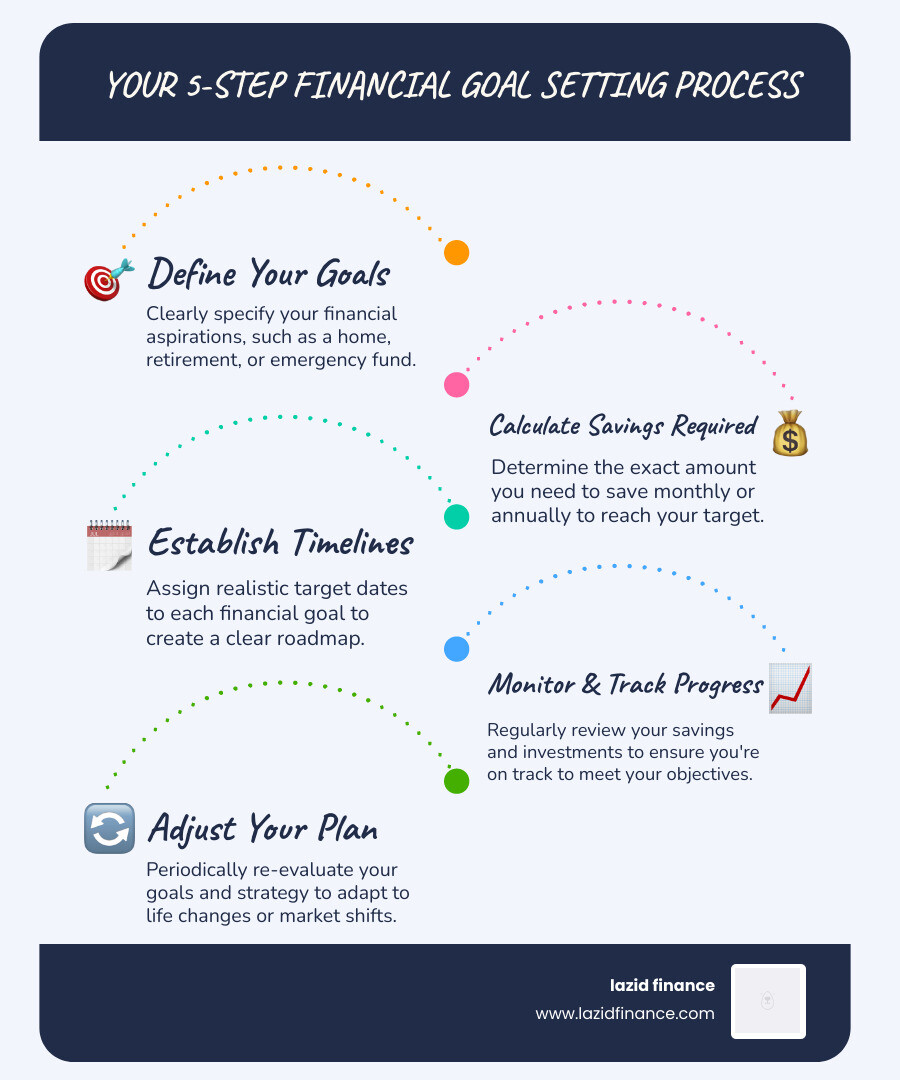
What is a Financial Goal Planner and Why Do You Need One?
At its heart, a financial goal planner is your GPS for wealth building. Instead of guessing how much you should save each month, these tools use math (the fun kind!) to tell you exactly what’s required to reach your destination. Whether you’re dreaming of a beach house or just want the peace of mind that comes with a fully funded emergency fund, a planner turns those dreams into a series of manageable steps.
We often see people struggle with “financial fog”—that vague feeling of anxiety because they aren’t sure if they are doing enough. Using a planner clears that fog. It helps you define specific savings targets and provides a concrete path to reach them. When you see your net worth projected out over ten or twenty years, it changes your relationship with money from one of stress to one of strategic action.
The data backs this up. Beyond the 2.7x improvement in financial outcomes mentioned earlier, nearly 70% of people using advanced planning tools report a significant growth in their net worth within the first year. It’s about more than just numbers; it’s about financial confidence. When you know you’re on track, you can enjoy your life today without the nagging guilt that you should be doing more for tomorrow.

Core Features of an Effective Financial Goal Planner
Not all planners are created equal. If you are browsing for a financial goal planner in 2026, you should look for these non-negotiable features:
- Compound Interest Calculations: The “eighth wonder of the world” needs to be baked into the tool. It should show you how your money grows over time, not just what you put in.
- Inflation Adjustment: A dollar today won’t buy a loaf of bread in 2045. A good planner adjusts your future needs based on expected inflation.
- Tax Implications: Your “gross” return isn’t what you keep. Effective tools factor in post-tax returns to give you a realistic picture.
- Variable Asset Allocation: Your risk tolerance changes as you age. The best planners allow you to adjust your mix of stocks and bonds over time.
- Progress Tracking: An interactive dashboard that updates as you contribute keeps you motivated.
- SMART Goal Framework: The tool should encourage goals that are Specific, Measurable, Attainable, Relevant, and Timebound.
How Planners Calculate Required Savings Using Compound Interest
Most of us think linearly: “If I save $500 a month for 10 years, I’ll have $60,000.” But a financial goal planner thinks exponentially. It factors in your initial investment, your time horizon, and your expected interest rate to show how compounding frequency (daily, monthly, or annually) accelerates your growth.
For example, using the Savings Goal Calculator | Investor.gov , you can input a target amount—say $100,000—and the tool will work backward. It looks at how many years you have to grow the savings and your estimated annual interest rate to find the precise monthly contribution needed. This “reverse engineering” of wealth is why these tools are so powerful; they take the guesswork out of the equation and replace it with a mathematical certainty.
Types of Financial Goal Planners for Every Life Stage
Your financial needs at 22 are vastly different from your needs at 62. A young professional might be focused on aggressive growth and debt payoff, while a pre-retiree is looking at capital preservation and healthcare costs.
- Young Professionals: Focus on tools that prioritize the “Optimal Allocation Waterfall”—getting that employer 401(k) match first, then tackling high-interest debt, then building an emergency fund.
- Mid-Career Builders: These users benefit from planners that handle multiple simultaneous goals, like saving for a child’s education while also maxing out retirement accounts.
- Pre-Retirees: At this stage, you need tools that offer “Sequence of Returns Risk” analysis—showing what happens if the market crashes right as you stop working.
| Feature | Free Calculators | Premium Planners | AI Advisors (2026) |
|---|---|---|---|
| Cost | $0 | $10–$30/month | Often Free/Freemium |
| Complexity | Low (Single Goal) | High (Full Portfolio) | Adaptive (Personalized) |
| Scenario Testing | Basic | Advanced (Monte Carlo) | Instant “What-If” |
| Data Privacy | Varies | High | Local Storage Focused |
Advanced Tools: From AI Advisors to FIRE Calculators
The landscape of 2026 has brought us incredible advancements in planning technology. AI advisors can now analyze your entire financial picture—income, expenses, debt, and risk tolerance—to generate a personalized roadmap in under a minute. These tools are updated with 2026 benchmarks, such as the current 401(k) contribution limit of $24,500.
For those pursuing FIRE (Financial Independence, Retire Early), specialized calculators focus on your “Safe Withdrawal Rate” (SWR). These tools help you find your “FI Number”—the exact amount of invested assets you need to never have to work again. Some tools use “Deterministic Modeling” to give you a straight answer based on specific events (like a 5% inflation spike), while others use “Monte Carlo Simulations” to run 1,000 different market scenarios to see how likely your plan is to succeed.
Handling Multiple Simultaneous Goals
Life doesn’t happen one goal at a time. You might be saving for a wedding, a house down payment, and retirement all at once. This is where a robust financial goal planner shines. Tools like the Goals Planner – Money & Life Exercises from Capital One help you categorize goals into timeframes:
- Short-term (0–3 years): Emergency funds, vacations, or small home repairs.
- Mid-term (4–9 years): A new car or a down payment on a home.
- Long-term (10+ years): Retirement or a child’s college fund.
By categorizing these, the planner can help you prioritize where your next dollar goes. It prevents you from over-funding a long-term goal while your short-term emergency fund sits empty.
How to Use a Financial Goal Planner to Maximize Returns
To get the most out of your financial goal planner, you need to feed it accurate data. Start with your goal amount and your time horizon. But don’t just guess your interest rate; look at historical averages for your specific asset mix.

One of the most effective strategies we recommend is using variable asset allocation. You shouldn’t keep the same investment mix forever. A planner that allows you to shift from aggressive equity to stable fixed income as you approach your goal date will help protect your gains from a last-minute market dip.
Integrating Your Financial Goal Planner with Budgeting Tools
A plan is only as good as the cash flow supporting it. This is why we love integrating goal planners with budgeting tools. By analyzing your “investible surplus”—the money left over after your essential expenses—you can see if your goals are actually realistic.
We suggest following the 50/30/20 rule: 50% for needs, 30% for wants, and 20% for savings and debt repayment. If your planner shows you need to save $1,000 a month to retire by 55, but your budget only shows a $200 surplus, you know you either need to adjust your timeline or find ways to trim the “lazy tax” (overpaying for utilities, subscriptions, and insurance).
The Role of Inflation and Taxes in Accurate Planning
This is where many DIY planners fail. If you plan to retire on $1 million in 30 years, you’re going to be in for a shock. Due to inflation, $1 million in 2056 will have the purchasing power of roughly $410,000 today (assuming 3% inflation).
An advanced financial goal planner factors this in automatically. It also accounts for taxes. If you’re saving in a traditional 401(k) or IRA, Uncle Sam will take his cut when you withdraw. Planning with “post-tax” numbers ensures that the amount you see on your screen is the amount you actually get to spend.
Common Pitfalls and Security in Online Planning
Even with the best tools, users often fall into a few traps. The biggest is “set it and forget it.” Your life changes—you get a raise, you have a child, or the market has a wild year. We recommend reviewing your financial goal planner at least quarterly to make small adjustments.
Another pitfall is being too optimistic. It’s tempting to plug in a 12% annual return, but a realistic 7% or 8% will lead to a much more resilient plan.
Privacy and Data Security Considerations
When you’re inputting your entire financial life into a website, security is paramount. In 2026, we have higher standards for data sovereignty. Many modern tools use local browser storage. This means your data never actually touches their servers; it stays on your computer, encrypted and private.
If you choose a tool that syncs with your bank accounts, ensure it uses read-only access via secure providers like Plaid. This allows the tool to see your balances to update your goals without ever having the ability to move your money. Always look for two-factor authentication (2FA) and clear privacy policies that state your data will never be sold to third parties.
Frequently Asked Questions about Financial Goal Planners
How do planners handle variable asset allocation?
Most advanced planners allow you to set a “glide path.” For example, you might start with 90% stocks and 10% bonds. As you get closer to your goal (like retirement), the planner automatically models a shift toward a 60/40 or 50/50 split to reduce volatility and protect your accumulated wealth.
What is the difference between deterministic and probabilistic modeling?
Deterministic modeling gives you a single, straight-line result based on the numbers you provide (e.g., “If you save X, you will have Y”). Probabilistic modeling, like Monte Carlo simulations, runs thousands of “what-if” scenarios with varying market returns to give you a percentage chance of success (e.g., “You have an 85% chance of reaching your goal”).
How often should I adjust my financial goals?
We suggest a “check-in” every three months and a “deep dive” once a year. However, you should also update your planner after major life events, such as a job change, a marriage, or a significant inheritance. Consistent, small adjustments are much easier than trying to fix a plan that has been off-track for five years.
Conclusion
Building wealth isn’t about luck; it’s about having a map and the discipline to follow it. A financial goal planner provides that map, giving you the clarity to make conscious decisions with every dollar you earn. Whether you are just starting your career or are within sight of the retirement finish line, these tools empower you to take control of your financial destiny.
At Lazid Finance, we believe in smart finance solutions tailored for mindful choices. By using the tools and strategies outlined in this guide, you aren’t just saving money—you’re buying your future freedom.
Ready to turn your financial dreams into a reality?
Start your journey with Lazid Finance and discover how intelligent tools can help you make the most of your money today and tomorrow.

