
Breaking the Cycle: How to Pay Off Debt Without Borrowing More
The Real Cost of Debt (And Why You Don’t Need Another Loan to Escape It)
Knowing how to pay off debt without a loan is simpler than most people think — and it doesn’t require borrowing a single dollar more.
Here are the core ways to do it:
- Debt Snowball — Pay off your smallest balance first, then roll that payment to the next debt
- Debt Avalanche — Target your highest-interest debt first to save the most money overall
- Budget and cut expenses — Use a framework like the 50/30/20 rule to free up cash every month
- Increase your income — Side hustles, selling unused items, or negotiating a raise
- Debt Management Plan (DMP) — Work with a nonprofit credit counselor to consolidate payments without a new loan
- Negotiate directly with creditors — Ask for lower rates or hardship programs on your own
If you’re carrying debt right now, you’re in very large company. About two-thirds of American adults say money is a significant source of stress in their lives, and roughly one in four people specifically point to credit card debt as a major concern. Credit card delinquencies have already climbed past their pre-pandemic levels — hitting 7.2% in 2023 — and in April 2026, rising costs are still squeezing household budgets tight.
The instinct many people have is to solve a debt problem by borrowing more — a consolidation loan, a balance transfer, a cash advance. Sometimes that works. But often it just moves the problem without fixing it.
The good news? You don’t need a new loan to break the cycle.
There are proven, practical strategies that work with the money you already have. Some are about psychology. Some are about math. Some involve getting professional help for free. All of them are within reach — even if your budget feels impossibly tight right now.
Let’s walk through exactly how to do it.
Proven Strategies for How to Pay Off Debt Without a Loan
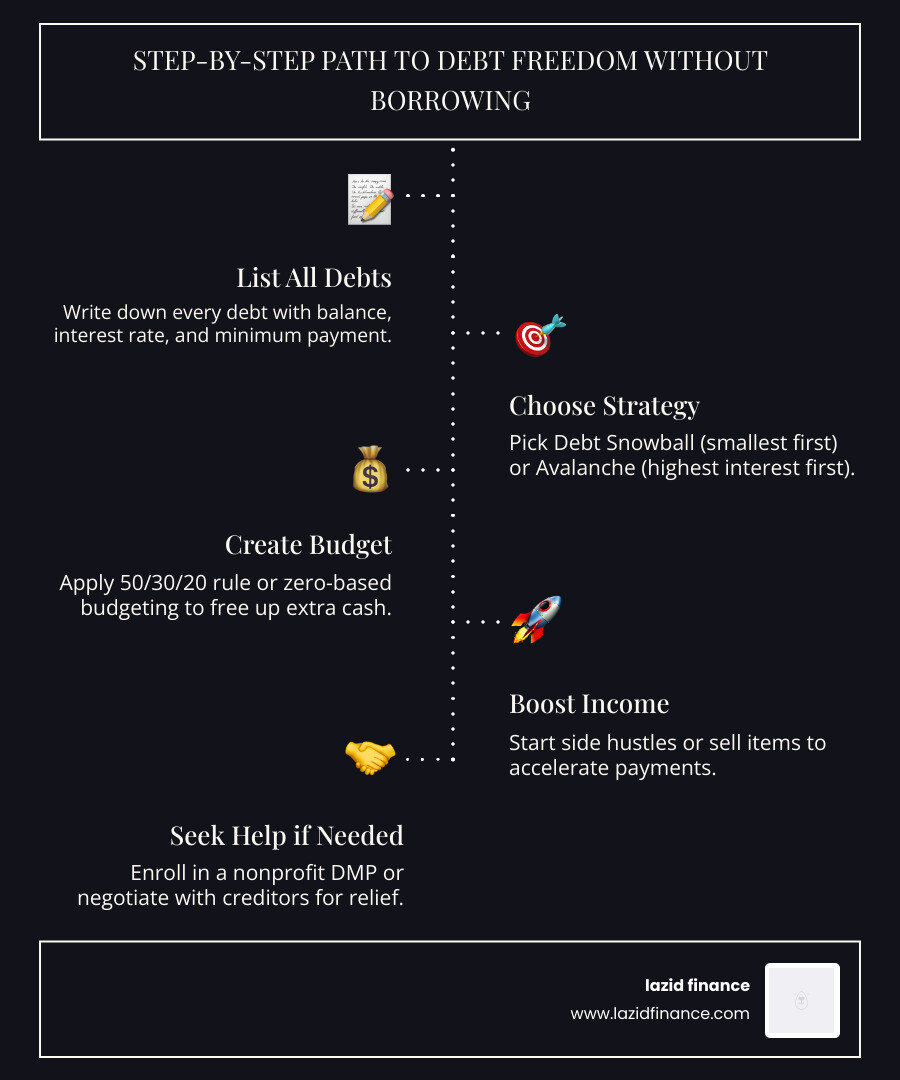
When we talk about how to pay off debt without a loan, we are really talking about a shift in strategy. Many people approach debt by throwing random amounts of money at different balances whenever they have a little extra cash. Research shows this “haphazard” approach rarely works because it lacks a system. To truly make progress, we need to choose between two main philosophies: the psychological win or the mathematical win.

Before picking a method, we must create a “Debt Inventory.” This means listing every single debt we owe: the lender, the total balance, the interest rate (APR), and the minimum monthly payment. Seeing these numbers in black and white can be intimidating, but it is the only way to gain control. Once we have our list, we can apply one of the two most effective DIY strategies.
The Debt Snowball Method for Psychological Momentum
The Debt Snowball method is designed for humans, not calculators. It prioritizes behavioral motivation over interest savings.
How it works:
- List your debts from the smallest balance to the largest balance, regardless of interest rates.
- Pay the minimum on every debt except the smallest one.
- Direct every extra dollar you can find toward that smallest balance.
- Once the smallest debt is gone, take the entire amount you were paying on it (the minimum plus the extra) and “roll” it into the next smallest debt.
The magic of the snowball is the “quick win.” When we clear a $300 medical bill in two months, we feel a surge of accomplishment. This momentum keeps us going when we eventually tackle larger balances. While it might cost a bit more in interest over time, the psychological boost is often what prevents people from giving up halfway through.
The Debt Avalanche Method for Maximum Interest Savings
If the snowball is for the heart, the Avalanche is for the head. This method is mathematically superior because it targets the most expensive debt first.
How it works:
- List your debts from the highest interest rate to the lowest interest rate.
- Pay the minimum on everything except the debt with the highest APR (usually a credit card or a payday loan).
- Put all extra funds toward that high-interest monster.
- Once that is paid off, move to the next highest interest rate.
The primary advantage here is cost reduction. By eliminating high-interest debt first, we stop the “bleeding” of interest charges. For example, paying off a $5,000 balance at 24% APR saves significantly more money than paying off a $5,000 balance at 7% APR. This method typically allows us to become debt-free faster and for less total money, provided we have the discipline to stay motivated without the frequent “wins” of the snowball method.
Maximizing Cash Flow Through Budgeting and Income Generation
Neither the snowball nor the avalanche works if there isn’t extra money to throw at the principal. Finding that extra cash requires us to look at our cash flow with a critical eye.
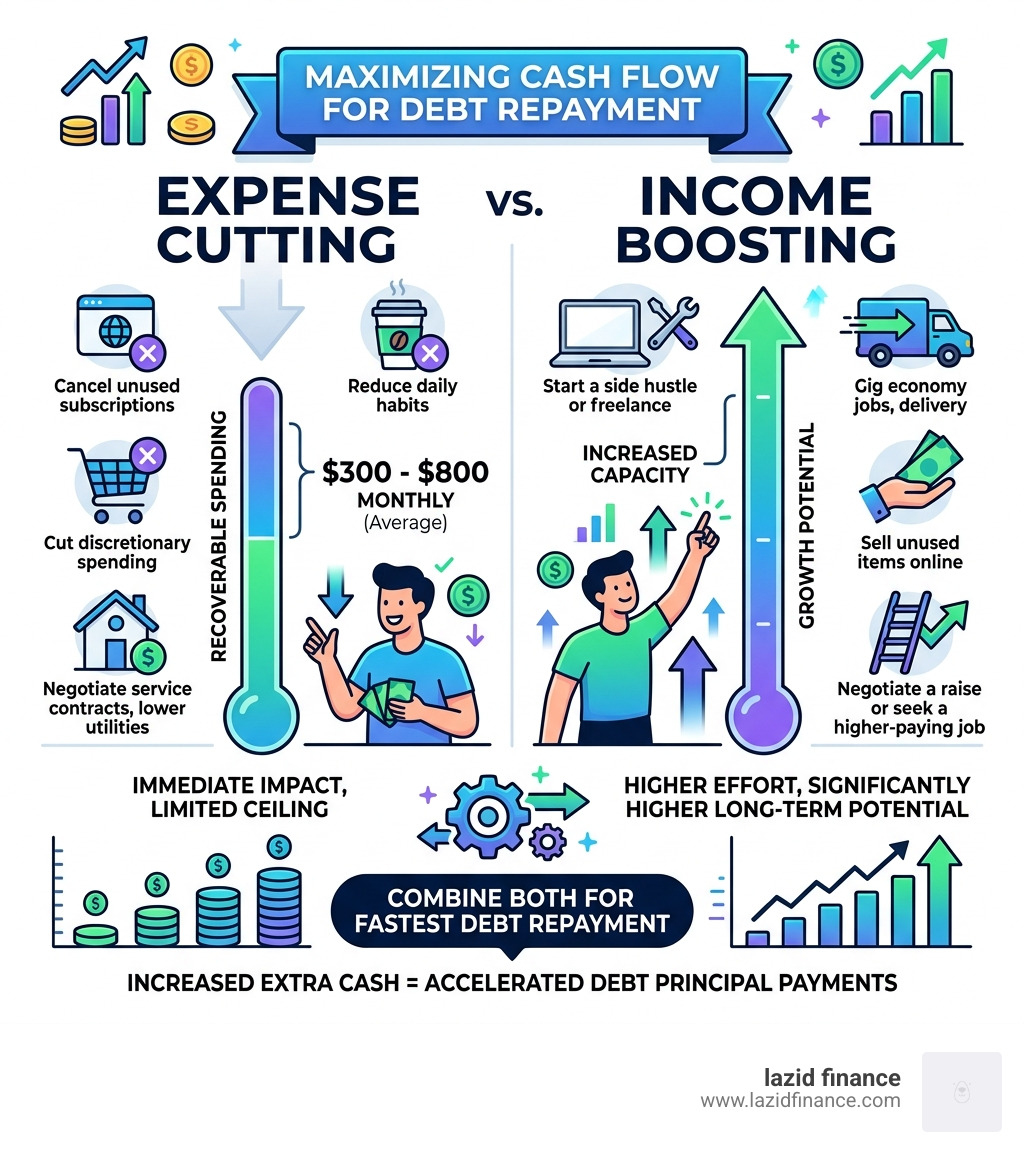
Many of us find that we have “recoverable spending”—money that disappears into subscriptions we don’t use or daily habits that don’t actually bring us joy. Research suggests that the average person can often find between $300 and $800 in their monthly budget just by tracking their transactions for 60 days.
Practical Ways to Increase Income and Cut Costs
To accelerate our journey of how to pay off debt without a loan, we should aim to increase the gap between what we earn and what we spend.
- The 50/30/20 Rule: Aim to spend 50% of your income on needs, 30% on wants, and 20% on debt repayment and savings. If your debt is overwhelming, you might need to temporarily shift the “wants” percentage toward your balances.
- Zero-Based Budgeting: Give every dollar a job before the month begins. If you have $100 left over at the end of your planning, it goes straight to your target debt.
- The Gig Economy: In April 2026, the gig economy is more diverse than ever. Beyond ridesharing, consider sharing your knowledge through online courses, participating in focus groups, or taking on freelance projects.
- Subscription Pruning: We call this “cord cutting 2.0.” Audit your digital subscriptions. If you haven’t watched a specific streaming service in 30 days, cancel it.
- Financial Windfalls: When you receive a tax refund, a work bonus, or even a cash gift, treat it as a “debt-crushing tool” rather than a reason to celebrate with a purchase.
Building an Emergency Fund While Paying Off Debt Without a Loan
It sounds counterintuitive to save money while you owe money, but a “starter” emergency fund is your best defense against new debt. Without a buffer, a flat tire or a broken appliance goes straight back onto the credit card, destroying your progress.
We recommend building a small emergency fund of $1,000 to $2,000 before you start aggressively overpaying your debts. Keep this money in a separate high-yield savings account. It exists to ensure that when life happens, you don’t have to break your debt-free streak.
Professional Alternatives to Debt Consolidation Loans
Sometimes, the DIY approach isn’t enough. If your unsecured debt is more than 50% of your gross income, or if you find yourself using credit cards just to buy groceries, it may be time for professional help. Crucially, “professional help” does not have to mean a new loan.

Navigating Debt Management Plans (DMP)
A Debt Management Plan (DMP) is offered by nonprofit credit counseling agencies. This is one of the most effective ways to consolidate your payments without consolidating your debt into a new loan.
How a DMP works:
- A counselor reviews your finances and works with your creditors to lower your interest rates.
- You make one single monthly payment to the credit counseling agency.
- The agency distributes that money to your creditors.
- Most plans are designed to make you debt-free within 48 to 60 months.
Unlike a consolidation loan, there is no credit check to start a DMP, and the interest concessions can save you thousands. However, you will usually be required to close your credit card accounts, which is a vital step in breaking the cycle of borrowing.
Direct Negotiation and the Risks of Debt Settlement
You can also negotiate directly with your creditors. Many credit card companies have “hardship programs” that they don’t advertise. If you call them and explain your situation, they may temporarily lower your interest rate or waive late fees.
We strongly advise caution regarding for-profit debt settlement companies. These companies often charge high fees (typically 15–20% of the total debt) and encourage you to stop making payments to “force” a settlement. This can lead to:
- Severe damage to your credit score.
- Lawsuits from creditors.
- Increased debt due to late fees and interest penalties.
As the American Bankers Association points out, you can often negotiate the same or better deals yourself without paying a third party.
Common Pitfalls to Avoid on Your Debt-Free Journey
Staying the course is the hardest part of how to pay off debt without a loan. As we move through 2026, watch out for these common traps:
- Lifestyle Creep: If you get a raise or a side hustle starts performing well, don’t upgrade your car or your apartment. Keep your expenses exactly where they are and put the extra income toward your debt.
- The Minimum Payment Trap: Minimum payments are designed by lenders to keep you in debt for decades. On a $15,000 balance at 22% APR, making only minimum payments could take 32 years to pay off. Increasing that payment by even $100 a month can shave years off the timeline.
- New Credit Inquiries: While you are in “payoff mode,” avoid opening new lines of credit. Each inquiry can ding your score, and each new card is a temptation to spend.
- Ignoring Collections: If a debt has gone to collections, don’t ignore it. Verify the debt is yours and check the statute of limitations in your state. Sometimes, you can settle these old debts for a fraction of what you owe.
Frequently Asked Questions about How to Pay Off Debt Without a Loan
Can I consolidate my debt without taking out a new loan?
Yes. The best way to do this is through a Debt Management Plan (DMP) with a nonprofit credit counseling agency. This groups your payments into one monthly amount and reduces your interest rates through direct negotiation by the counselor, but it does not involve a new loan or a credit check.
Is debt settlement better than credit counseling?
Generally, no. Credit counseling (DMPs) focuses on paying back the full principal at lower interest rates, which helps your credit score over time. Debt settlement involves falling behind on payments to settle for less than you owe, which severely damages your credit and often costs more in fees.
How long does it typically take to become debt-free without a loan?
Repayment timelines vary, but most structured plans like DMPs or aggressive Snowball/Avalanche methods take between 3 and 5 years. The speed depends entirely on your “budget surplus”—the more you can cut expenses and increase income, the faster the timeline.
Conclusion
At Lazid Finance, we believe that the path to financial freedom is paved with mindful choices rather than more borrowing. Our goal is to provide intelligent financial tools for conscious decisions, helping you navigate the complexities of personal finance with clarity.
Learning how to pay off debt without a loan is about more than just numbers; it’s about reclaiming your peace of mind. Whether you choose the psychological momentum of the Snowball method or the mathematical efficiency of the Avalanche, the key is consistency. By building a starter emergency fund, maximizing your cash flow, and perhaps seeking the guidance of a nonprofit credit counselor, you can break the cycle of debt for good.
Debt management isn’t about perfection—it’s about progress. Every dollar you pay above the minimum is a step toward a more stable, stress-free future. Stay focused on your long-term stability and keep tracking your progress.
For more resources on making smart finance solutions tailored for mindful choices, visit our website. We are here to help you make the most of your money in 2026 and beyond.
More info about smart finance services

