
The Ultimate Guide to Killing Your Credit Card Balances Fast
The Best Way to Pay Off Credit Card Debt (And Why Most People Get It Wrong)
The best way to pay off credit card debt depends on your situation, but here are the most effective strategies ranked by impact:
- 0% balance transfer card – Move high-rate balances to a 0% intro APR card and pay aggressively before the period ends (12-21 months)
- Debt avalanche – Pay the highest-interest card first while making minimums on the rest; saves the most money
- Debt snowball – Pay the smallest balance first for quick motivational wins; keeps you consistent
- Debt consolidation loan – Combine multiple cards into one lower-rate personal loan (avg. ~12% vs. ~22% for cards)
- Pay more than the minimum – Even $100 extra per month can save thousands in interest and years of payments
Americans are now carrying over $1.17 trillion in credit card debt. The average APR sits at 22.76% — the highest ever recorded. On a $10,000 balance, that’s over $2,200 per year in interest before you pay down a single dollar of what you actually owe.
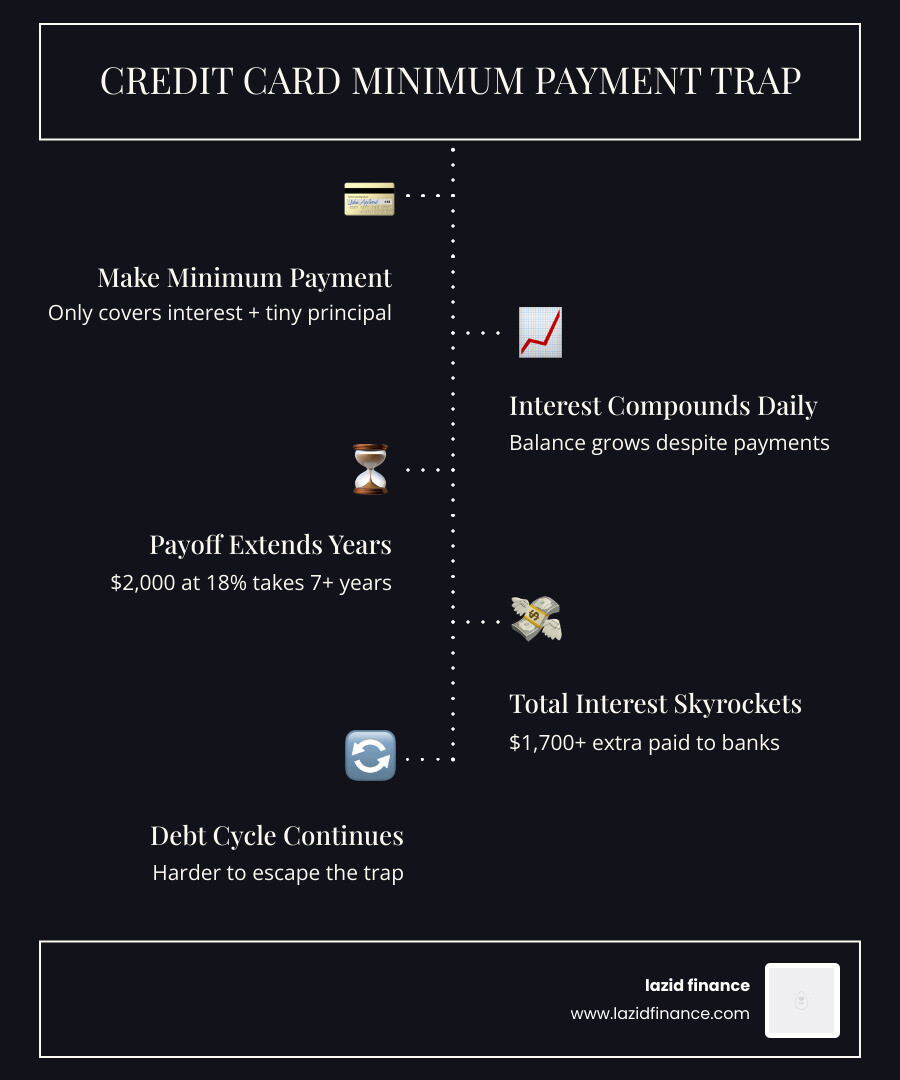
The real trap? Minimum payments.
If you only make minimum payments on a $2,000 balance at 18% interest, you could spend over seven years paying it off — and hand over roughly $1,700 in interest along the way. The card companies aren’t rooting against you, but the math certainly isn’t rooting for you either.
Here’s the thing most debt guides miss: this isn’t purely a math problem. It’s a behavior problem. The best strategy in the world fails if you can’t stick to it. That’s why this guide covers both the numbers and the psychology behind getting free — fast.
Assessing Your Debt and Choosing the Best Way to Pay Off Credit Card Debt
Before we can fight the monster, we have to know exactly how big it is. It is tempting to just “pay a little extra” whenever you feel flush, but that is rarely the best way to pay off credit card debt. True freedom requires a map.
We recommend starting with a full debt inventory. Grab a coffee, sit down with your laptop, and list every single card you own. You need four columns:
- The current balance.
- The Annual Percentage Rate (APR).
- The minimum monthly payment.
- The credit limit.
Knowing your credit limit is vital because it helps you calculate your credit utilization ratio—the amount of credit you’re using compared to what you have available. Ideally, you want to keep this below 30%. If you have a $10,000 limit and owe $7,000, your 70% utilization is likely dragging down your credit score.
According to How to Pay Off Your Credit Card Debt, understanding your cash flow is the next step. You can’t pay off debt if you don’t know where your money is going. Look at your last three months of bank statements. How much is left over after the rent and groceries are paid? That “leftover” amount is your ammunition.

The Debt Avalanche: The Best Way to Pay Off Credit Card Debt for Interest Savings
If you are a fan of logic and hate the idea of giving banks a single penny more than necessary, the Debt Avalanche is for you. This method is mathematically the most efficient best way to pay off credit card debt.
Here is how we do it:
- List your debts from the highest interest rate to the lowest.
- Make the minimum payment on every single card.
- Throw every extra dollar you have at the card with the highest APR.
Once that first card is gone, you take the entire amount you were paying on it and “avalanche” it into the next card on the list. Because you are attacking the most expensive debt first, you reduce the total amount of interest that compounds daily. This can save you thousands of dollars over the life of your debt.
The Debt Snowball: The Best Way to Pay Off Credit Card Debt for Motivation
While the avalanche wins on paper, the Debt Snowball often wins in real life. Why? Because humans are motivated by progress. If you have five different credit cards, the avalanche might take a year before you actually close an account. That can feel discouraging.
With the snowball method:
- List your debts from the smallest balance to the largest.
- Ignore the interest rates for a moment.
- Pay the minimum on everything, then attack the smallest balance with a vengeance.
When you see that $300 balance disappear in three weeks, you get a hit of dopamine. You feel like a winner. That “win” gives you the fuel to tackle the $1,200 balance, and then the $5,000 balance. Scientific research on the snowball method suggests that users are 14% more likely to stick to their plan when they see these quick victories. It turns debt repayment into a game of momentum.
Leveraging Financial Tools for Rapid Repayment
Sometimes, you need more than just a better payment order; you need better terms. If your cards are charging you 25% interest, your payments are barely touching the principal. We need to lower that rate.
One of the most powerful moves is the 0% APR balance transfer. Many cards offer an introductory period of 12 to 21 months where you pay zero interest on transferred balances.
However, there are rules to this game:
- The Fee: Most cards charge a 3% to 5% transfer fee. On a $5,000 transfer, a 5% fee is $250. That sounds like a lot, but compared to paying 22% interest for a year, you’re still saving nearly $1,000.
- The Deadline: If you don’t pay the balance off before the promo ends, the rate often jumps back up to a high APR.
- The Credit Score: You generally need a “good” to “excellent” score (usually 670 or higher) to qualify for these offers.
According to 5 Strategies for Paying Off Credit Card Debt, the biggest danger here is the temptation to use the newly emptied cards for new purchases. If you transfer your debt but don’t change your spending habits, you’ll end up with twice the debt.

Debt Consolidation and Personal Loans
If your credit score isn’t quite high enough for a 0% card, or if you owe more than a single card limit can handle, a debt consolidation loan might be the best way to pay off credit card debt for you.
This involves taking out a personal loan and using the cash to pay off all your credit cards at once. Instead of five different due dates and five different interest rates, you have one fixed monthly payment.
- Lower Rates: While credit card APRs can hit 30%, personal loans for 24 months average around 12.33%.
- Fixed Terms: Unlike credit cards, which are “revolving” debt (you can keep spending and the debt never ends), a personal loan is “installment” debt. It has a clear end date.
- Credit Boost: Moving debt from revolving credit cards to an installment loan can actually improve your credit score by lowering your utilization ratio.
Be careful with home equity loans for this purpose. While the rates are lower, you are using your house as collateral. As noted in How to Pay Off Credit Card Debt: Fast & Long-Term Strategies, if you can’t make the payments, you risk foreclosure. We usually suggest sticking to unsecured personal loans unless you have a rock-solid repayment plan.
Behavioral Strategies to Accelerate Your Progress
The math of debt is simple: spend less than you earn and put the difference toward the balance. But if it were that easy, we wouldn’t have $1.17 trillion in debt! We have to outsmart our own brains.
One of our favorite tactics is the “cooling off” rule. Before making any non-essential purchase over $50, you must wait 48 hours. Most impulse buys lose their shine after two days. This simple rule can save the average consumer between $2,000 and $5,000 a year.
We also advocate for the 50/30/20 budget:
- 50% of your income goes to Needs (rent, utilities).
- 30% goes to Wants (streaming, dining out).
- 20% goes to Savings and Debt Repayment.
If you are serious about killing your debt fast, try a “no-spend month.” For 30 days, you only buy the bare essentials. No takeout, no new clothes, no movie tickets. It sounds miserable, but it creates massive momentum and proves to you that you are in control of your money, not the other way around.
Don’t forget the income side of the equation. About 36% of Americans now have a side hustle, and 20% of those people use that extra cash specifically to pay down debt. Whether it’s selling unused items on a marketplace or picking up extra shifts, every extra $100 you earn is $100 that isn’t accruing 22% interest.
Negotiating with Creditors and Professional Help
Most people don’t realize they can just… call the bank. It sounds too simple, but the success rate for requesting a lower interest rate is between 50% and 70%. If you have been a loyal customer and made your payments on time, call them up and say: “I’ve been seeing offers for lower rates elsewhere. I’d like to stay with you, but I need a lower APR to make this work. What can you do for me?”
If you are truly struggling and the balances are overwhelming, you might need a Debt Management Plan (DMP). This is usually done through a non-profit credit counseling agency. They negotiate with your creditors to lower your interest rates and combine your payments into one. You pay the agency, and they pay the creditors. This typically takes three to five years.
For more personalized guidance on choosing the right tools for your journey, you can find More info about debt management services. We believe that mindful choices today lead to financial freedom tomorrow.
Frequently Asked Questions about Credit Card Debt
How does paying off credit card debt impact my credit score?
Paying off debt is one of the fastest ways to boost your score. Your “credit utilization”—how much of your limit you’re using—makes up about 30% of your total score. As you pay down balances, your utilization drops, and your score rises. Additionally, a history of on-time payments is the single biggest factor in your credit health. Just remember: try not to close the cards once they are paid off. Keeping them open (but unused) increases your total available credit and the average age of your accounts, both of which help your score.
Should I pay more than the minimum payment?
Absolutely. Minimum payments are designed to keep you in debt for as long as possible. They primarily cover the interest, meaning your actual balance barely moves. On a $10,000 balance at 22% APR, paying just $100 extra a month can save you over $6,000 in interest and shave five years off your repayment timeline. Think of every dollar above the minimum as a “strike” against the principal balance.
Is it better to save for an emergency or pay off debt first?
This is a classic debate. We suggest a middle ground: build a $1,000 “starter” emergency fund first. Why? Because life happens. If your car breaks down while you’re paying off debt and you have $0 in savings, you’ll just put the repair on the credit card and feel like a failure. Once you have that $1,000 buffer, throw every spare cent at the debt. Once the high-interest debt is gone, you can go back to building a full 3-to-6-month emergency fund.
Conclusion
The best way to pay off credit card debt isn’t a secret formula; it’s a combination of the right strategy and the right mindset. Whether you choose the mathematical precision of the avalanche or the psychological boost of the snowball, the most important step is the one you take today.
Debt can feel like a heavy weight, but it is not a life sentence. By auditing your spending, leveraging tools like balance transfers, and staying consistent with your payments, you can reclaim your financial future. At Lazid Finance, we provide the smart solutions you need to make mindful choices and build lasting wealth.
Ready to stop treading water and start moving forward? Start your journey to financial clarity and take the first step toward a debt-free life. Your future self will thank you.

