
How to Use a Financial Calculator in 5 Easy-to-Follow Steps
Why a Financial Calculator Is the Smartest Tool for Your Money
A financial calculator is a specialized tool that goes far beyond basic math — it helps you figure out loan payments, investment growth, retirement savings, and more, all in seconds.
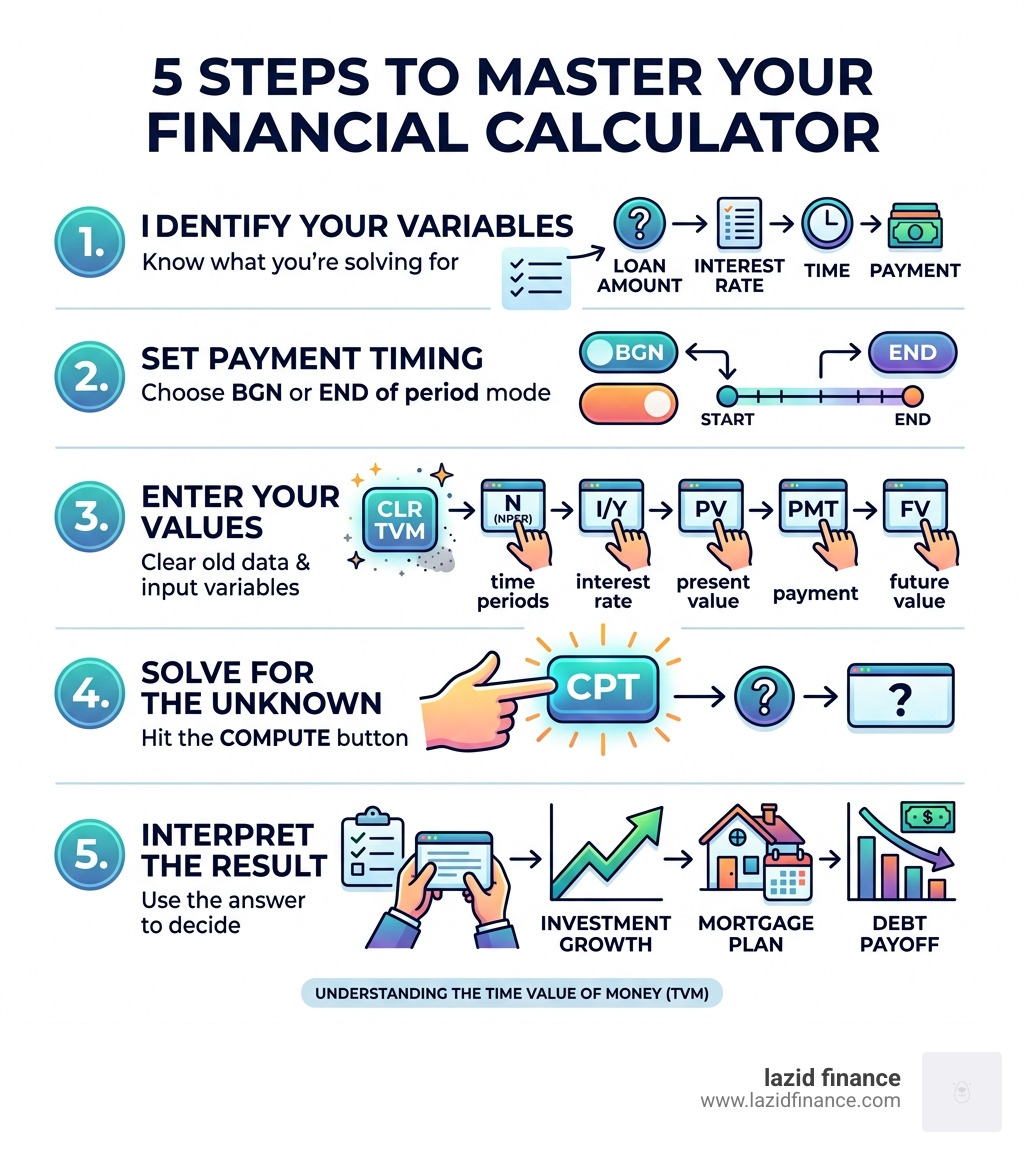
Here’s a quick overview of how to use one in 5 steps:
- Identify your variables — Know what you’re solving for (loan amount, interest rate, time period, or payment)
- Set payment timing — Choose Beginning or End of period mode
- Clear old data and enter your values — Input PV, FV, PMT, I/Y, and N as needed
- Solve for the unknown — Hit the compute button for your answer
- Interpret the result — Use the output to make a real financial decision
Think about it this way: if someone owed you $500, would you want it all now or spread across four payments over a year? Most people instinctively want it now — and that instinct is exactly what financial math is built on. Money today is worth more than money tomorrow. That idea is called the time value of money, and it sits at the heart of every calculation a financial calculator performs.
Whether you’re planning a mortgage, tracking investment growth, or mapping out a debt payoff strategy, understanding how to use a financial calculator puts you in control of your financial future.
Understanding the Lazid Financial Calculator vs. Standard Devices
At first glance, a financial calculator might look like the standard one sitting in your junk drawer, but under the hood, it’s a completely different engine. While a standard calculator is great for splitting a dinner bill (adding, subtracting, multiplying, and dividing), it struggles with the complexities of modern finance.
Standard devices operate on “linear” math. To calculate compound interest or an amortization schedule on a basic calculator, you would need to memorize long, intimidating algebraic formulas and punch in numbers for every single period. It’s a recipe for a headache and, more importantly, a recipe for error.
Our specialized tools at Lazid Finance are designed for “exponential” math. These tools handle the heavy lifting of concepts like Net Present Value (NPV) and Internal Rate of Return (IRR). Here is how they stack up against the old-school basics:
| Feature | Standard Calculator | Lazid Financial Tool |
|---|---|---|
| Basic Math | Yes | Yes |
| Simple Interest | Yes (Manual) | Yes (Automatic) |
| Compound Interest | Very Difficult | Instant |
| Amortization | No | Yes (Full Schedules) |
| Cash Flow Analysis | No | Yes (NPV/IRR) |
| Visual Aids | No | Yes (Graphs/Timelines) |
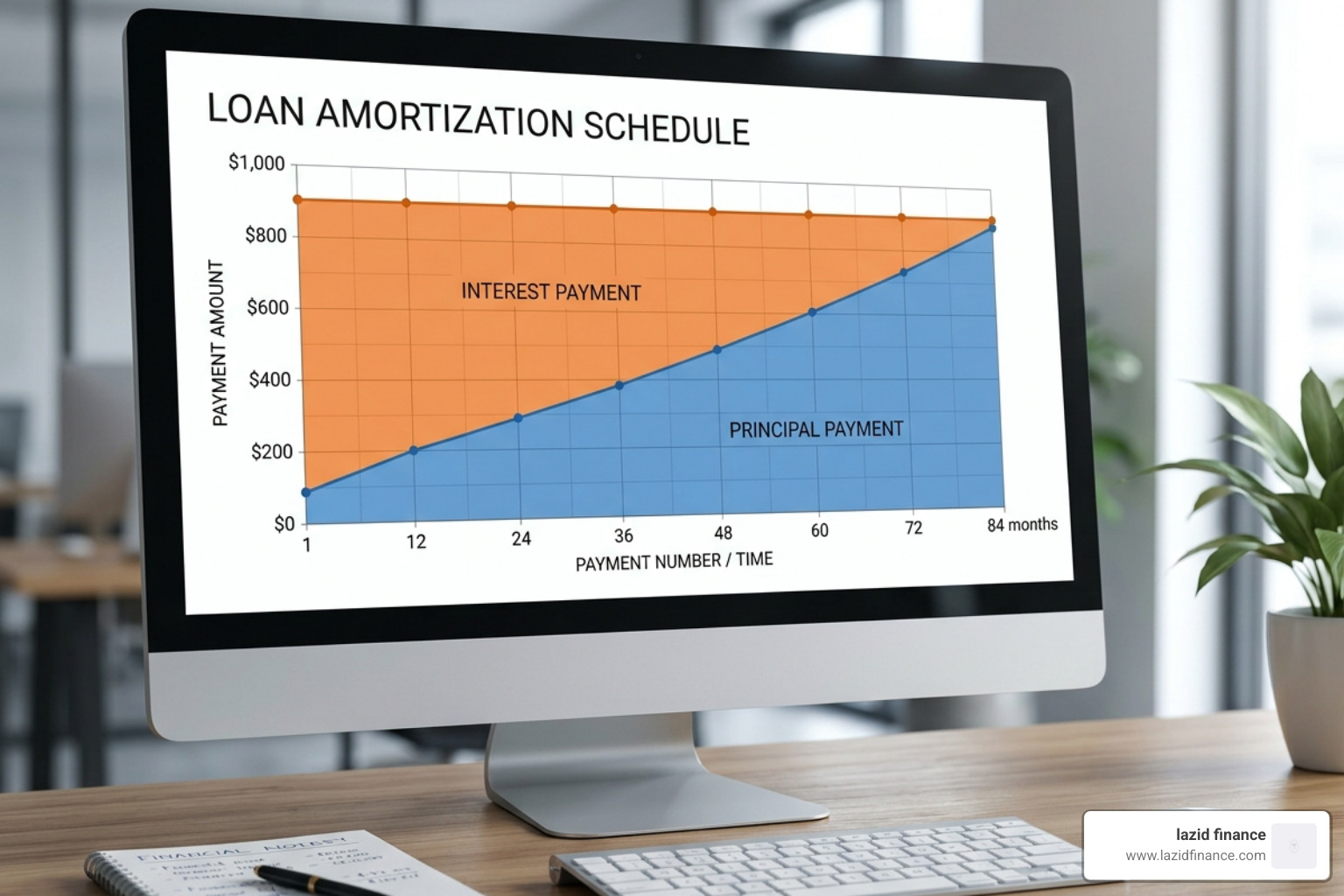
Why are specialized digital tools essential in April 2026? Accuracy and speed. When interest rates and market conditions shift rapidly, being able to visualize your cash flow or see exactly how much of your next mortgage payment goes toward interest versus principal is a game-changer. Digital interfaces provide a “timeline” view of your money, helping you see the journey of your wealth rather than just a final, static number.
The Core Components of Time Value of Money (TVM)
To master any financial calculator, you first need to speak its language. Most financial problems are solved using five core variables, often referred to as the “TVM keys.” Understanding these is like learning the secret code to wealth management.
Present Value (PV)
This represents the current value of a future sum of money or stream of cash flows. If you are putting $10,000 into a savings account today, your PV is $10,000. In loan scenarios, the PV is typically the amount you are borrowing.
Future Value (FV)
This is what your money will be worth at a specific date in the future, based on a certain interest rate. For example, if you invest $100 today at a 10% interest rate, your FV after one year is $110. After two years, thanks to the power of compounding, it becomes $121.
Periodic Payment (PMT)
PMT represents a recurring amount paid or received each period. This could be your monthly mortgage payment, a monthly contribution to a Roth IRA, or even the rent you receive from an investment property.
Interest Rate (I/Y)
This is the annual interest rate or the rate of return on an investment. It’s the “engine” that grows your FV or determines the cost of your PV.
Number of Periods (N)
This is the total number of compounding periods or payment periods. If you have a 30-year mortgage with monthly payments, your N is 360 (30 years x 12 months).
Compounding Frequency
This is a critical setting. Interest doesn’t always compound once a year; it can be semiannual, quarterly, monthly, or even daily. The more frequently your interest compounds, the faster your money grows (or the more interest you owe on a debt). Mastering these variables through the Lazid interface allows you to see the “what-ifs” of your financial life clearly.
5 Steps to Master Your Financial Calculator
Using a financial calculator doesn’t require a degree in finance. By following our structured 5-step process, you can solve complex problems with confidence.
1. Variable Identification: Defining Your Financial Goal
Before you touch a button, ask yourself: “What am I trying to find?” Are you trying to see how much you need to save each month (solve for PMT)? Or are you trying to see how much your current savings will be worth in 20 years (solve for FV)? Clearly identifying which variables you have and which one you need is the most important step.
2. Payment Timing: Setting the Mode (Beginning vs. End)
This is a setting that many people overlook, but it can change your results by thousands of dollars.
- End Mode (Ordinary Annuity): Payments occur at the end of the period (like most mortgages or car loans).
- Beginning Mode (Annuity Due): Payments occur at the start of the period (like rent or some insurance premiums). Setting this correctly ensures your interest is calculated accurately from the very first day.
3. Data Entry: Clearing Previous Calculations and Inputting Values
Old data is the enemy of a fresh calculation. Always use the “Clear TVM” or “Reset” function before starting. When entering data, remember the “Sign Convention.” Usually, money leaving your pocket (like an investment or a loan payment) is entered as a negative number, while money coming into your pocket (like a loan amount received or a future withdrawal) is positive.
4. Solving Unknowns: The Computation Phase
Once your known variables (N, I/Y, PV, PMT, or FV) are entered, simply press the button for the variable you want to solve. In a digital financial calculator, this is often as simple as clicking the “Calculate” button next to the empty field.
5. Result Interpretation: Making Informed Decisions Based on Data
The number on the screen is just the start. Use it to evaluate your lifestyle. If the financial calculator shows that your dream home requires a $4,000 monthly payment, but your budget only allows for $2,500, you now have the data to adjust your expectations or your savings timeline.
Why Lazid Finance Offers the Best Calculation Experience
While traditional physical calculators have been industry standards for decades, modern web-based tools from Lazid Finance offer a superior experience. Manual devices often have a steep learning curve and tiny screens that don’t show you the “why” behind the numbers.
Our tools provide integrated mobile features, meaning you can run numbers on a car lot or during a house viewing. More importantly, we offer visual aids and interactive graphs. Seeing a bar chart of your debt decreasing over time is much more motivating than staring at a single row of digits on a physical device.
Maximizing Your Financial Calculator for Long-Term Wealth
A financial calculator isn’t just for loans; it’s a blueprint for your future. You can use it for:
- Savings Goals: Determine exactly how much to set aside for a child’s education.
- Budgeting: Use the 50/30/20 rule and calculate the long-term impact of your “wants” vs. “needs.”
- Investment Growth: Model different market scenarios using an interest rate variance range.
- Net Worth Tracking: Project your total value over the next decade.

Specialized Tools for Every Financial Goal
While a general financial calculator is the “steam engine” of finance, sometimes you need a specialized tool for a specific job. At Lazid Finance, we provide a suite of tools tailored to every milestone:
- Mortgage Planning: Go beyond the monthly payment. Factor in property taxes, insurance, and Private Mortgage Insurance (PMI) to see the true cost of homeownership.
- Auto Loans: Compare the total cost of a lease versus a purchase, including depreciation.
- Retirement Projections: Use a finance calculator to see if your 401(k) and Social Security will sustain your lifestyle.
- Debt Payoff Strategies: Compare the “Debt Snowball” (paying smallest balances first) versus the “Debt Avalanche” (paying highest interest rates first).
- Tax Estimation: Calculate your take-home pay after federal and state deductions so there are no surprises on payday.
- Student Loans: Determine the impact of making bi-weekly payments versus monthly ones.
- Credit Card Management: See how much interest you’ll save by paying just $50 more than the minimum payment each month.
Frequently Asked Questions about Financial Calculators
What is the difference between “Beginning” and “End” mode?
Payment timing is everything. In “End” mode, interest has a full period to accumulate before you make a payment. In “Beginning” mode, you pay upfront, which means you owe less interest over the life of the calculation. For a savings account, “Beginning” mode is better because your money earns interest for the entire first month. For a loan, “End” mode is standard, but paying at the “Beginning” would actually save you money on total interest.
Why use a dedicated financial tool instead of manual formulas?
Efficiency and peace of mind. Manual formulas for a Compound Interest Calculator | Investor.gov involve exponents and fractions that are easy to mistype. Lazid Finance tools simplify the process, offering real-time updates and ensuring that the math is 100% accurate every time. You focus on the strategy; we focus on the arithmetic.
Are there free digital tools available for financial calculations in 2026?
Absolutely. In 2026, you don’t need to spend $100 on a plastic calculator. You can access a full suite of tools via Lazid Finance for free. Whether you prefer a desktop version for deep planning or a mobile-optimized tool for quick checks on the go, modern fintech has made these powerful resources accessible to everyone. You can even find specialized digital tools to handle pure time-value-of-money problems.
Conclusion
Mastering a financial calculator is one of the most empowering steps you can take for your financial health. It moves you away from guesswork and toward conscious, data-driven decisions. Whether you are calculating the growth of a single dollar or planning a multi-million dollar retirement, these tools provide the clarity you need to grow your wealth with confidence.
At Lazid Finance, we believe in providing intelligent financial tools for conscious decisions. Our smart finance solutions are tailored for mindful choices, ensuring you have the “A+ to F” clarity you need to succeed.
Ready to see where you stand? Explore our tools and take control of your journey today. More info about our services

