
Financial Goals for Your 40s: A Guide to Not Working Forever
Your 40s Are a Financial Turning Point — Here’s What to Focus On
Financial goals for your 40s should be a top priority right now — and if you’re wondering where to start, here’s a quick snapshot:
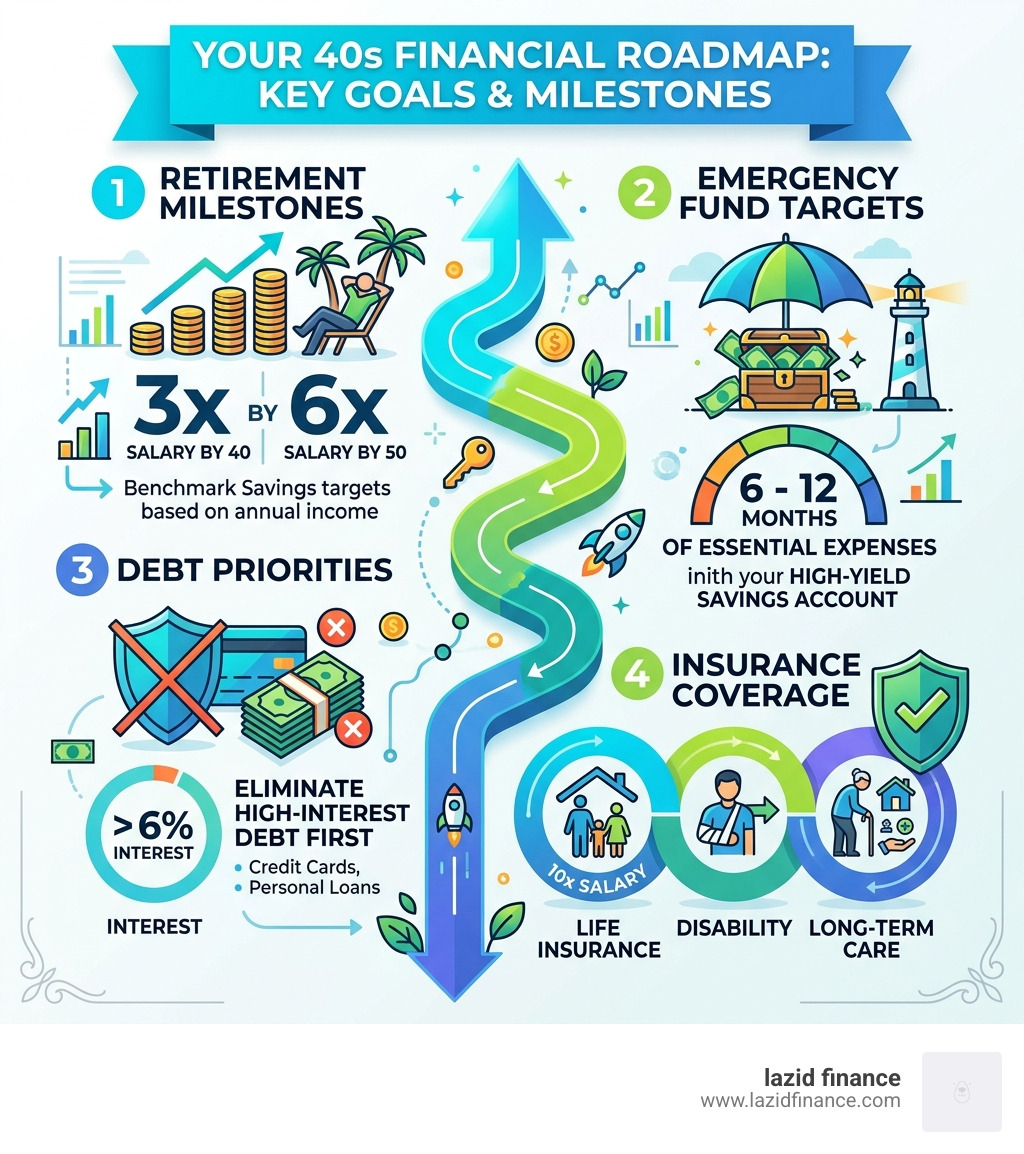
Key financial goals to hit in your 40s:
- Retirement savings — aim for 3x your annual salary saved by 40, 6x by 50
- Emergency fund — build 6-12 months of essential expenses in a high-yield savings account
- Debt — eliminate high-interest debt (focus on anything above 6% interest first)
- Insurance — secure life insurance (10x salary), disability, and long-term care coverage
- Estate planning — create or update your will, beneficiaries, and power of attorney
- College savings — open a 529 plan, but never at the expense of retirement
- Net worth — target 2-4x your annual income by age 40
Your 40s are likely your peak earning years. That’s the good news.
The complicated news? Those same years come loaded with competing demands — mortgage payments, kids, possibly aging parents, and the slow creep of lifestyle inflation quietly eating your raises before you notice them.
This is the decade that separates people who retire when they want to from those who don’t have a choice. The gap between those two groups usually isn’t income. It’s decisions made (or delayed) right now, in your 40s.
Many people in this stage are part of what financial planners call the sandwich generation — caught between the financial needs of their children and their aging parents, while also trying to build their own future. It’s a real squeeze.
And the numbers reflect how hard it is: the average U.S. household headed by someone aged 44-49 has only about $81,347 saved for retirement — far below where most experts say you should be.
But here’s the thing: it’s not too late. Your 40s are actually one of the most powerful decades to course-correct, accelerate savings, and build real financial resilience — if you know what to focus on.
Benchmarking Your Progress: Retirement and Net Worth Milestones

When we talk about financial goals for your 40s, the first question most of us ask is: “Am I behind?” It’s a natural concern, especially when life in your 40s feels like a constant juggling act. To find the answer, we look at benchmarks—not as a source of stress, but as a compass to guide our next moves.
The most widely accepted benchmark for retirement savings is based on multiples of your salary. By the time you blow out 40 candles, the goal is to have three times your annual salary tucked away in retirement accounts. If you earn $100,000, that’s a $300,000 nest egg. By age 45, you should aim for four times, and by age 50, that number jumps to six times.
Why the sudden acceleration? Because your 40s are often when your income reaches its highest point. This is the decade where compound interest starts to do the heavy lifting, provided you’ve given it enough fuel.
Beyond retirement accounts, we also need to look at your total net worth. 9 Financial Milestones to Hit by Age 40 suggests that a healthy net worth at this stage is roughly two to four times your annual income. This includes the equity in your home, your savings, and your investments, minus any debts like your mortgage or car loans.
To help you visualize where you stand, here is a breakdown of the savings multiples many financial professionals recommend:
| Age | Retirement Savings Target |
|---|---|
| 40 | 3x annual salary |
| 45 | 4x annual salary |
| 50 | 6x annual salary |
| 60 | 8x annual salary |
| 67 | 10x annual salary |
Setting Realistic Financial Goals for Your 40s Net Worth
Calculating your net worth is like taking a “financial selfie”—it shows you exactly what you look like right now. In our 40s, we want that picture to show increasing stability. To hit that 2-4x income milestone, we need to focus on two things: increasing assets and decreasing liabilities.
A key part of this is your savings rate. We generally recommend aiming to save at least 15% to 20% of your gross income. If that feels high, this includes your employer’s 401(k) match. If you put in 10% and your boss puts in 5%, you’re hitting that 15% target.
Asset allocation also becomes more nuanced during this decade. You still have 20 to 25 years before traditional retirement, which means you can afford to keep a significant portion of your portfolio in equities (stocks) for growth. However, you should also begin diversifying into more stable assets to protect against market volatility. Reaching 10 Financial Goals to Reach By Age 40 means ensuring your money is working as hard as you are.
Catch-Up Strategies for Late Starters
If you looked at the table above and felt a pit in your stomach, take a deep breath. You are not alone. Many people spend their 20s and 30s paying off student loans or starting families, leaving little room for aggressive retirement saving.
The best catch-up strategy is automation. If you don’t see the money, you won’t spend it. We suggest increasing your 401(k) contribution by just 1% or 2% every year. You’ll hardly notice the difference in your paycheck, but over a decade, it adds up to a massive sum.
Another powerful move is “bonus allocation.” When you get a raise or a year-end bonus, resist the urge to buy a new car or upgrade your kitchen. Instead, commit at least 50% of that windfall directly to your retirement or debt payoff. Finally, consider a side hustle. In today’s economy, turning a hobby into a small revenue stream can provide the extra “boost” needed to bridge a savings gap.
Strategic Debt Management and the 40s Emergency Fund

In your 40s, debt can either be a tool or a trap. We often distinguish between “good debt” (like a mortgage) and “bad debt” (like credit cards). By age 40, your goal should be to eliminate all high-interest consumer debt.
A good rule of thumb is the “6% rule.” If a debt has an interest rate higher than 6%, it is likely costing you more than you are earning in the stock market. Paying it off is essentially a guaranteed return on your investment.
To tackle this, you can use the Snowball Method (paying off the smallest balances first for a psychological win) or the Avalanche Method (paying off the highest interest rates first to save the most money). Both are effective, but the key is consistency. A Guide to Financial Planning in Your 40s emphasizes that freeing up your cash flow from debt is the fastest way to accelerate your path to independence.
Sizing Your Emergency Fund for Financial Goals for Your 40s
In your 20s, a $1,000 emergency fund might have felt like a fortune. In your 40s, with a mortgage, kids, and aging parents, that won’t even cover a broken HVAC system.
The ideal size for an emergency fund in your 40s is 6 to 12 months of essential living expenses. Why so much? Because at this stage of your career, if you lose a high-paying job, it may take longer to find a replacement at the same salary level.
We recommend keeping this money in a high-yield savings account (HYSA). As of April 2026, these accounts offer much better rates than traditional brick-and-mortar banks, allowing your “safety net” to at least keep pace with inflation. Following Financial goals for your 30s, 40s, 50s, and beyond means ensuring your emergency fund is liquid and accessible, but separate from your daily spending money.
Managing “Good Debt” and Mortgages
Mortgages are often the largest line item in a 40-something’s budget. While it’s “good debt,” it still represents a significant liability.
In your 40s, you should evaluate whether refinancing makes sense for your long-term goals. If interest rates have dropped since you bought your home, a refinance could shave hundreds off your monthly payment—money that could be redirected to retirement.
However, be wary of tapping into home equity for non-essential renovations. While a new deck is nice, it rarely returns 100% of its cost when you sell. Your home is a place to live, but your 401(k) is what will pay for your life after work.
Essential Financial Goals for Your 40s: Protecting Your Wealth
By the time you reach 40, you’ve likely spent two decades building your life. Now, you need to protect it. Wealth protection is just as important as wealth creation.
The first pillar is life insurance. The general rule of thumb is to have coverage equal to ten times your annual salary. If you have a spouse and children who depend on your income, this is non-negotiable. While many employers offer group life insurance, it’s often not enough. We recommend looking into a private term life policy to fill the gap.
Disability insurance is equally critical. You are statistically more likely to become disabled during your working years than you are to pass away prematurely. Ensure your policy covers at least 60% of your income. Investing in Your 40s: Financial Planning & Wealth Building highlights that your ability to earn an income is your most valuable asset—don’t leave it unprotected.
Estate Planning and Legacy Building
Estate planning isn’t just for the ultra-wealthy. If you own a home or have children, you need a plan. At a minimum, your financial goals for your 40s should include:
- A Will: To dictate who gets your assets and, more importantly, who will care for minor children.
- Power of Attorney: To designate someone to make financial decisions if you become incapacitated.
- Healthcare Directive: To outline your medical wishes.
- Beneficiary Designations: Ensure your 401(k), IRAs, and life insurance policies have the correct names listed. These designations actually override what is written in your will!
Guide to Financial Planning in Your 40s suggests that your 40s are also the right time to start thinking about long-term care. While you may not need it for decades, purchasing long-term care insurance in your 40s or early 50s can lock in much lower premiums.
Tax Optimization and Asset Location
As your income grows, taxes become one of your biggest expenses. Smart financial planning in your 40s involves “tax diversification.” This means having money in three different buckets:
- Taxable: (Checking, savings, brokerage accounts)
- Tax-Deferred: (Traditional 401(k), Traditional IRA)
- Tax-Free: (Roth IRA, Roth 401(k), HSA)
The Health Savings Account (HSA) is often called the “ultimate retirement account.” It offers a triple tax advantage: contributions are tax-deductible, growth is tax-free, and withdrawals for medical expenses are tax-free. If you can afford to pay for current medical bills out of pocket, you can let your HSA grow for decades to cover healthcare costs in retirement.
For high earners who exceed the income limits for a Roth IRA, the “Backdoor Roth” strategy is a popular way to still get money into a tax-free growth environment.
Balancing the “Sandwich Generation” Challenges
This is the hardest part of the 40s: the “Squeeze.” You want to help your kids with college, but you also see your parents getting older and potentially needing financial help.
The most important rule we can share is this: Put your own oxygen mask on first. You can borrow money for college. You can’t borrow money for retirement. If you sacrifice your retirement savings to pay for your child’s tuition, you may end up being a financial burden on that same child later in life.
That said, 529 plans are excellent tools for college savings. They offer tax-free growth and withdrawals for education expenses. Even small, regular contributions can make a significant dent in future tuition bills. What Should My Financial Goals Be In My 40s? | Bull Oak reminds us that balancing these priorities requires a clear-eyed look at your budget and a willingness to have honest conversations with your family.
Maximizing Tax-Advantaged Accounts as Part of Financial Goals for Your 40s
To reach your goals, you need to squeeze every bit of utility out of your accounts. In 2026, the 401(k) contribution limit is higher than ever, and we should strive to max it out if possible.
Once you hit age 50, the IRS allows “catch-up contributions,” which let you put away even more. While you might not be 50 yet, you should be planning your budget now so that you can take full advantage of those limits the moment you qualify.
Don’t forget about taxable brokerage accounts. Once you’ve maxed out your tax-advantaged options, a standard brokerage account offers the most flexibility. There are no age restrictions on when you can withdraw the money, making it a key tool if you plan to retire before age 59.5.
Frequently Asked Questions about 40s Finances
How much should I have saved for retirement by age 40?
Aim to have at least three times your annual salary saved. If you earn $80,000, your goal should be $240,000. If you are behind, don’t panic—focus on increasing your savings rate by 1% each year and allocating future raises to your retirement fund.
Should I prioritize my child’s college fund or my retirement?
Always prioritize retirement. Your children have several options to fund their education, including scholarships, grants, and loans. You only have your savings to fund your life after work. A secure retirement is actually the best gift you can give your children.
What is the ideal size of an emergency fund in your 40s?
We recommend 6 to 12 months of essential expenses. This covers housing, food, utilities, and insurance. With the increased responsibilities of your 40s, a larger cushion provides the peace of mind necessary to make bold career moves or weather unexpected family emergencies.
Conclusion
Navigating the financial goals for your 40s doesn’t have to feel like a burden. It’s actually an opportunity to take control of your story. By focusing on benchmarks, eliminating high-interest debt, and protecting your assets, you are building a bridge to a future where work is a choice, not a requirement.
At Lazid Finance, we believe in providing intelligent financial tools for conscious decisions. Our goal is to help you make mindful choices today that lead to financial independence tomorrow. Whether you’re just starting to track your net worth or you’re looking to optimize a complex portfolio, we are here to provide the smart finance solutions you need.
Don’t let your 40s be a “lost decade.” Take one small step today—whether it’s checking your 401(k) balance or opening a high-yield savings account—and start building the life you want.
Get started with Lazid Finance

