
An Essential Guide to Financial Goals
What Are Financial Goals (And Why Do They Matter)?
Financial goals are specific targets you set for how you earn, save, spend, and invest your money over time.
Here’s a quick overview of what you need to know:
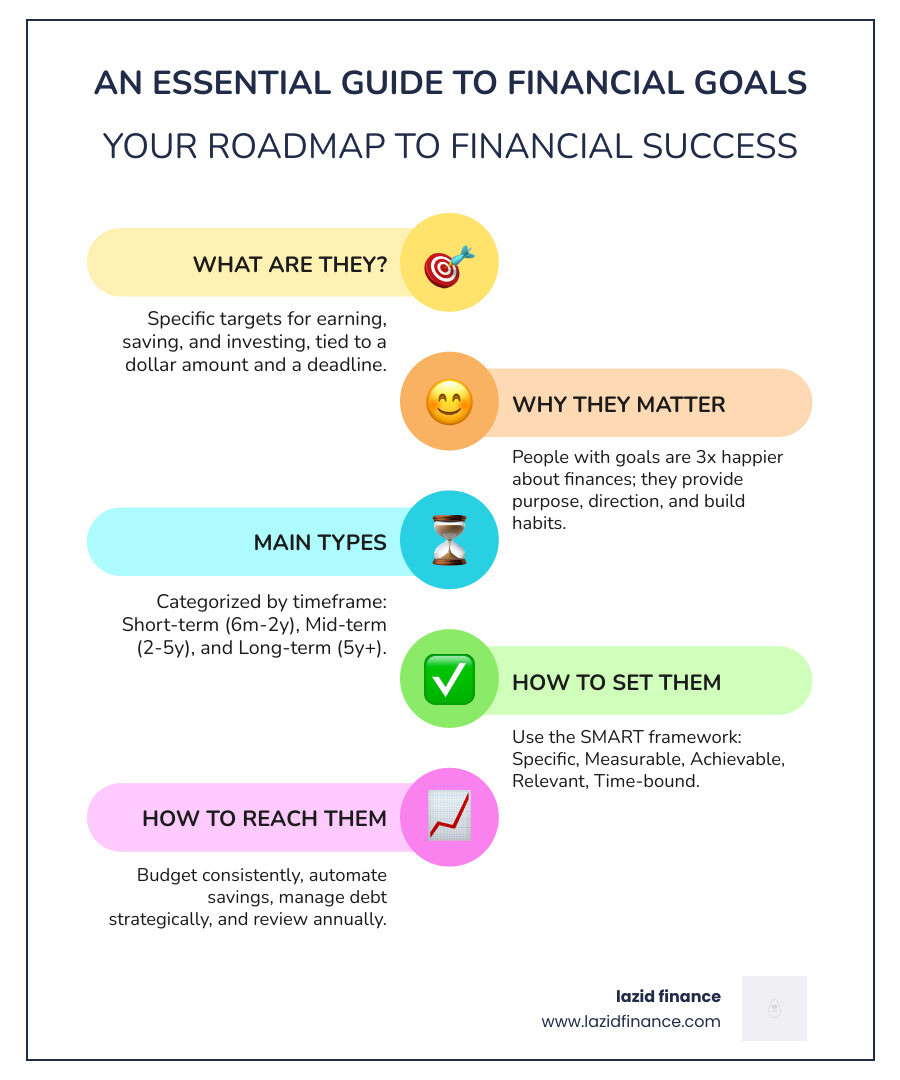
- What they are: Concrete targets tied to a dollar amount and a deadline — like saving $10,000 for a car by next year
- Why they matter: People who set clear financial goals are about three times more likely to feel happy about their financial situation than those who don’t plan ahead
- Three main types:
- Short-term — achievable within 6 months to 2 years (e.g., emergency fund, vacation savings)
- Mid-term — 2 to 5 years away (e.g., home down payment, paying off student loans)
- Long-term — 5+ years out (e.g., retirement, generational wealth)
- How to set them: Use the SMART framework — make goals Specific, Measurable, Achievable, Relevant, and Time-bound
- How to reach them: Budget consistently, automate savings, manage debt strategically, and review your plan at least once a year
Without a clear target, it’s easy to overspend, under-save, and miss out on opportunities that could change your financial future. A goal like “I want to save more” is too vague to act on. But “I will save $500 a month into a high-yield savings account for the next 18 months” — that’s something you can build a plan around.
Think of financial goals as both a to-do list and a long-term strategy. They give your money a purpose, help you build better habits, and keep impulse spending in check.
The good news? You don’t need to be a financial expert to get started. You just need a starting point.
Defining Financial Goals and Their Importance
As we navigate through April 2026, the landscape of personal finance continues to evolve, but the core principle remains the same: clarity is power. We define financial goals as the roadmap for your money. Without them, we are essentially driving without a GPS; we might be moving, but we aren’t necessarily getting anywhere.
Setting these goals provides us with a sense of purpose and direction. When we know exactly what we are working toward, our daily financial health improves because our choices become mindful rather than impulsive. Research has shown that individuals who establish clear objectives are significantly more likely to feel satisfied with their economic status. In fact, people who set clear financial goals are about three times as likely to feel happier about their financial situation than those who do not plan ahead.
Beyond happiness, goals offer us:
- Security: An emergency fund ensures a “spending shock” doesn’t derail our lives.
- Freedom: Knowing we have a plan for retirement or debt payoff allows us to make life choices based on what we want, not just what we can afford.
- Mindful Spending: When we prioritize a down payment on a home, that daily $7 latte suddenly feels less important.
By Mastering Your Financial Goals: Short, Mid, and Long-Term Strategies, we move from reactive spending to proactive wealth building. At Lazid Finance, we believe that every dollar should have a job, and that job is defined by the goals you set today.
Categorizing Goals by Timeframe: Short, Mid, and Long-Term
To make a large dream manageable, we must break it down into time horizons. Not every goal requires the same strategy; saving for a summer trip to Japan requires a different approach than saving for a retirement that is thirty years away.

The standard industry practice is to categorize these into three buckets:
- Short-Term Goals (6 months to 2 years): These are the immediate wins. They focus on liquidity and safety. Typical examples include building an initial emergency fund or saving for a minor home improvement.
- Mid-Term Goals (2 to 5 years): These require more stamina. They often involve larger sums of money, such as a down payment for a home or paying off a significant student loan balance.
- Long-Term Goals (5+ years): These are the “big picture” objectives. Because the timeframe is longer, we can utilize the power of compound interest through investing. Retirement and estate planning fall firmly into this category.
According to the Saving and Setting Financial Goals resources, segmenting goals helps prevent “goal fatigue.” It allows us to celebrate small victories while keeping our eyes on the ultimate prize.
Examples of Common Financial Goals
To give you some inspiration, here are some common milestones we help our community plan for:
Short-Term:
- Emergency Fund: Aim for $2,000 or half a month’s expenses as a “starter” fund, eventually growing to 3–6 months of living expenses.
- Travel Fund: Saving $500 a month for 8 months to fund a dream vacation.
- Credit Score Improvement: Using 30% or less of your total credit limit to boost your score into the 700s.
Mid-Term:
- Wedding Savings: The average ceremony can be costly; saving $1,000 a month over two years can create a $24,000 “I do” fund.
- Car Purchase: Aiming to save 20–30% of the estimated down payment to secure better loan terms.
- Debt Payoff: Allocating 10% of monthly income to whittle away student loans or credit card debt.
Long-Term:
- Homeownership: 74% of Americans prioritize owning a home. Aiming for a 20% down payment eliminates private mortgage insurance (PMI).
- Retirement: A good rule of thumb is to save 15% of your pretax income annually.
- Generational Wealth: Establishing an estate plan or a will to ensure your legacy benefits the next generation.
How to Set SMART Financial Goals
We’ve all made New Year’s resolutions that were forgotten by February. Usually, this happens because the goal was too vague. To ensure your financial goals actually stick, we recommend the SMART framework.

This method, highlighted in How to Set Financial Goals | U.S. Bank, turns a dream into a data-driven mission.
- Specific: Don’t just say “I want to save money.” Say “I want to save for a home down payment.”
- Measurable: Attach a number. “I need $50,000.”
- Achievable: Is it realistic? If you earn $60,000 a year, saving $50,000 in one year might not be possible, but doing it over five years is.
- Relevant: Does this goal align with your values? If you value travel over homeownership, your goals should reflect that.
- Time-bound: Set a deadline. “I will have this money by December 2029.”
Defining Your Financial Goals with the SMART Framework
When we apply this framework, we create an accountability loop. For example, instead of saying “I want to retire comfortably,” a SMART goal would be: “I will contribute 15% of my gross income to my 401(k) to reach a balance of $1 million by age 67.”
This level of detail allows you to track progress monthly. If you fall behind, you don’t abandon the goal; you adjust the habits. Maybe you cut discretionary spending by $200 or find a side hustle to bridge the gap. Writing your goals down makes you 42% more likely to achieve them—so grab a notebook or a digital tool and get specific!
Practical Strategies to Achieve Your Financial Goals
Setting the goal is only half the battle; the other half is the “how.” We need a system that makes success inevitable.
The Foundation: Budgeting and Saving
We recommend starting with the 50/30/20 Rule. This simple strategy suggests:
- 50% of your income goes to Needs (rent, groceries, utilities).
- 30% goes to Wants (dining out, hobbies).
- 20% goes to Savings and Debt Repayment.
One of the most effective strategies is to “pay yourself first.” This means your savings contribution should leave your bank account the moment your paycheck hits. Automating this process removes the temptation to spend that money elsewhere.
Managing Debt
If high-interest debt is holding you back, consider two popular methods:
- Debt Snowball: Pay off the smallest balances first to gain psychological momentum.
- Debt Avalanche: Pay off the debts with the highest interest rates first to save the most money over time. Fidelity recommends targeting any debt with an interest rate over 6% for aggressive payoff.
Investing for Growth
For long-term financial goals, saving in a standard bank account isn’t enough because inflation will eat away at your purchasing power. Investing allows you to benefit from compound interest—earning interest on your interest.
- Short-term investing: For goals 1–3 years away, look for low-risk options like Money Market Funds, Certificates of Deposit (CDs), or Short-Term Bonds. These offer higher returns than a basic savings account but protect your principal.
- Long-term investing: For retirement, stocks generally offer higher return potential, though they come with more volatility.
As we discuss in How to Set Financial Goals for Your Future, your asset allocation should match your risk tolerance. If you need the money in two years, don’t put it all in the stock market!

Conclusion
At Lazid Finance, our mission is to provide you with the intelligent financial tools needed for conscious decisions. Achieving your financial goals isn’t about deprivation; it’s about choosing what you want most over what you want now. By using the SMART framework, automating your savings, and understanding your timeframe, you can build a life of security and freedom.
Ready to take control? Get started with Lazid Finance and turn your aspirations into a reality.
Goal Strategy Comparison Table
| Goal Type | Timeframe | Primary Strategy | Suggested Account |
|---|---|---|---|
| Short-Term | < 2 Years | Saving / Liquidity | High-Yield Savings / Money Market |
| Mid-Term | 2–5 Years | Saving & Low-Risk Investing | CDs / Short-Term Bonds |
| Long-Term | 5+ Years | Diversified Investing | 401(k) / IRA / Brokerage |
How often should I review my financial goals?
We recommend a deep-dive annual check-up at the very least. However, life doesn’t always wait for the calendar. You should revisit your plan whenever a major life event occurs—such as a marriage, a career shift, or the birth of a child. Monthly tracking of your net worth is also a great habit to stay motivated.
What is the best way to handle high-interest debt?
The “best” way depends on your personality. The avalanche method is mathematically superior because it targets high-interest rates (like credit cards with 24% APR). However, the snowball method works wonders for those who need a “win” to stay motivated. Regardless of the method, aim to allocate at least 10% of your monthly income specifically toward debt repayment and keep your credit utilization below 30% to protect your score.
How much should I save for an emergency fund?
The standard advice is to save 3 to 6 months of essential living expenses. If you are self-employed or have an irregular income, we suggest aiming closer to 12 months for extra security. Keep these funds in a dedicated high-yield savings account so they are accessible but separate from your daily spending cash.

