
Ultimate Checklist for Loan Comparison
The Science of Loan Comparison: Beyond the Monthly Payment
Loan comparison is the process of evaluating multiple loan offers side by side to find the one that costs you the least — or fits your budget best.
Here’s a quick summary of what to compare before choosing any loan:
| Factor | Why It Matters |
|---|---|
| APR | Includes interest + fees — the true cost |
| Loan term | Longer terms = lower payments, more interest |
| Origination fees | Can add 1–6% to your total cost |
| Fixed vs. variable rate | Affects payment predictability |
| Total interest paid | The real number that matters most |
| Credit score tier | Determines the rates you qualify for |
Most borrowers focus on the monthly payment. That’s the most expensive mistake you can make.
A lower monthly payment often means a longer loan term — which means you pay far more in total interest. For example, a $10,000 loan at 12% APR costs $1,298 in interest over 2 years. Stretch that to 7 years and the interest balloons to $4,828 — a 272% increase.
The difference between a good loan and a costly one can also come down to your rate. On a $10,000 loan over 3 years, a 12.64% APR costs about $2,067 in total interest. At 35.99% APR? That same loan costs over $6,487 — more than three times as much.
Shopping around matters too. Borrowers who compare multiple loan offers can save an average of $1,659 — and those with fair or good credit who get six or more offers can save up to $3,138.
This guide walks you through every factor that affects the true cost of a loan, so you can make a smarter, more confident borrowing decision.
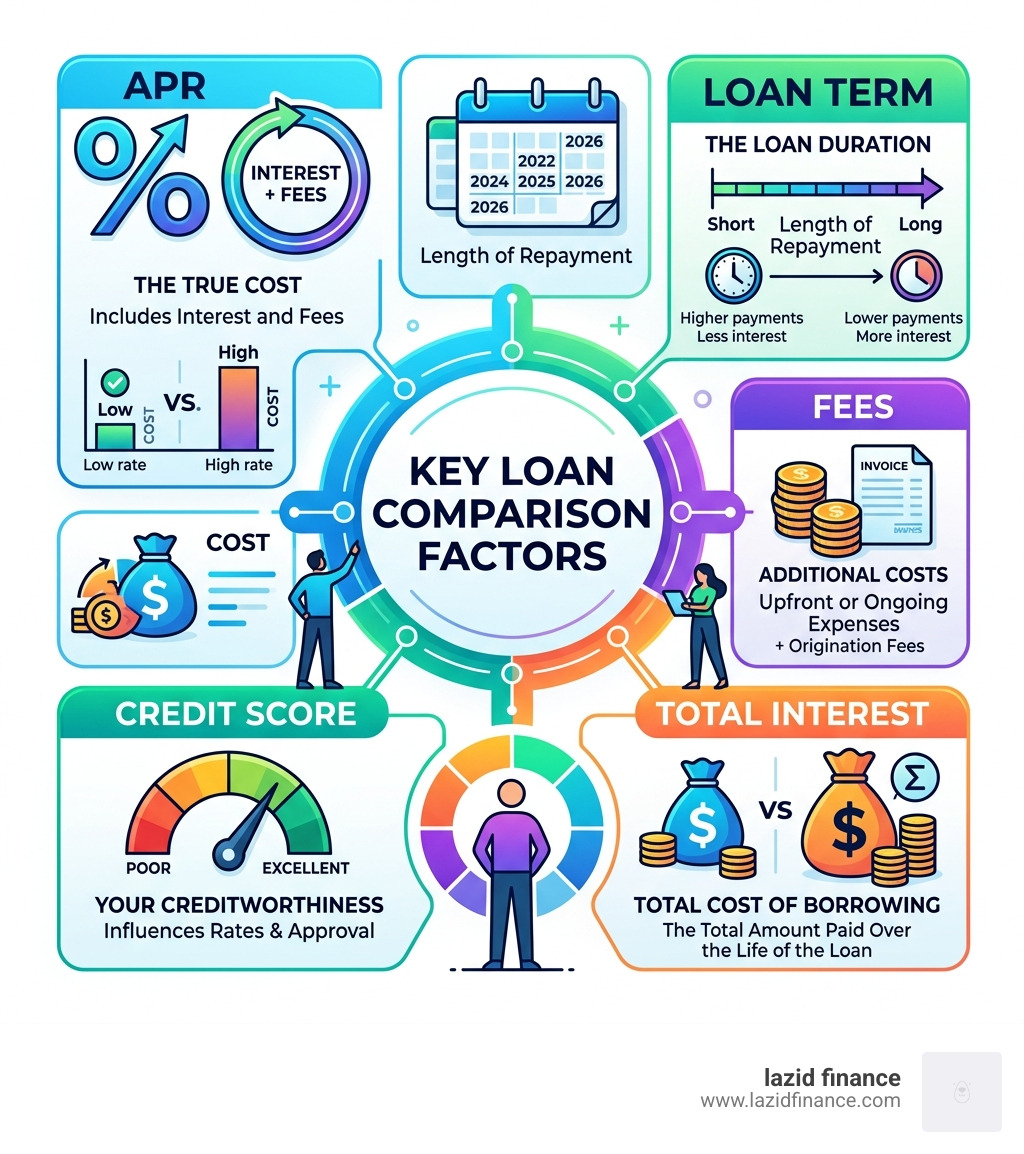
When we talk about the “science” of loan comparison, we are really talking about looking past the marketing fluff. Lenders love to highlight low monthly payments because they look affordable on a refrigerator sticky note. But as we’ve seen, those low payments are often a Trojan horse for decades of interest.
In April 2026, the lending market is more diverse than ever. Whether you are looking for a personal loan for debt consolidation — which accounts for 31.3% of all personal loan requests — or a mortgage for a new home, the principles remain the same. We want to minimize the total amount of money leaving your pocket over the life of the loan.
Statistics show that the average borrower requesting a debt consolidation loan is looking for about $11,829. By using a rigorous loan comparison strategy, that borrower could potentially knock thousands off their total repayment cost just by finding a lender that values their specific credit profile.

Decoding the True Cost: APR vs. Interest Rates
One of the most frequent questions we hear at Lazid Finance is: “What’s the difference between my interest rate and the APR?” It sounds like financial jargon, but understanding this distinction is the “Secret Sauce” of loan comparison.
The interest rate is the percentage a lender charges you for the privilege of borrowing the principal amount. Think of it as the “base price.”
The APR (Annual Percentage Rate), however, is the “all-in” price. It includes the interest rate plus any mandatory fees, such as origination fees, documentation fees, and, in the case of mortgages, closing costs and points.
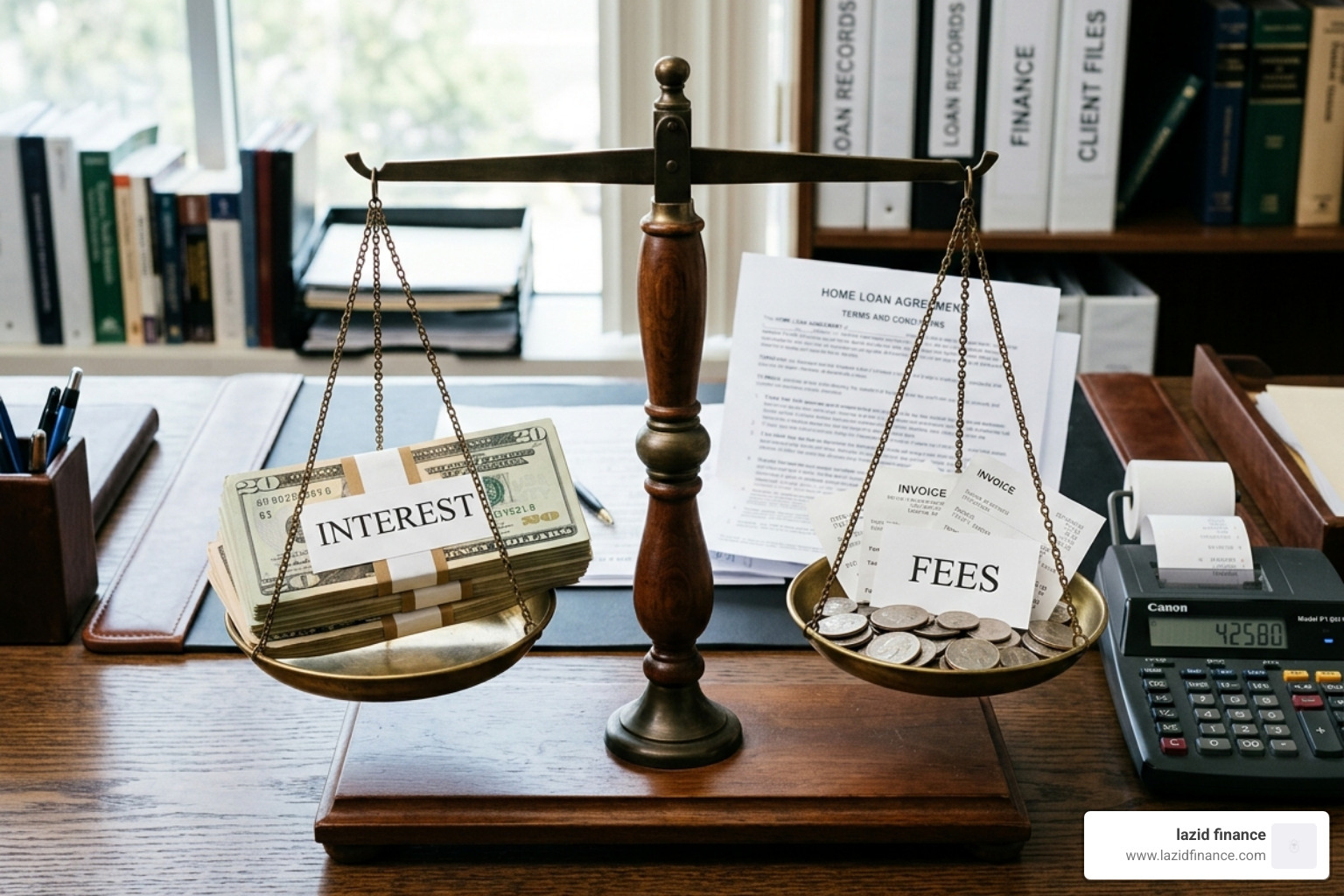
Why does APR matter more? Because a loan with a 6.5% interest rate and $3,000 in fees might actually be more expensive than a loan with a 6.8% interest rate and zero fees. The APR levels the playing field, allowing you to compare two very different fee structures on an apples-to-apples basis.
To see this in action, you can use the Lazid Finance Loan Comparison Tool to plug in different combinations of rates and fees.
Using a Loan Comparison Calculator Step-by-Step
Using a loan comparison calculator isn’t just for math whizzes. It’s a self-help tool designed for independent analysis. Here is how we recommend you use our Interactive Loan Comparison Calculator (2026) to get the most accurate results:
- Gather Your Quotes: Don’t guess. Use actual pre-qualification offers you’ve received from lenders.
- Input the Principal: This is the total amount you want to borrow.
- Enter the APR: Make sure you are using the APR, not just the base interest rate, to ensure fees are included in the calculation.
- Set the Loan Term: Enter the number of years or months you’ll be paying back the loan.
- Compare Side-by-Side: Most modern calculators allow you to view two or three loans at once. Look at the “Total Interest Paid” column first. This is the “cost of admission” for the loan.
- Analyze the Monthly Payment: Ensure the payment fits comfortably within your monthly cash flow without sacrificing your emergency savings.
By changing just one variable at a time — like the term length — you can see exactly how much that “extra year” of lower payments is actually costing you in the long run.
Factoring in Origination Fees and Closing Costs
We need to talk about the “hidden” costs that often get buried in the fine print. Origination fees are administrative costs charged by the lender for processing your application. These typically range from 1% to 6% of the loan amount.
Here is the kicker: origination fees are often deducted from the loan proceeds before you ever see the money. If you take out a $20,000 loan with a 10% origination fee, you’ll only receive $18,000 in your bank account, but you’ll still owe interest on the full $20,000.
When performing your loan comparison, always check if the fee is “out of pocket” or “deducted from proceeds.” If it’s deducted, you may need to borrow a slightly larger amount to ensure you have enough cash for your intended purpose (like paying off high-interest credit cards).
For a deeper dive into these pesky charges, check out our guide on Calculating Total Loan Costs.
How Loan Terms and Credit Scores Impact Your Wallet
The length of your loan (the term) is perhaps the most powerful lever you can pull to change the cost of your debt. In general, the shorter the term, the less you pay in interest, but the higher your monthly payment will be.
Let’s look at a $300,000 mortgage at 7% interest. The difference between a 15-year and a 30-year term is staggering:
| Loan Term | Monthly Payment | Total Interest Paid |
|---|---|---|
| 15 Years | ~$2,696 | ~$185,000 |
| 30 Years | ~$1,996 | ~$419,000 |
By choosing the 15-year term, you save $234,000 in interest. That’s enough to buy a small fleet of cars or fund a very comfortable retirement.
The same logic applies to personal loans. A $10,000 loan at 12% APR shows a massive jump in cost as you extend the term:
| Term Length | Total Interest Cost | % Increase vs 2-Year |
|---|---|---|
| 2 Years | $1,298 | – |
| 3 Years | $1,957 | 50% |
| 5 Years | $3,346 | 158% |
| 7 Years | $4,828 | 272% |
Our advice? Always choose the shortest repayment term you can comfortably afford.
Impact of Credit Scores on 2026 Loan Comparison
Your credit score is essentially your “financial GPA,” and in 2026, lenders are using it more strictly than ever. Your score determines which “credit tier” you fall into, which in turn dictates your APR.
Based on current 2026 data, here is how APRs typically break down by credit tier for a $5,000 personal loan over 48 months:
- Excellent Credit (800+): 15.75% APR (Total cost: $6,771)
- Very Good Credit (740-799): 17.89% APR
- Good Credit (670-739): 23.27% APR
- Fair Credit (580-669): 27.79% APR
- Poor Credit (Under 580): 30.25% APR (Total cost: $8,676)
The difference between “Excellent” and “Poor” credit on this small loan is $1,905. If you find yourself in the lower tiers, it is often wiser to spend six months improving your score — by paying down credit card balances and ensuring every payment is on time — before you start your loan comparison journey.
One important tip: when you are ready to shop, do it all at once. Most credit scoring models (like FICO) treat multiple inquiries for the same type of loan as a single inquiry if they happen within a 14-to-45-day window. This allows you to “rate shop” without tanking your score.
Choosing Your Structure: Fixed vs. Variable Rates
When you’re comparing loans, you’ll likely encounter the choice between a fixed-rate and a variable-rate (adjustable) loan.
Fixed-rate loans are the “safe bet.” Your interest rate stays exactly the same for the entire life of the loan. This provides total predictability; you’ll know exactly what your 120th payment will be before you even sign the first one. We usually recommend fixed rates for long-term debt like mortgages or 5-year personal loans.
Variable-rate loans (often tied to an index like SOFR) usually start with a lower interest rate than fixed loans. However, that rate can fluctuate based on market conditions.
- The Pro: If market rates go down, your payment might drop.
- The Con: If rates rise, your monthly payment could skyrocket.
Variable loans usually come with “caps” that limit how much the rate can rise in a year or over the life of the loan. While they can save you money if you plan to pay the loan off very quickly (within a year or two), they carry significant risk if the economy gets bumpy.
Smart Shopping Strategies for 2026 Borrowers
At Lazid Finance, we believe in being “conscious borrowers.” That means having a plan before you ever click “Apply.”
First, aim for pre-approval. Many online lenders now offer a “soft credit inquiry” that allows you to see your potential rates and terms without affecting your credit score. This is the gold standard for loan comparison. Only when you formally accept an offer will the lender perform a “hard inquiry.”
Second, watch your Debt-to-Income (DTI) ratio. According to the Consumer Financial Protection Bureau, lenders look at how much of your monthly income goes toward debt payments. If your DTI is over 43%, you might find it harder to get approved for the best rates, regardless of how high your credit score is.
To help keep your offers organized, we recommend using our Lazid Finance Comparison Dashboard. It’s a great way to keep track of multiple quotes in one secure place.
Common Mistakes in Loan Comparison
Even the most careful borrowers can trip up. Here are the most common pitfalls we see:
- The Monthly Payment Trap: As we’ve hammered home, focusing only on the monthly payment is a recipe for overpaying. Always look at the “Total Cost of Borrowing.”
- Ignoring Prepayment Penalties: Some lenders charge you a fee if you pay your loan off early. If you plan to use a tax refund or a bonus to crush your debt, make sure your loan doesn’t punish you for it. A 2-3% penalty on a $100,000 loan can cost you $2,000 to $3,000.
- Falling for “Interest-Free” Furniture Loans: Read the fine print! These “0% interest for 60 months” deals often include retroactive interest. If you miss the final payment by even one day, the lender might charge you the full 29.9% interest from the very first day you bought that sofa.
- Not Comparing Enough Lenders: Don’t just go to your local bank. Check credit unions (which are nonprofits and often have lower rates) and reputable online fintech lenders, which now account for nearly 50% of unsecured personal loans in the U.S.
Frequently Asked Questions about Loan Comparison
Why is APR more important than the interest rate?
The interest rate only tells you the cost of the principal. The APR includes the interest rate plus fees like origination charges and closing costs. Comparing APRs ensures you are seeing the true yearly cost of the loan, preventing lenders from “hiding” the cost of a loan in high upfront fees.
When does it make financial sense to refinance a loan?
Refinancing generally makes sense if you can lower your interest rate by at least 0.5% to 1.0%. However, you also need to consider the “break-even point.” If it costs you $2,000 in fees to refinance your mortgage, but you only save $50 a month, it will take you 40 months just to break even. If you plan to move in two years, refinancing would actually lose you money.
Should I choose a lower monthly payment or a lower total cost?
This depends entirely on your cash flow. If your budget is extremely tight and a high payment puts you at risk of defaulting, choose the lower monthly payment (longer term) to preserve your financial stability. However, if you have extra room in your budget, always choose the lower total cost (shorter term). It is the fastest way to build wealth.
Conclusion
At Lazid Finance, our mission is to provide you with the intelligent financial tools you need to make conscious decisions. Borrowing money shouldn’t feel like a gamble; it should be a calculated step toward your goals, whether that’s owning a home, starting a business, or finally becoming debt-free.
By mastering the art of loan comparison, you take the power back from the lenders. You stop being a “monthly payment” and start being a savvy consumer who understands APRs, term lengths, and the true cost of credit.
Ready to see how much you could save? Start your journey with Lazid Finance today and use our suite of tools to find the mindful borrowing choice that’s right for you. Remember: the best loan isn’t just the one you get approved for — it’s the one that costs you the least in the long run. Happy shopping!

