
How to Track Savings Progress with Quick Changes
Why a Savings Tracker Is the Fastest Way to Hit Your Financial Goals
A savings tracker is a tool — app, spreadsheet, or printable — that helps you record, visualize, and hit your savings goals faster. Here’s a quick overview of what you need to know:
- What it does: Records money saved over time toward a specific goal (vacation, emergency fund, down payment)
- Types available: Mobile apps, bank-built tools, Excel/Google Sheets templates, printable charts
- Best for: Anyone who wants to stop guessing and start seeing real progress
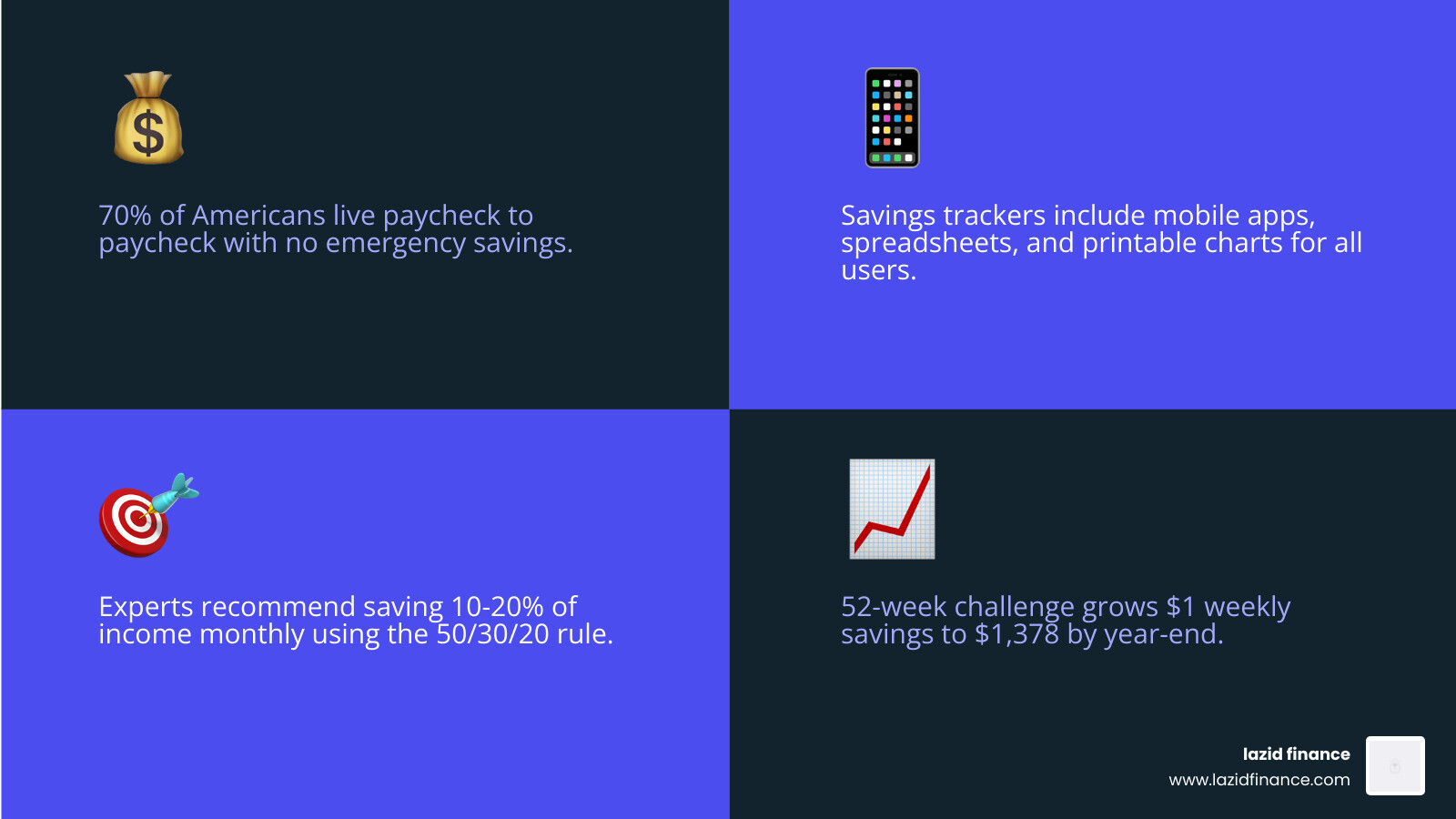
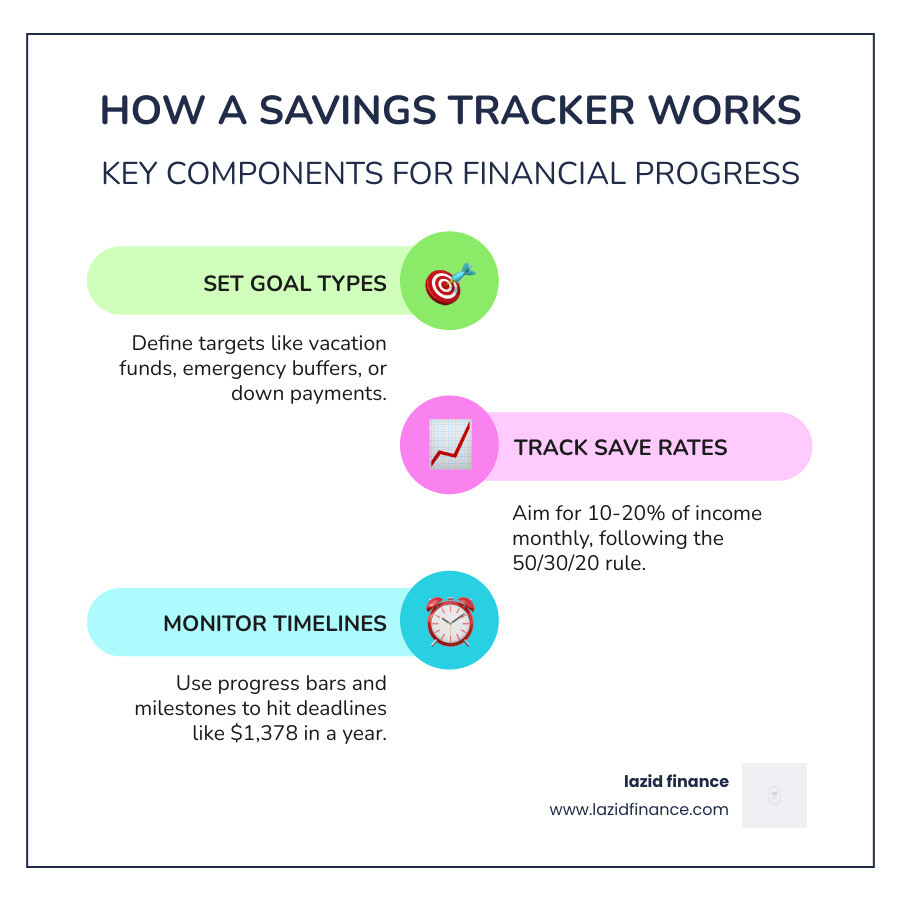
- How much to save: Financial experts recommend 10–20% of your income each month (the 50/30/20 rule suggests 20%)
- Quick win: Even saving $1 a week and increasing it weekly can add up to $1,378 in a single year (the 52-week challenge)
The hard truth? Around 70% of Americans live paycheck to paycheck, with no savings cushion for emergencies. That’s not a lack of income — it’s often a lack of visibility. When you can see your money moving toward a goal, you make better decisions about where it goes.
Whether you want to track a vacation fund, build a $1,000 emergency buffer, or save for a house, a savings tracker turns a vague wish into a concrete plan with real numbers and real deadlines.
The Psychology of Financial Success in 2026
As we navigate through April 2026, the financial landscape has changed, but the human brain hasn’t. We still struggle with “present bias”—the tendency to want that $7 latte today rather than $70,000 in a retirement account thirty years from now. This is exactly why 70% of Americans continue to live paycheck to paycheck. Without a savings tracker, our brains view “savings” as a loss of current fun rather than a gain of future freedom.

Financial anxiety often stems from the unknown. We wonder: Do I have enough for the rent? Can I afford that weekend trip? By implementing the 50/30/20 budget rule, we take the guesswork out of the equation. This rule suggests allocating 50% of your income to needs, 30% to wants, and 20% to savings and debt repayment.
The first milestone in any successful tracker is the emergency fund. Experts suggest a “Starter Fund” of $1,000 to $3,000 to handle immediate shocks, eventually scaling up to cover 3–6 months of living expenses. When you see that progress bar move from 10% to 50% on your dashboard, your brain releases dopamine. You aren’t just “not spending money”; you are winning a game.
Choosing the Right Savings Tracker for Your Lifestyle
Not all trackers are created equal, and the “best” one is simply the one you will actually use. At Lazid Finance, we believe in smart solutions tailored for mindful choices, so let’s look at the options available in 2026.

Digital Apps and 3D Visualizations
For those who live on their phones, digital apps offer high-tech motivation. Some popular apps, like Loot, use 3D money jar visualizations that fill up as you add funds. Others provide “thermometer” styles that change color as you approach your goal. The primary benefit here is automation—many apps can link to your bank account to track every penny in real-time.
Customizable Printable Trackers
Sometimes, the tactile feel of a pen on paper is what makes a goal feel “real.” Printable trackers are incredibly popular on platforms like Pinterest because they allow for total creative freedom. You can color in a “savings jar” or a “house” icon every time you save $50. This manual interaction creates a “friction” that forces you to acknowledge your progress.
Excel and Google Sheets
If you love data, a spreadsheet is your best friend. You can factor in complex variables like the Annual Percentage Yield (APY) and compounding frequency. Using a savings goal calculator alongside your spreadsheet allows you to predict exactly when you’ll hit your target based on different interest rate scenarios.
Data Privacy Considerations
In 2026, we must be mindful of our digital footprint. Some web-based tools now offer “privacy by design,” meaning they run entirely in your browser without requiring a login or storing your data on a server. If you are wary of sharing your banking credentials, a manual digital tracker or a printable is a safer bet.
Step-by-Step: Setting Up Your System for Maximum Growth
Setting up a savings tracker isn’t just about picking a tool; it’s about building a workflow that guarantees success.
- Identify Your Starting Point: What is your initial investment? Even if it’s $0, you need to log it.
- Pick Your Frequency: Will you save daily, weekly, or every payday? Matching your savings to your income cycle is the most effective way to stay consistent.
- Account for Interest: If you’re using a high-yield savings account (HYSA) with a 4-5% APY, your money works for you. Use a savings goal calculator to see how much interest will shorten your timeline.
- Add a “Boost” Strategy: Plan for one-time windfalls like tax refunds or selling old clothes.
| Feature | Manual/Printable Tracker | Automated Digital App |
|---|---|---|
| Ease of Use | Requires manual entry | Set it and forget it |
| Motivation | High (visual/creative) | Moderate (notifications) |
| Accuracy | Prone to human error | Highly precise |
| Privacy | Maximum | Variable |
| Cost | Usually free | May have subscriptions |
Defining SMART Goals in Your Savings Tracker
Vague goals like “save more” are where dreams go to die. To succeed, your goals must be:
- Specific: “Hawaii Vacation 2027” instead of “Travel.”
- Measurable: “$5,000” instead of “a lot.”
- Achievable: Based on your actual income.
- Relevant: Does this goal actually improve your life?
- Time-bound: “By June 1st.”
Using a savings goal app can help you calculate the exact daily or weekly contribution needed to hit these SMART targets.
Monitoring Progress and Celebrating Milestones
We recommend a weekly check-in. This isn’t just to log numbers; it’s to adjust for life. If you had a car repair this week and couldn’t save, don’t quit. Simply update your “Current Saved” amount, and let your savings tracker re-calculate your new finish date.
Celebrate at 25%, 50%, and 75%. These don’t have to be expensive celebrations—maybe a movie night or a special meal at home. The goal is to reinforce the habit.
Gamifying Your Finances with Popular Savings Challenges
Who says saving has to be boring? Gamification is a powerful tool to trick your brain into enjoying the process of building wealth.
- The 52-Week Challenge: You start by saving $1 in Week 1, $2 in Week 2, and so on. By Week 52, you’re saving $52 that week, and your total savings tracker will show a balance of $1,378!
- The 100-Envelope Method: Label 100 envelopes from $1 to $100. Each week, pick two and put the corresponding amount of cash inside. By the end, you’ve saved $5,050.
- The No-Spend Month: Commit to only spending on essentials (rent, groceries, utilities) for 30 days. Sweep everything left over into your goal.
- Micro-Savings and Round-Ups: Many modern trackers allow for “round-ups.” If you buy a coffee for $3.45, the tracker rounds it to $4.00 and puts the $0.55 into your savings. It sounds small, but 2–3 swipes a day can result in $30 a month without you ever feeling the pinch.
Pro-Tip: Conduct a subscription audit. Research shows 89% of Americans underestimate their subscription spending, often by over $200 a month. Use your tracker to log what you save by canceling just one unused streaming service.
Frequently Asked Questions about Savings Tracking
How much should I save each month?
While the 10–20% rule is a great benchmark, it depends on your life stage. A young professional might aim for 20% to take advantage of compound interest, while someone with a high mortgage might start at 5–10%. The key is to start. Even $20 a paycheck is better than $0.
Can savings trackers help with shared goals?
Absolutely! In 2026, many apps offer shared dashboards. Couples can track a down payment for a house together, or roommates can track a shared “furniture fund.” This creates transparency and keeps everyone accountable. Just remember that in joint accounts, some bank-integrated trackers only show goals to the person who created them, so check the settings!
What are the best ways to automate my savings?
Automation is the “secret sauce” of wealth.
- Pay Yourself First: Set up a recurring transfer from your checking to your savings for the day after your paycheck hits.
- Smart-Save AI: Some trackers analyze your spending and move small amounts of “safe-to-save” money automatically.
- Naming Your Buckets: Don’t just have a “Savings Account.” Name it “New Car Fund” or “Emergency Safety Net.” This psychological trick makes you less likely to “rob” the account for a non-essential purchase.
Conclusion
At Lazid Finance, we know that financial freedom isn’t about how much you make; it’s about how much you keep and how mindfully you manage it. A savings tracker is more than just a list of numbers—it’s a roadmap to the life you want to live. By choosing the right tool, setting SMART goals, and gamifying the process, you turn the “chore” of saving into a rewarding journey.
Don’t let another paycheck slip through your fingers. Whether you use a high-tech AI app or a simple printable jar, the best time to start tracking is today.
Start making smarter financial choices today

