
Sprint to Success with a 3 Month Financial Goal
What Is a 3 Month Financial Goal (And Why It Works)
A 3 month financial goal is a specific, time-bound money target you set out to achieve within 90 days — think saving $1,000 for emergencies, paying off a credit card, or cutting $300 from your monthly spending.
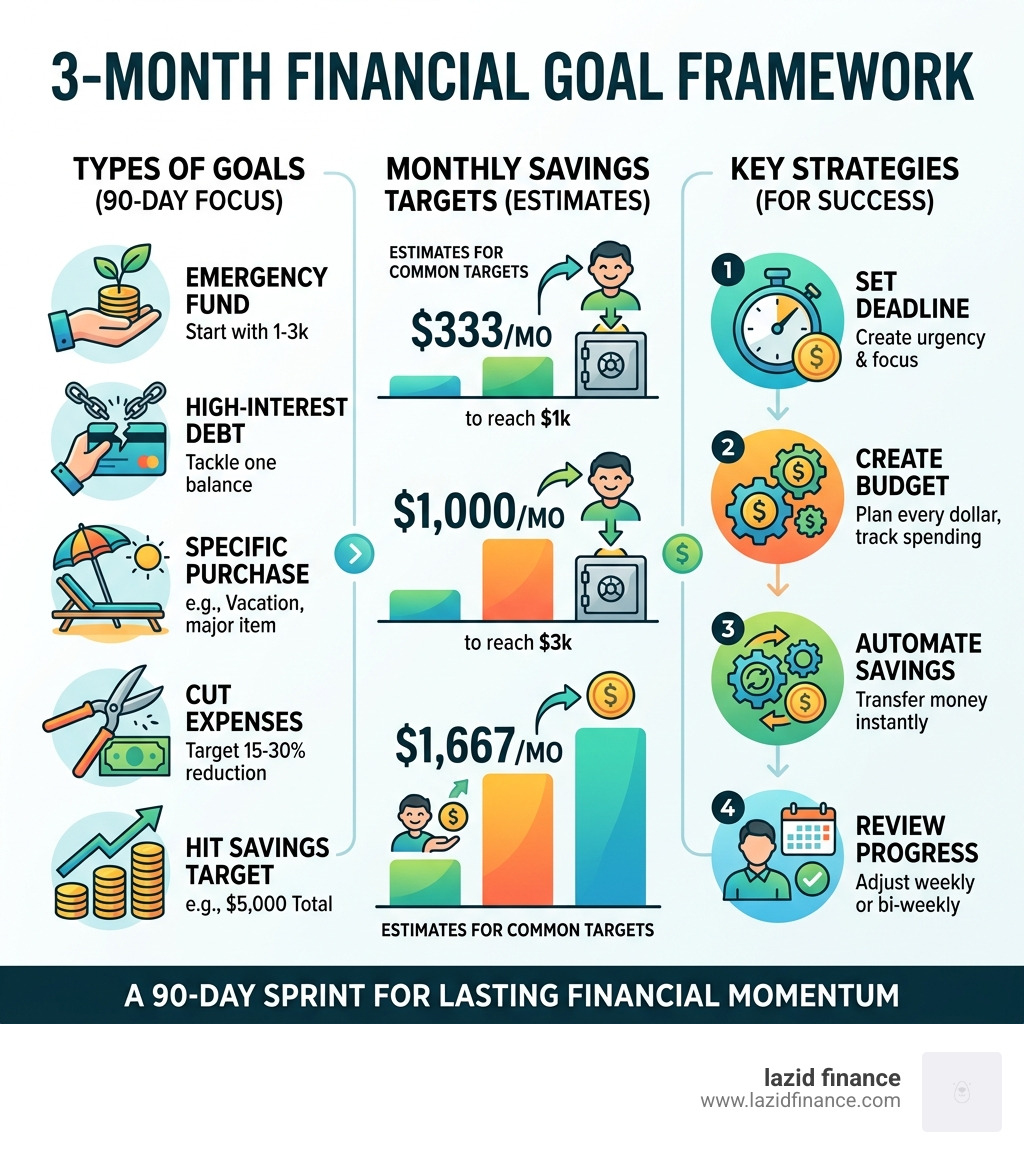
Here are the most common 3-month financial goals people set:
- Build a starter emergency fund — save $1,000 to $3,000 as a financial safety net
- Pay off high-interest debt — tackle one credit card or loan balance
- Save for a specific purchase — vacation, appliance, or down payment contribution
- Cut monthly expenses — reduce spending by 15–30% through a focused budget sprint
- Hit a savings target — such as $5,000, which requires saving roughly $1,667/month or $417/week
Three months is just long enough to build real momentum, but short enough to stay focused. That’s what makes the 90-day window so powerful.
Research in behavioral economics backs this up. Studies on habit formation suggest it takes roughly 66 to 90 days of repeated behavior before a new habit becomes automatic — meaning a 3-month sprint isn’t just a financial strategy, it’s a brain-rewiring exercise.
And unlike vague goals like “save more money,” a 3-month target gives you a clear deadline. That deadline creates urgency. Urgency drives action.
Whether you’re starting from zero or trying to break a cycle of living paycheck to paycheck, a focused 3-month plan can shift your financial trajectory faster than you’d expect.
Why a 3 Month Financial Goal is Your Secret Weapon
In personal finance, we often talk about decades — saving for retirement in 30 years or paying off a mortgage in 15. While long-term vision is essential, the human brain isn’t naturally wired to stay motivated by rewards that are decades away. This is where the 3 month financial goal becomes your secret weapon.
As of April 2026, the economic landscape remains dynamic. Relying on a “yearly resolution” often leads to disappointment because life changes too quickly. A 90-day sprint, however, allows us to adapt to current inflation rates and income shifts in real-time. By focusing on a shorter horizon, we reduce the “procrastination gap” and turn financial planning into a series of achievable wins.
The Psychology of a 90-Day Sprint
Why 90 days? It’s the “Goldilocks” zone of productivity. According to neuroscience, your brain experiences a significant identity shift when you commit to a time-bound challenge. When you see your bank balance grow or your debt shrink every single week, your brain releases dopamine. This creates a positive feedback loop that makes you want to keep going.
Research into neuroplasticity shows that your brain physically rewires itself when you practice new behaviors consistently. Most experts agree that while a habit might start to form in 21 days, it takes about 66 to 90 days for that behavior to become your “new normal.” By the end of your 3 month financial goal, you won’t just have more money; you’ll have a different relationship with spending. You can learn more about this transformation in this video on how You Can Change Your Finances in 3 Months.
How a 3 Month Financial Goal Fits Your Long-Term Vision
Think of your 3-month goals as the individual bricks that build your financial fortress. You can’t reach a mid-term goal (like buying a car in 3 years) or a long-term goal (like retirement) without mastering these short-term milestones first.
As noted by Vanguard, short-term goals range from a few months to three years. By breaking a large, intimidating objective into 90-day segments, you create a clear financial trajectory. If your long-term dream is to build significant wealth, these sprints ensure you have the liquidity and the discipline to handle larger investments later.
Top Examples of 3-Month Financial Milestones
Setting a goal is easy; setting the right goal is where the magic happens. Depending on where you are in your journey, your 3 month financial goal might look very different from your neighbor’s.

Building a Starter Emergency Fund
If you don’t have a safety net, this should be your absolute priority. An emergency fund provides peace of mind and prevents you from sliding back into debt when the car breaks down or the fridge stops cooling.
While a full emergency fund should eventually cover 3 to 6 months of living expenses, a 90-day sprint is perfect for building a “starter” fund of $1,000 to $3,000. To do this quickly, focus only on your essential expenses — housing, utilities, and basic groceries — and funnel everything else into savings. For a deeper dive into accelerating this process, check out this 2026 Guide to Building an Emergency Fund Fast.
Crushing Debt with a 3 Month Financial Goal
High-interest debt is a wealth-killer. With credit card APRs often hovering above 20%, every day you carry a balance, you are losing money to interest. A 90-day debt sprint can involve:
- The Debt Snowball: Paying off your smallest balance first to gain psychological momentum.
- The Debt Avalanche: Focusing on the debt with the highest interest rate to save the most money over time.
According to SoFi, focusing on debt as a short-term goal is one of the most effective ways to free up cash flow for future investing. Even if you can’t pay off the entire balance in three months, the progress you make will significantly reduce the interest you pay in the long run.
Target Savings for Different Income Levels
| Monthly Income | 3-Month Goal Total | Weekly Savings Needed | Monthly Savings Needed |
|---|---|---|---|
| $3,000 | $1,500 | $125 | $500 |
| $5,000 | $3,000 | $250 | $1,000 |
| $8,000 | $5,000 | $417 | $1,667 |
Step-by-Step Strategy to Hit Your 90-Day Target
To succeed, you need more than just a wish; you need a framework. At Lazid Finance, we believe in using the SMART criteria:
- Specific: “Save $2,000” instead of “Save more.”
- Measurable: You can track every dollar in an app or spreadsheet.
- Achievable: It should be a stretch, but not impossible based on your income.
- Relevant: Does this goal actually improve your life right now?
- Time-bound: You have exactly 90 days.

Calculating Your Weekly and Monthly Savings
Let’s look at a popular ambitious target: saving $5,000 in 3 months. To hit this, the math is simple but demanding:
- Monthly: $1,666.67
- Bi-weekly: $833.33
- Weekly: $416.67
Using a savings goal calculator can help you factor in any initial investment you already have. For example, if you start with $500 already in the bank, your weekly requirement drops to about $375. Every little bit counts!
Rapid Expense Cutting and Income Boosting
If your current budget doesn’t have an extra $417 a week lying around, you have two levers to pull: spend less or earn more.
The Expense Audit:
- Subscriptions: Cancel any service you haven’t used in the last 30 days. The average person spends over $200 a month on subscriptions — cutting these can give you an immediate boost.
- Negotiation: Call your internet or insurance provider. In 2026, loyalty rarely pays; asking for a better rate or a “new customer” promotion can save $50–$100 monthly.
- The “One Thing” Rule: Pick one discretionary category (like dining out or impulse Amazon buys) and freeze it for the 90 days.
The Income Boost:
- Selling Items: Declutter your home. Selling old electronics, clothes, or furniture on online marketplaces can easily net you $500–$1,000 in a single weekend.
- Gig Economy: Ridesharing, freelance writing, or virtual assistance can bridge the gap between your current savings and your goal.
- The 15-40% Rule: Aim to increase your total income by 15-40% during the sprint to make the savings feel less like a sacrifice and more like a victory.
Tools and Challenges to Stay Motivated
Motivation is what gets you started; systems are what keep you going. Gamifying your 3 month financial goal can make the process feel less like a chore and more like a challenge.
The 100 Envelope Challenge
This is a classic for a reason. By labeling 100 envelopes with numbers 1 through 100 and filling one each day (or a few each week) with that dollar amount, you end up with exactly $5,050. Over 90 days, you’d need to fill about 1.1 envelopes per day. It’s a visual, tactile way to see your progress.
Maximizing Returns on Short-Term Savings
Don’t let your hard-earned money sit in a standard checking account earning 0.01% interest. For a 3-month goal, liquidity is key, but you should still make your money work for you.
- High-Yield Savings Accounts (HYSA): These are FDIC-insured and currently offer much higher rates than traditional banks.
- Certificates of Deposit (CDs): If you know for a fact you won’t need the money for exactly 3 months, a short-term CD can lock in a high rate.
- Money Market Accounts: These offer a blend of high interest and check-writing capabilities.
According to U.S. Bank, automating these transfers is the single most effective way to ensure success. If the money leaves your paycheck before you see it, you won’t miss it.
Tracking Progress and Avoiding Pitfalls
We recommend a weekly “Money Date.” Spend 15 minutes every Sunday reviewing your transactions.
- Avoid the “All or Nothing” Trap: If you have an unexpected car repair and miss your savings target one week, don’t give up. Adjust your goal for the remaining weeks and keep moving.
- Watch for Impulse Buys: Marketing is designed to break your discipline. Remind yourself of your “why” every time you’re tempted to spend.
At Lazid Finance, we are committed to helping you make these mindful choices. You can learn more about our mission and how we support your financial journey.
Frequently Asked Questions about 3-Month Goals
Is it realistic to save $5,000 in just 3 months?
Yes, but it requires a combination of aggressive expense cutting and income boosting. For someone earning a median income, saving $1,667 a month usually requires picking up a side hustle or selling unused assets. However, for many, the “found money” from canceling unused subscriptions and meal planning covers a significant portion of this target.
Where should I keep my short-term savings for maximum growth?
For a 3 month financial goal, the best place is a High-Yield Savings Account (HYSA). You want your money to be “liquid” (easily accessible) while still earning a competitive interest rate. Avoid putting short-term savings into the stock market, as a sudden market dip could leave you with less than you started with right when you need to hit your goal.
What are the most common mistakes to avoid during a 90-day sprint?
The biggest mistake is not tracking progress. If you don’t know where your money is going, you can’t redirect it toward your goal. Other common pitfalls include setting an unrealistic budget that leads to burnout and failing to automate savings. Willpower is a finite resource; automation is infinite.
Conclusion
A 3 month financial goal is more than just a number on a screen; it’s a 90-day transformation of your habits, your mindset, and your future. By narrowing your focus to a single season, you can achieve milestones that previously felt out of reach.
At Lazid Finance, we provide the intelligent tools you need to make these conscious, mindful decisions. Whether you are building an emergency fund, crushing debt, or saving for a dream vacation, the 90-day sprint is your fastest path to success.
Ready to take the first step? Start your 3-month challenge today and see how much your life can change in just 90 days.

