
Mastering Financial Goals for Students Before Graduation
Why Financial Goals for Students Matter More Than You Think
Financial goals for students are specific money targets you set to guide your spending, saving, and borrowing decisions while in school and beyond.
Here are the most important financial goals to focus on as a student:
- Build an emergency fund – Start with $500-$1,000 to cover surprise expenses
- Create and stick to a budget – Track every dollar coming in and going out
- Minimize student loan debt – Apply for scholarships and grants before borrowing
- Save consistently – Even $25-$50 per month builds powerful long-term habits
- Start building credit – Use a credit card responsibly and pay it off monthly
- Set a mid-term goal – Save for a car, relocation costs, or study abroad
- Think long-term – Open a Roth IRA early and let compound interest work for you
Most students don’t think about money until it becomes a problem. A loan email lands in your inbox. An unexpected car repair wipes out your account. Suddenly, finances feel overwhelming.
But here’s the thing: you don’t need a high income to take control of your money. You just need a plan.
Research backs this up. Students who set clear financial goals graduate with 20-30% less debt on average. Those with strong financial literacy are 72% more likely to save and 50% more likely to comparison shop before spending.
The habits you build now — even small ones — compound over time, just like interest does.
This guide walks you through exactly how to set, categorize, and achieve financial goals at every stage of your student life.
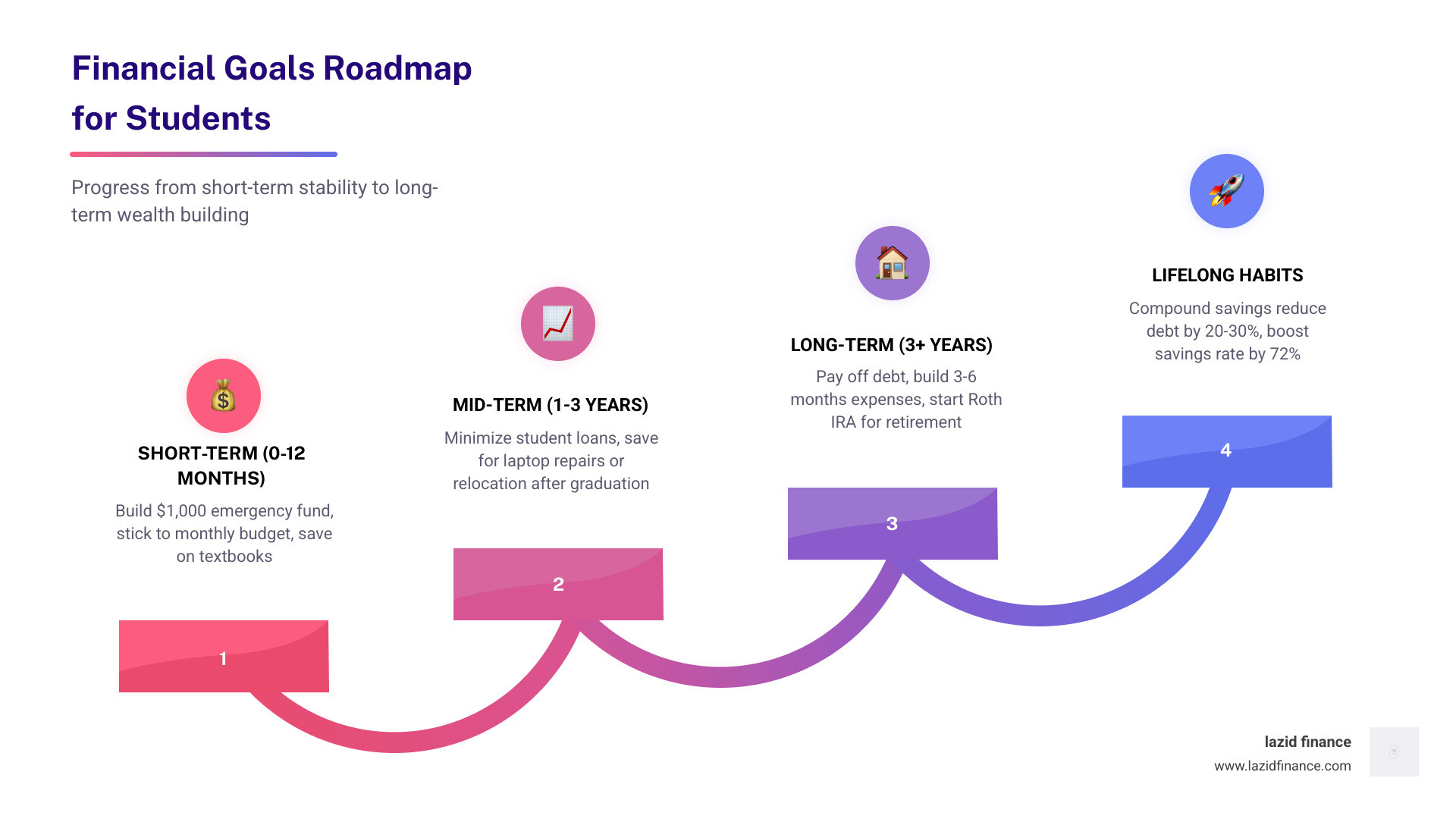
Why Setting Financial Goals for Students is Essential
Setting financial goals for students isn’t just about having a bigger number in your bank account; it’s about survival and empowerment. In the current economic landscape of April 2026, the cost of living and education remains a primary concern. Without a roadmap, it is incredibly easy to drift into high-interest debt that can take decades to erase.
Debt Reduction and Future Security
The most immediate benefit of goal setting is debt mitigation. According to financial literacy studies, students who actively set financial targets graduate with significantly less debt. By focusing on goals like “paying interest while in school” or “securing one external scholarship per semester,” you aren’t just saving money; you are buying your future freedom.
Boosting Financial Literacy
Setting goals forces us to learn how money works. When we decide to save for a laptop, we naturally start looking into interest rates, high-yield savings accounts, and the difference between “needs” and “wants.” This literacy is a superpower. Students with these skills are 72% more likely to save money consistently and 50% more likely to comparison shop, ensuring they get the best value for every dollar spent.
Stress Management
Let’s be honest: money is a top stressor for students. That “horror-movie jump scare” feeling of checking your bank balance after a weekend out is real. Having a plan replaces that anxiety with a sense of control. When you have an objective, every financial decision becomes a choice rather than a guess. You aren’t just “not spending money”; you are “funding your relocation” or “protecting your emergency buffer.”
Categorizing Your Financial Objectives: Short, Mid, and Long-Term
To make progress, we need to break our big dreams into digestible bites. We categorize goals by their time horizons to help us prioritize where our next dollar should go. The art of financial goal setting in college involves balancing your current needs with your future aspirations.
| Goal Type | Timeline | Typical Examples for Students |
|---|---|---|
| Short-Term | 0–12 Months | Emergency fund, textbooks, spring break trip, new laptop |
| Mid-Term | 1–5 Years | Car down payment, relocation for first job, paying off a specific loan |
| Long-Term | 5+ Years | Home down payment, retirement (Roth IRA), starting a business |
Short-Term Financial Goals for Students (0-12 Months)
These are your “quick wins” that build momentum. The most critical short-term goal is the Rainy Day Fund. While experts often suggest 3–6 months of living expenses for working professionals, we recommend students start with a $500 to $1,000 buffer.
Why? Because life happens. Laptops break during finals week. Cars need unexpected repairs. A $1,000 emergency fund prevents these hiccups from turning into high-interest credit card debt. Other short-term goals include saving for next semester’s textbooks or mastering a monthly budget where you track every “sneaky” expense, like those daily $6 lattes that can eat up 15% of a part-time income.

Mid-Term and Long-Term Financial Goals for Students
Mid-term goals act as a bridge between your student life and your professional career. A major mid-term goal for many is the “Relocation Fund.” Moving for a summer internship or your first post-grad job is expensive. Between moving trucks, security deposits, and first month’s rent, you might need $3,000 or more. Saving $125 a month over two years makes this milestone achievable rather than stressful.
Long-term goals might feel distant, but April 2026 is the perfect time to start. Consider the power of compound interest—often called the “eighth wonder of the world.” Opening a Roth IRA at 18 or 19 and contributing just $25 a month can grow to thousands by the time you’re 30. Following a guide to post-college financial planning ensures that when you do graduate, you aren’t starting from zero; you’re starting with a foundation.
The SMART Framework for Student Success
We’ve all made “New Year’s Resolutions” that lasted exactly three days. To avoid that fate with your financial goals for students, use the SMART method. This framework turns vague wishes into actionable plans.
- Specific: Instead of saying “I want to save money,” say “I want to save for a $600 emergency fund.”
- Measurable: How will you track it? “I will save $50 every month from my part-time job.”
- Attainable: Be realistic. If you earn $400 a month, saving $350 is likely impossible. Aim for a stretch that doesn’t break your spirit.
- Relevant: Does this goal matter to you? Align your goals with your values. If you value travel, saving for study abroad is a relevant goal.
- Time-bound: Give yourself a deadline. “I will have $600 saved by December 31st.”
Using this method, as detailed in this SMART goal setting for students guide, provides the accountability needed to stay on track. Don’t forget to celebrate milestones! When you hit the halfway point of your goal, treat yourself to a small (budgeted!) reward.
Practical Strategies to Achieve Your Financial Milestones
Setting the goal is the “what”; strategy is the “how.” We believe in using intelligent systems to make financial success the path of least resistance.
The 50/30/20 Rule
This is a classic budgeting framework adapted for student life:
- 50% for Needs: Rent, groceries, basic utilities, and tuition.
- 30% for Wants: Dining out, streaming services, and social events.
- 20% for Financial Goals: Savings, emergency fund, and debt repayment.
Automate Your Success
The easiest way to save is to never see the money in your checking account. Set up an automated transfer of 10% of every paycheck or allowance directly into a separate savings account. This “pay yourself first” mentality ensures your goals are funded before you have a chance to spend the money on impulse buys.

Leverage Student Perks
Your student ID is basically a discount card. From software and streaming services to local restaurants and public transit, always ask for a student discount. These small savings add up. If you save $20 a month through discounts and put that into a 7% return investment, it could be worth $12,000 in ten years!
Increase Your Income
If your budget is too tight, look for “side hustles” that fit a student schedule. Tutoring, dog walking, or campus work-study programs are excellent options. Additionally, never stop applying for scholarships. Many students stop after freshman year, but there are thousands of “upperclassman” scholarships that go unclaimed every year.
Overcoming Common Financial Hurdles in College
Even with the best plan, obstacles will appear. The key is to anticipate them.
Irregular Income
Many students rely on seasonal work or sporadic support from family. To manage this, we suggest building a “buffer” during high-income months to cover the lean ones. Treat your income as an average rather than a windfall.
The 56% Emergency Statistic
It is a startling fact that 56% of Americans cannot cover a $1,000 emergency with savings. As a student, you are particularly vulnerable to this. This is why the emergency fund is the “Goal Zero.” When you face a hurdle—like a medical bill or a broken phone—your emergency fund acts as your financial shock absorber.
Peer Pressure and Lifestyle Inflation
College is a social whirlwind. It’s hard to say “no” to a weekend trip or an expensive dinner when all your friends are going. This is where strategies for student financial challenges come in handy. Be honest with your friends about your goals. Often, you’ll find they are in the same boat and would appreciate a low-cost “movie night in” just as much as an expensive night out.
Frequently Asked Questions about Student Finances
How much should a student save for an emergency fund?
While the standard advice is 3–6 months of expenses, that can feel impossible when you’re a student. Start with a goal of $500. Once you hit that, aim for $1,000. This amount covers most “student-sized” emergencies like a laptop repair or a last-minute flight home.
Can I set financial goals with a limited income?
Absolutely. In fact, it’s more important to have goals when money is tight. Even saving $5 or $10 a week builds the “muscle memory” of saving. Financial habits are like physical fitness; you start with small weights and build up as you get stronger.
What are the best tools for tracking student spending?
We recommend using digital tools that sync with your bank accounts for real-time tracking. Apps that categorize your spending automatically can show you exactly where your money is “leaking.” If you prefer a tactile approach, a simple notebook or a “no-buy” calendar can be incredibly effective for visual learners.
Conclusion
At Lazid Finance, we believe that mastering financial goals for students is about more than just numbers; it’s about creating a life of mindful choices. By setting SMART goals, categorizing your objectives, and using practical strategies like automation, you are building the foundation for long-term wealth and confidence.
Don’t wait until graduation to start your financial journey. Start small—track your income today or set one SMART goal this week. Your future self will thank you for the freedom you are building right now. For more tools to help you make these conscious decisions, visit Lazid Finance.

