
Why You Need a Monthly Budget Tracker in 2026
A monthly budget tracker is the single most practical tool you can use to stop wondering where your money went — and start deciding where it goes.
Here’s what a monthly budget tracker does for you, fast:
- Tracks income vs. spending — see exactly what comes in and what goes out each month
- Organizes expenses by category — housing, food, transport, health, entertainment, and more
- Compares projected vs. actual totals — so you catch overspending before it becomes a crisis
- Supports savings goals and debt payoff — put every dollar to work with a clear plan
- Works as a spreadsheet, app, or printable worksheet — pick the format that fits your life
Most people don’t run out of money because they earn too little. They run out because they don’t have visibility. You can’t fix what you can’t see.
The good news? Setting up a monthly budget tracker takes less time than you think — and the payoff is real. People who track their budgets consistently report hitting savings goals faster, paying off debt sooner, and feeling significantly less financial stress month to month.
Whether you’re juggling rent, subscriptions, groceries, and a side hustle — or just trying to figure out why your bank account always looks thin by the 20th — a budget tracker gives you the clarity to make smarter decisions.
Let’s break down exactly how to build one that actually works for you.
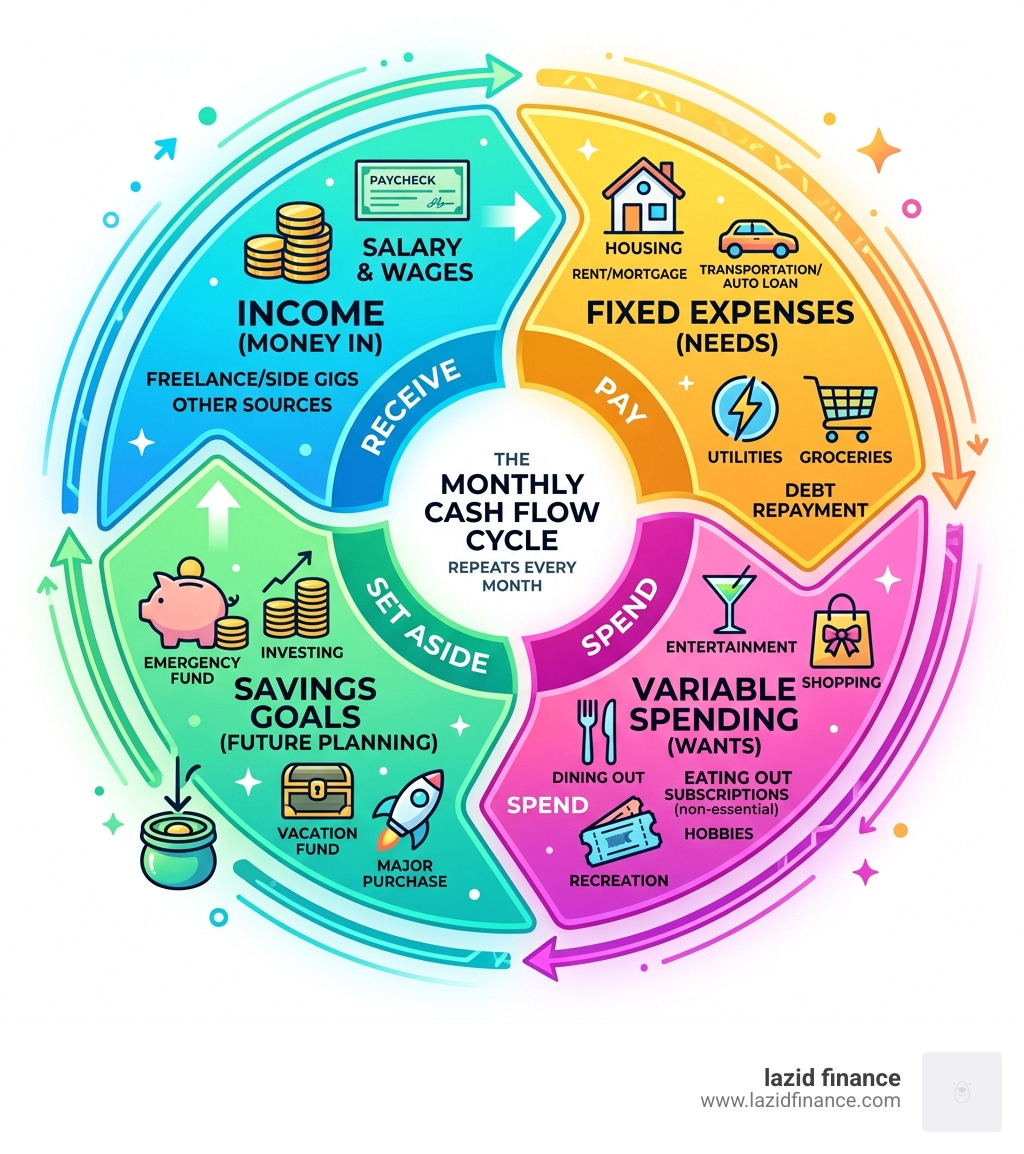
In 2026, the financial landscape is faster than ever. With digital subscriptions, micro-transactions, and the “buy now, pay later” culture, money can leak out of your pockets in a thousand tiny ways. We’ve seen that over 10,000 users tracking budgets through various systems have found that simply acknowledging where the money goes is 80% of the battle. When we look at the $2.4M+ tracked in savings goals across the community, it’s clear that a monthly budget tracker isn’t just a chore; it’s a roadmap to freedom.
Choosing the Best Monthly Budget Tracker for Your Lifestyle
There is no “one size fits all” when it comes to managing your cash. If you’re “broke and restless,” you need a tool that matches your energy level and your tech preferences. Are you a data nerd who loves a good formula? Or are you someone who needs a nudge on your phone every time you buy a $7 latte?
Currently, there are a staggering 15,979 budget templates available for customization across the web. Whether you want something minimalist or a retro Y2K aesthetic, the options are endless.
The Benefits of a Spreadsheet-Based Monthly Budget Tracker
For those who want total control, a spreadsheet is the “Old Faithful” of personal finance. We love spreadsheets because they don’t have feelings, they don’t charge subscription fees, and they don’t share your data with third parties unless you want them to.
Using a spreadsheet allows you to build a custom dashboard that updates automatically as you plug in your numbers. You can find Free budget template spreadsheets to customize | Microsoft Excel that come pre-populated with formulas. This means you don’t need to be a math whiz to see your variance analysis—the sheet does the heavy lifting for you.
Why go the spreadsheet route?
- Data Privacy: Your financial data stays in your own cloud or on your hard drive.
- Infinite Customization: Want a category specifically for “Emergency Burrito Fund”? You can add it in five seconds.
- Offline Access: You don’t always need a 6G connection to check if you can afford those new shoes.
Why a Mobile Monthly Budget Tracker Works for On-the-Go Users
If the thought of opening a laptop makes you break out in hives, a mobile app is your best friend. Modern apps can link accounts from more than 17,000 financial institutions, meaning your transactions are imported and categorized while you sleep.
A mobile monthly budget tracker offers:
- Real-time visibility: Check your “Dining Out” balance while you’re standing in line at the food truck.
- Push notifications: Get a friendly (or firm) reminder when a bill is due or when you’ve hit 90% of your shopping limit.
- Multi-currency support: Essential for the restless digital nomad of 2026 who might be earning in USD but spending in EUR or CAD.
| Feature | Spreadsheet | Mobile App |
|---|---|---|
| Automation | Manual or CSV Import | Automatic Bank Sync |
| Customization | High (Change anything) | Medium (Fixed categories) |
| Privacy | High (Local storage) | Variable (Cloud-based) |
| Cost | Usually Free | Often Subscription-based |
| Learning Curve | Moderate | Low |
Step-by-Step: Setting Up Your Monthly Budget Tracker
Setting up your tracker shouldn’t feel like doing your taxes. It should feel like a 10-minute strategy session for your future self.

1. Identify Your Total After-Tax Income
Don’t use your gross salary. Uncle Sam and the taxman have already taken their cut. Use your “take-home” pay—the actual amount that hits your bank account. If you have a variable income (freelance or side hustles), we recommend using a conservative average. It’s better to be surprised by extra cash than to be short on rent.
2. List Your Fixed Expenses
These are the “non-negotiables.” Rent, utilities, insurance, and that gym membership you swear you’ll use this week. These stay relatively the same every month.
3. Factor in Variable Spending
This is where the “restless” part of your budget lives. Groceries, gas, entertainment, and “oops” purchases. This is also where most people find the most room to save.
4. Set Savings and Debt Goals
Treat your savings like a bill you owe yourself. Whether it’s an emergency fund or a vacation to Mars (hey, it’s 2026), put it in the tracker.
Categorizing Your Expenses Effectively
If your categories are too broad (like “Stuff”), you won’t learn anything. If they are too specific (like “Blueberry Muffins”), you’ll get overwhelmed. Aim for the “Goldilocks” zone—about 5 to 10 main categories.
Common categories include:
- Housing: Rent/Mortgage, repairs, insurance.
- Transportation: Car payments, gas, public transit, Uber/Lyft.
- Daily Living: Groceries, personal care, cleaning supplies.
- Entertainment: Subscriptions (Netflix, etc.), dining out, hobbies.
- Health: Insurance premiums, gym, therapy, medications.
If you want to get creative with how your tracker looks, check out Free and customizable budget templates – Canva. They offer thousands of visual planners that make the process feel more like an art project and less like an accounting nightmare.
Tracking Projected vs Actual Totals
This is the secret sauce of a successful monthly budget tracker. At the start of the month, you project what you’ll spend. At the end of the month, you enter what you actually spent.
The difference between the two is called variance.
- Positive Variance: You spent $50 on groceries when you budgeted $100. High five! You have $50 extra for your savings goal.
- Negative Variance: You spent $200 on “entertainment” when you budgeted $50. Time for a “restless” reality check.
Tracking this variance helps you identify habits you didn’t know you had. Maybe you’re spending more on subscriptions than you realized, or maybe your “quick coffee” habit is actually a $150-a-month line item.
Mastering Budgeting Frameworks and Debt Strategies
Once you have your monthly budget tracker set up, you need a strategy to manage the numbers. We often suggest starting with a proven framework to take the guesswork out of the process.
The 50/30/20 Rule
This is the “gold standard” for a reason. It’s simple:
- 50% for Needs: Housing, groceries, utilities.
- 30% for Wants: Dining out, hobbies, that cool gadget.
- 20% for Savings and Debt: Paying off the past and funding the future.
If you’re currently “broke,” your “Needs” might be closer to 80%. That’s okay! The goal is to track your progress and slowly shift those percentages toward your goals.
Zero-Based Budgeting
In this system, every single dollar is assigned a job until you have $0 left. If you earn $3,000, you assign all $3,000 to categories (including savings). This prevents money from “disappearing” into the void of mindless scrolling and late-night online shopping.
Integrating Debt Payoff with Your Monthly Budget Tracker
Debt is the biggest anchor for the restless soul. Your monthly budget tracker should be your primary weapon against it. With a 98% user satisfaction rate among those who use structured debt plans, the results speak for themselves.
There are two main strategies you can integrate into your tracker:
- The Debt Snowball: Pay off your smallest balance first. This gives you a quick psychological win and keeps you motivated.
- The Debt Avalanche: Pay off the debt with the highest interest rate first. This is mathematically the fastest way to save money on interest.

Handling Irregular Expenses and Sinking Funds
One of the biggest reasons budgets fail is the “Surprise Expense.” But let’s be honest: your car insurance bill that comes once a year isn’t a surprise—it’s just irregular.
This is where Sinking Funds come in. If your annual car registration is $240, you budget $20 every month into a “Sinking Fund” category. When the bill arrives, the money is already there. No stress, no panic.
For those with variable income or freelancers, we recommend a “Buffer Target.” Aim to keep at least $200–$500 of “leftover” cash in your account at all times to handle the ebbs and flows of life. You can use this [PDF] Make a Budget – Consumer.gov worksheet to get a physical handle on these irregular costs if digital tools feel too abstract.
Frequently Asked Questions about Monthly Budgeting
How often should I review and adjust my monthly budget tracker?
We recommend a Weekly Check-in. It takes about 10 minutes. Look at what you’ve spent so far and see if you’re on track for the rest of the month.
At the end of the month, do a Monthly Reconciliation (30 minutes) to see your final totals and set your targets for next month. Every three months, do a Quarterly Review to see if your larger goals (like that emergency fund) need adjusting. The habit is more important than the tool!
What should I do if my monthly expenses exceed my income?
First, don’t panic. Take a deep breath. Then, look at your tracker and start “trimming the fat.”
- Cut the “Wants” first: Cancel the subscriptions you don’t use and skip the takeout for a few weeks.
- Lower Fixed Costs: Can you renegotiate your internet bill? Switch to a cheaper phone plan?
- Increase Income: If you’ve cut everything and you’re still in the red, it’s time to look at a side hustle or a career move. A tracker gives you the hard data you need to make that decision.
Are online budget tracking apps secure for my financial data?
Security is a valid concern in 2026. Most reputable apps use bank-level encryption (AES-256) and multi-factor authentication (MFA).
Look for apps that offer “Read-Only” access. This means the app can see your transactions to categorize them, but it cannot move your money or make payments. Always read the privacy policy to ensure your data isn’t being sold to advertisers. If you’re still nervous, stick to a manual spreadsheet—it’s the ultimate “air-gapped” security.
Conclusion: Take Control of Your Finances Today
Being “broke and restless” doesn’t have to be your permanent state. By implementing a monthly budget tracker, you are taking the first step toward a more conscious and mindful financial life.
At Lazid Finance, we believe in providing intelligent financial tools for conscious decisions. Our mission is to help you make smart finance solutions tailored for mindful choices. Whether you use a high-tech app or a simple piece of paper, the goal is the same: clarity, control, and peace of mind.
Don’t wait for the “perfect” time to start. The best time was yesterday; the second-best time is right now. Grab a template, link your accounts, and start telling your money where to go.
Start your journey with Lazid Finance and turn your restlessness into financial fuel. You’ve got this!

