
Finding the Best Personal Wealth Tracker for Your Goals
Why Tracking Your Personal Wealth Changes Everything
A personal wealth tracker is an app or tool that combines all your financial accounts – savings, investments, property, debt, and more – into one clear picture of your net worth.
Most people think budgeting is the key to building wealth. But there’s a bigger lever: knowing your net worth and watching it grow.
There’s a well-known principle in performance psychology that says measurement itself drives improvement – and that reporting that measurement back accelerates the rate of improvement even further. Personal finance works the same way.
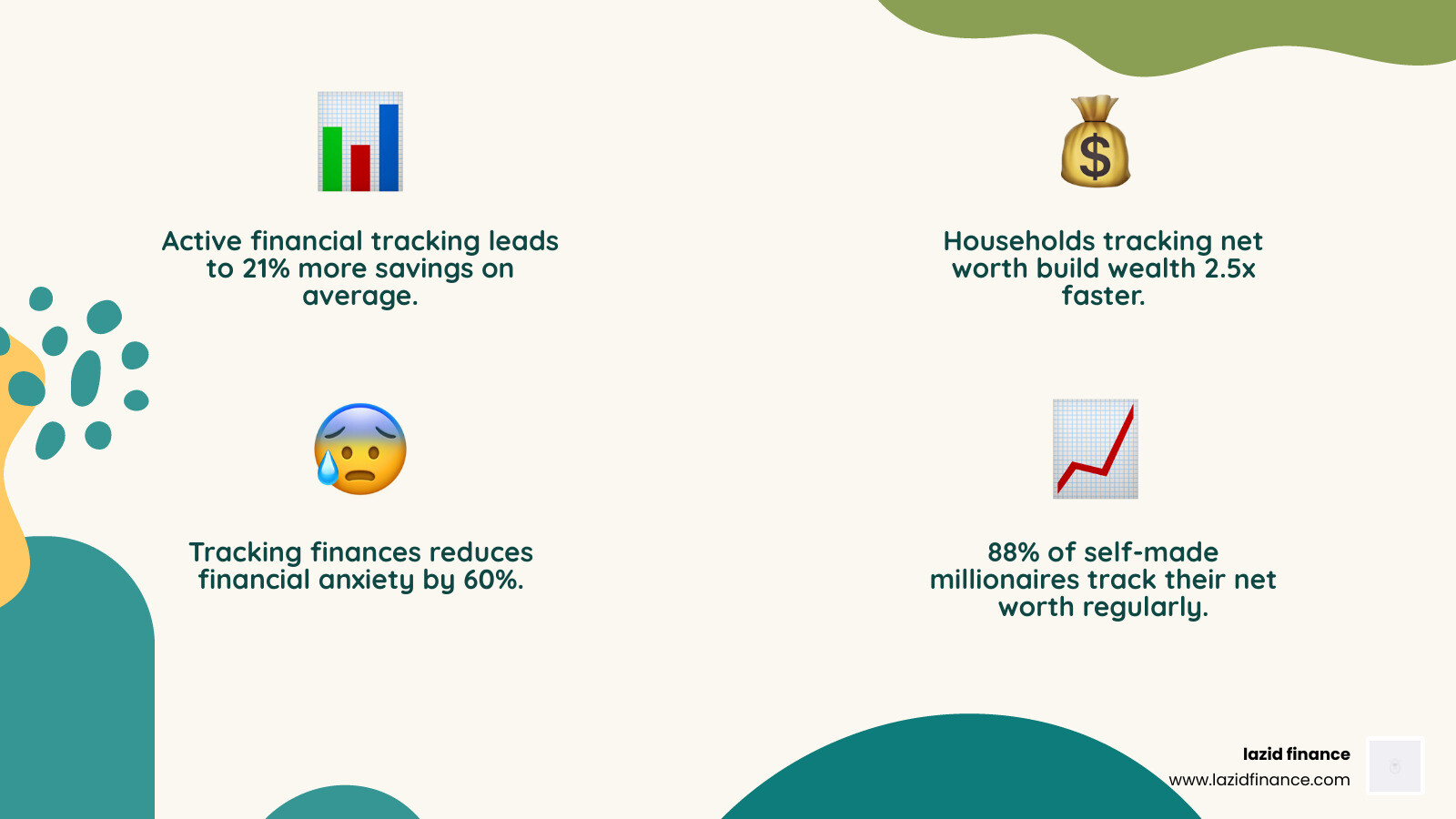
The numbers back this up. People who actively track their finances save 21% more on average. Households that track net worth build wealth 2.5 times faster. And perhaps most surprisingly, simply tracking your financial position reduces financial anxiety by 60%.
Yet most people have no single place where all their money lives together. Bank accounts in one app, investments in another, a mortgage statement in a drawer somewhere. That scattered picture makes it nearly impossible to make confident financial decisions.
That’s exactly what a personal wealth tracker solves.
What is a Personal Wealth Tracker and Why Use One?
At its core, a personal wealth tracker is your financial “vital signs” monitor. While a budgeting app looks at the micro-where every dollar went this week-a wealth tracker looks at the macro: are you actually getting richer?
We define net worth as a simple equation: Total Assets – Total Liabilities = Net Worth. Assets include your cash, stock portfolios, retirement accounts, real estate, and even luxury collectibles. Liabilities are what you owe, such as mortgages, student loans, and credit card balances.

Why does this matter? Because income is not wealth. You can earn $200,000 a year but have a negative net worth if your lifestyle costs $210,000. Conversely, a modest earner who consistently invests can build a massive “scoreboard” of financial health.
The habits of the wealthy prove this point. Research shows that 88% of self-made millionaires regularly track their net worth, a finding popularized in studies like The Millionaire Next Door. It isn’t just a hobby for them; it’s a strategy. By seeing the impact of every debt payment and every investment gain, you stay motivated. It’s the difference between wandering through a forest and having a GPS.
If you’re ready to stop guessing, you can Calculate Your Net Worth with Lazid Finance and begin your journey toward more info about mindful finance.
Essential Features for Comprehensive Financial Oversight
In April 2026, the standard for a personal wealth tracker has moved far beyond simple manual entry. Modern tools offer a “command center” for your money. Here is what we believe are the non-negotiables:
- Account Aggregation: The best apps can link to over 17,000 financial institutions. This allows for real-time updates so your dashboard reflects your actual balances the moment you log in.
- Diverse Asset Support: Your wealth isn’t just in a checking account. Modern trackers support 21+ asset types, including crypto, private equity, and real estate.
- Multi-Currency Capabilities: If you have investments in London, New York, and Tokyo, you need a tool that supports 160+ currencies with live exchange rates.
- Retirement Planning: A great tracker doesn’t just show where you are; it projects where you’ll be. It should help you visualize retirement timelines and wealth growth based on the Rule of 72 (where money invested at a 10% return doubles roughly every 7.2 years).
Comparing Asset Types
To understand your wealth, we need to distinguish between what you can spend today and what is “locked up.”
| Feature | Liquid Assets | Illiquid Assets |
|---|---|---|
| Examples | Cash, Stocks, ETFs, Crypto | Real Estate, Private Equity, Art |
| Speed to Cash | Instant to 3 days | Weeks to Months |
| Valuation | Real-time market data | Estimated/Appraisal-based |
| Purpose | Emergency funds, active trading | Long-term growth, stability |
Security and Privacy in a Personal Wealth Tracker
When you link your entire financial life to one app, security is the number one concern. We look for bank-level encryption and mandatory two-factor authentication (2FA).
However, privacy is becoming just as important as security. Some users prefer “Privacy by Design” tools. These apps might use Apple’s CloudKit technology to store data in your personal iCloud account rather than on their own servers. The most secure trackers promise no data selling to third parties-because when the product is free, you are often the product. Some apps even offer “local storage” options where your data never leaves your device.
How a Personal Wealth Tracker Assists with Budgeting
While wealth tracking is about the big picture, it naturally improves your daily habits. Seeing your “Savings Rate” (the percentage of income you keep) is the ultimate motivator.
- Spending Analysis: By categorizing transactions, you can see if “lifestyle creep” is eating your raises.
- 30% Deposit Increase: Statistics show that tracking your savings progress increases monthly deposits by an average of 30%.
- Financial Wins: Instead of feeling guilty about buying a coffee (the budgeting trap), you feel empowered when you see your debt drop by $500. This shift from “restriction” to “growth” is why active trackers make 20% better financial decisions.
Comparing Tracking Methods: Automation vs. Manual Entry
How do you get your data into the app? There are two main schools of thought:
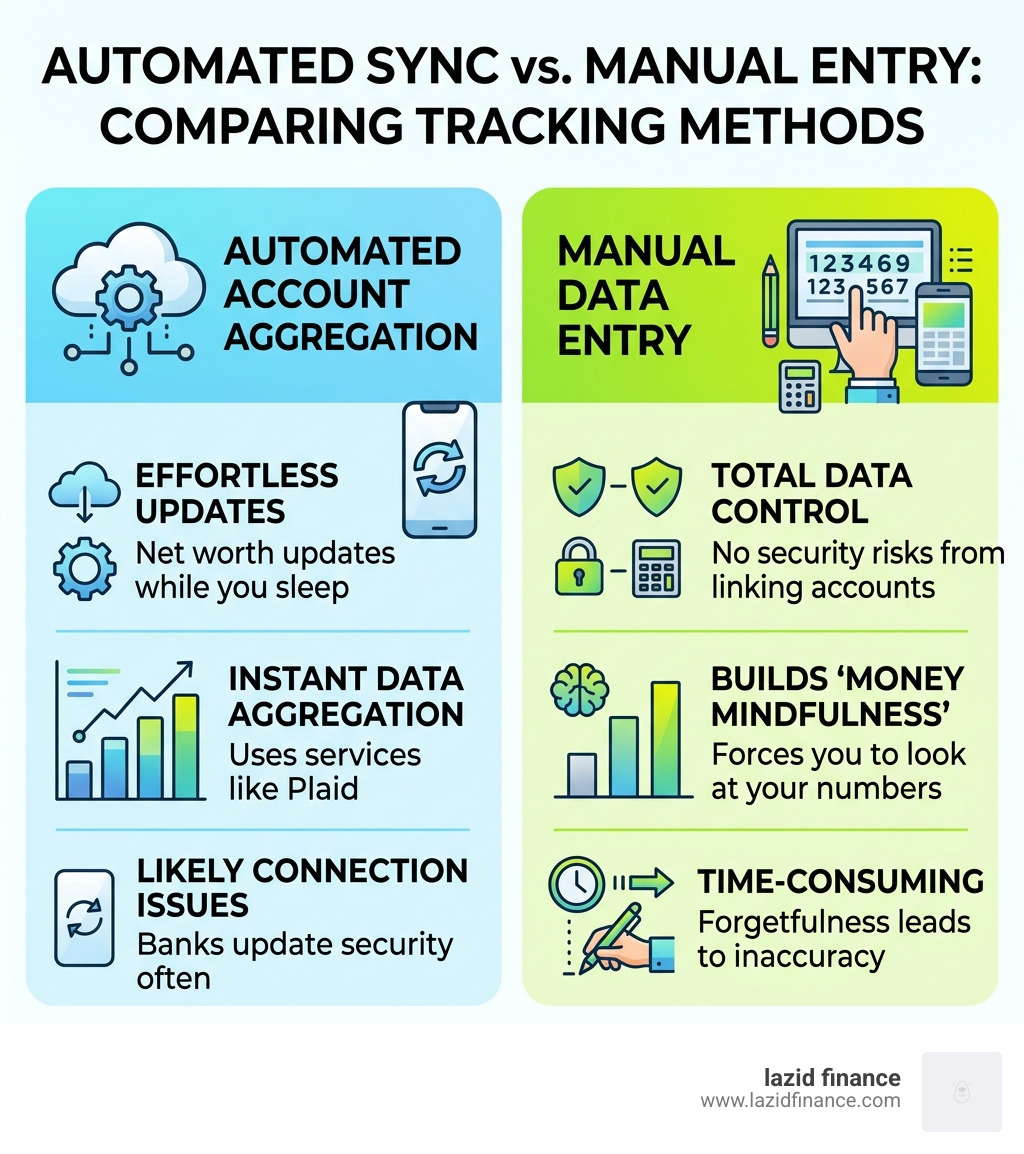
1. Automated Account Aggregation Using services like Plaid, the app “talks” to your bank.
- Pros: It’s effortless. Your net worth updates while you sleep.
- Cons: Connection issues can occur when banks update their security. Some users feel uneasy about sharing login credentials.
2. Manual Data Entry The “old school” method of typing in your balances.
- Pros: Total data control. No security risks from linking accounts. It forces you to actually look at your numbers, which builds “money mindfulness.”
- Cons: It’s time-consuming. If you forget to update your stock prices, your data becomes inaccurate.
Many advanced users still swear by Excel spreadsheets. They love the infinite customization, allowing them to build complex “FIRE” (Financial Independence, Retire Early) tables. However, for most of us, the time saved by an app is worth the trade-off. You can read more about The Evolution of Wealth Tracking: From Spreadsheets to Apps to see which path fits your personality.
Choosing the Best Personal Wealth Tracker for Your Profile
No two financial journeys are the same. A 22-year-old with student loans has different needs than a 55-year-old with three rental properties.

When selecting your tool, ask: “What is my biggest pain point?” Is it high fees? Lack of privacy? Or just not knowing where the money goes? Check out our guide on How to Choose the Right Financial Tools for Your Journey.
The AI-Powered Analyst for Advanced Investors
If you have a complex portfolio, you need more than a balance sheet. You need an analyst. The latest 2026 trackers use AI to provide:
- Fee Optimization: Identifying high-cost ETFs that are secretly draining your wealth.
- Sector Allocation: Showing you if you are too “heavy” in tech (e.g., 45% tech vs. the S&P 500’s ~30%).
- Risk Profiling: Ensuring your holdings align with your age and goals.
- Insider Data: Some premium apps even track politician and CEO trading activity to give you an edge.
The Privacy-First Tracker for Beginners
If you’re just starting, keep it simple. Approximately 15% of households have a zero or negative net worth. If that’s you, don’t panic—it’s just a starting point. For beginners, a tracker that emphasizes debt paydown and simple UI is best. You don’t need complex “sector maps”; you need to see your credit card balance hitting zero. A privacy-focused app that doesn’t require bank linking can be a great way to “dip your toes” into wealth tracking without feeling overwhelmed.
Frequently Asked Questions about Wealth Tracking
Should I include my home and car in my net worth?
Yes, but be conservative. Your home is likely your largest asset, but we recommend valuing it at what you could sell it for today, minus 6% for realtor fees. Financial planners suggest keeping your primary residence at no more than 30-40% of your total net worth to stay liquid.
For cars, remember they are depreciating assets. A car typically loses 15-25% of its value annually in the first few years. Use a “quick sale” value (like Kelley Blue Book private party minus 10%) so you aren’t inflating your wealth with a vehicle that is losing value every day.
How often should I update my personal wealth tracker?
You don’t need to check it daily-that leads to emotional stress over market volatility.
- Monthly: Great for tracking spending and savings habits.
- Quarterly (Every 3 months): The “sweet spot” for most people to review investment performance and net worth growth.
- Annually: A mandatory “financial physical” to set goals for the next year.
What are the median net worth benchmarks by age in 2026?
It’s human nature to compare. While your journey is unique, here are the median US benchmarks (based on Federal Reserve data adjusted for 2026):
- Under 35: $13,900
- 35-44: $91,300
- 45-54: $168,600
- 55-64: $212,500
- 65-74: $266,400
- 75+: $254,800
Conclusion
Building wealth isn’t about luck; it’s about intentionality. By using a personal wealth tracker, you move from being a passive observer of your money to being the CEO of your own life. Whether you choose an AI-powered automated tool or a private manual app, the act of measuring your progress will naturally lead to better choices.
At Lazid Finance, we believe in providing intelligent financial tools for conscious decisions. We want to help you replace financial anxiety with financial confidence. The road to wealth is long, but it’s a lot easier to travel when you can see exactly where you’re going.
Ready to see your full financial picture? Start your journey to financial clarity today.

