
Stop the Bleeding: Best Digital Budget Planners to Master Your Finances
Why a Digital Budget Planner Is the Fastest Way to Take Control of Your Money
The best digital budget planners available right now include:
- Zero-based apps – Best for assigning every dollar a job and reducing money stress
- Margin-finding tools – Best for identifying hidden savings fast
- Digital envelope systems – Best for category-based budgeting on mobile
- Multi-currency platforms – Best for global users and digital nomads
- Privacy-focused options – Best for those who prefer no bank connection
- Google Sheets / Excel templates – Best for customizable, self-managed budgeting
- Canva budget templates – Best for visual, design-forward planners
Most people don’t have a spending problem. They have a visibility problem.
When you can’t clearly see where your money is going, it disappears. Rent, subscriptions, takeout, impulse buys — it all adds up faster than you expect. By the end of the month, you’re left wondering what happened.
That’s exactly what a digital budget planner is designed to fix.
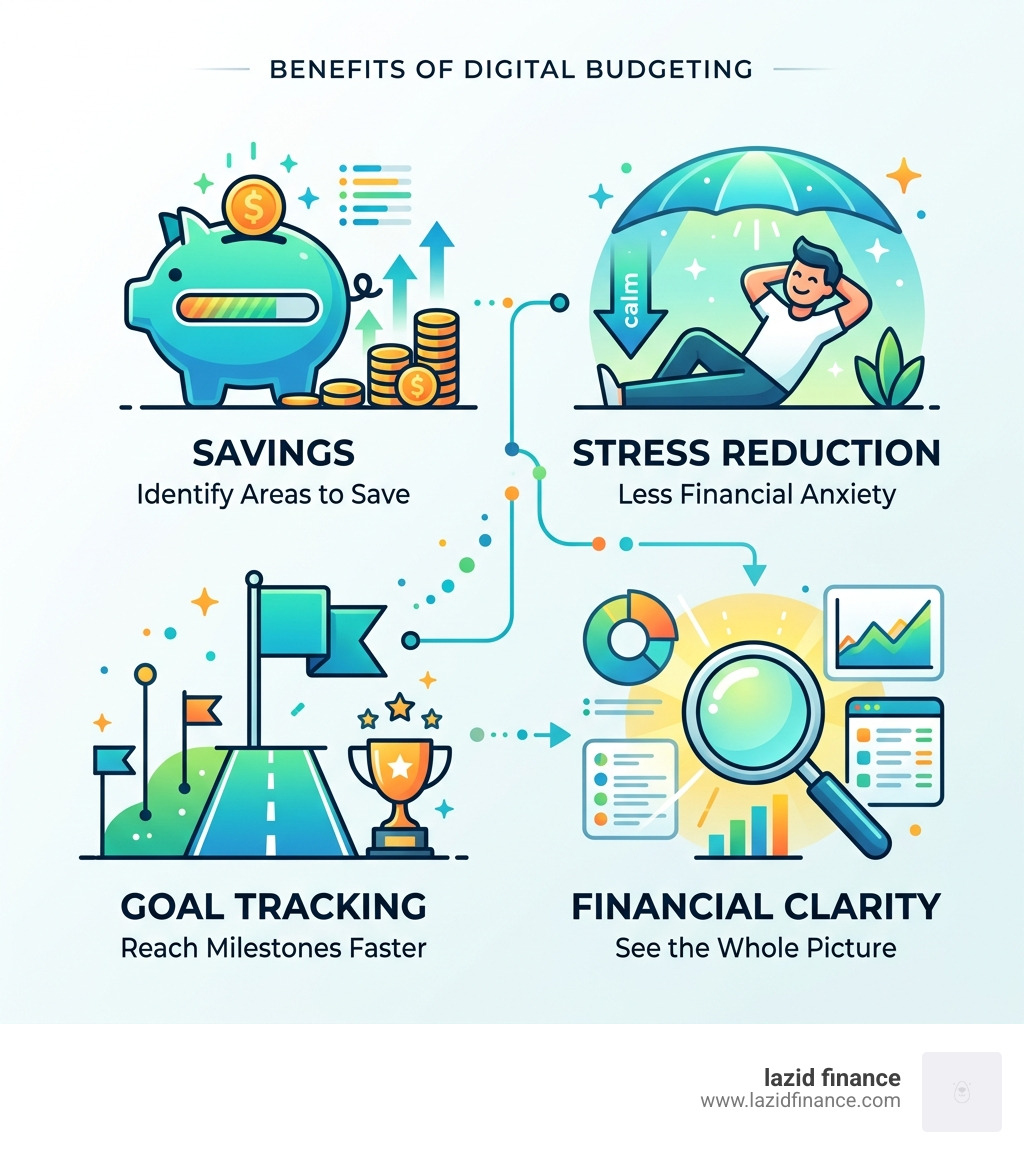
Unlike a notebook or a rough mental estimate, a digital planner tracks every dollar in real time. It shows you patterns. It flags problems before they become crises. And it gives you a clear picture of where your money actually goes — not just where you think it goes.
The results can be significant. Users of top-tier apps report saving an average of $600 in their first month alone. Collectively, users of leading budgeting tools found over $2 billion in budget margin in 2025. These aren’t magic tricks — they’re just what happens when people finally see their finances clearly.
The good news? You have more options than ever. From free apps to premium tools, from spreadsheet templates to iPad planners, there’s a digital budget planner that fits your lifestyle and your goals.
This guide breaks down the best ones — so you can stop guessing and start making real progress.
Choosing Your Digital Budget Planner: Key Features and Types
Finding the right tool is like finding the right pair of shoes; if it doesn’t fit your lifestyle, you won’t use it. We’ve found that the market generally splits into three main categories: dedicated mobile apps, customizable spreadsheet templates, and visual digital planners (often used on tablets).
When we evaluate a digital budget planner, we look at its ability to handle “margin”—the gap between what you earn and what you spend. For instance, new users of leading budgeting apps often identify $3,015 or more in potential margin during their initial 15-minute onboarding. That is a massive amount of “lost” money that a good planner can recover.
| Feature | Mobile Apps | Spreadsheet Templates | Visual Digital Planners |
|---|---|---|---|
| Automation | High (Bank Sync) | Medium (Formulas) | Low (Manual Entry) |
| Customization | Moderate | Very High | High (Aesthetic) |
| Setup Speed | Fast (15 mins) | Moderate | Slow (Creative) |
| Best For | On-the-go tracking | Data enthusiasts | Tablet/Stylus users |
One of the most critical features to look for is the breadth of bank integration. Industry leaders allow users to link accounts from more than 17,000 financial institutions. If your planner can’t talk to your bank, you’ll be doing a lot of manual data entry—which is fine for some, but a dealbreaker for others.
Mobile Apps and Cross-Platform Compatibility for Your Digital Budget Planner
In 2026, a budget that only lives on your desktop is a budget that gets ignored. We believe the best digital budget planner must offer cloud syncing across all your devices. Whether you are at the grocery store on your iPhone or sitting at your desk on a Mac, your data should be identical.
Professional-grade apps now optimize specifically for different platforms. On an iPad, you might see a beautiful dashboard with charts and graphs, while the mobile version provides real-time alerts the moment a transaction hits your account. This “anywhere, anytime” access is why 90% of users of these tools say their finances are in a better place since starting; they are never more than a tap away from their financial reality.
Spreadsheet Templates and Customizable Layouts
For those who want absolute control without a monthly subscription, spreadsheet templates are the gold standard. We often recommend Free and customizable budget templates – Canva for those who want a visual start, or Microsoft Excel’s native templates for those who love formulas.
If you are looking for something more structured, professional annual budget templates offer Google Sheets-based solutions that track income, expenses, and even credit card spending in one place. These templates are “reusable every year”—you simply make a new copy of the sheet, which makes them a one-time investment for a lifetime of tracking.
Maximizing Your Digital Budget Planner on a Budget
You shouldn’t have to spend a fortune to save a fortune. There are incredible ad-free tools that offer core features for zero cost. They sustain themselves through optional small fees for bank linking rather than selling your data.
The ROI on these tools is staggering. Consider this: the average user of a premium budgeting app saves $6,000 in their first year. Even if you pay for a premium subscription, the cost is a drop in the bucket compared to the thousands of dollars in “found money.” Furthermore, 92% of users report feeling significantly less money stress. You can’t really put a price on sleeping better at night, can you?
Popular Budgeting Methods Supported by Digital Tools
A digital budget planner is more than just a ledger; it’s an implementation of a financial philosophy. Depending on your personality, you might prefer one of these four heavy hitters:
- Zero-Based Budgeting: This is the “Give Every Dollar a Job” method. You assign every cent of your income to a category until your balance hits zero. Leading apps are built specifically for this.
- Envelope Budgeting: Historically done with paper envelopes and cash, digital versions let you create virtual “envelopes.” When the “Eating Out” envelope is empty, you stop eating out.
- 50/30/20 Rule: A simpler approach where 50% goes to needs, 30% to wants, and 20% to savings. Many templates allow you to toggle this view.
- Debt Snowball vs. Avalanche: These are payoff strategies. The Snowball method (paying smallest debts first) builds momentum, while the Avalanche method (paying highest interest first) saves the most money.

The impact of these methods is real. In 2025 alone, users of leading zero-based apps found over $2 billion in margin by simply applying these principles. Whether you’re a middle-class family or managing a shared household, these methods provide the structure needed to stop the bleeding.
Achieving Financial Goals and Debt Payoff
Can a digital budget planner actually help you pay off debt? The data says yes. Users of advanced digital planners have tracked over $2.4 million in savings goals, and we’ve seen testimonials of users paying off $14,000 in credit card debt in just 18 months.
Modern planners often include “Sinking Funds” trackers. These are essentially savings accounts for non-monthly expenses—like your car insurance that’s due every six months or your annual holiday shopping. By setting these up, you avoid the “financial emergency” that isn’t actually an emergency; it was just a predictable expense you didn’t plan for. This proactive planning is why 70% of dedicated budgeters could live for three months or more on their savings alone.
Security, Privacy, and Bank Connections in a Digital Budget Planner
We know that “linking your bank” can feel a bit like giving a stranger the keys to your house. However, modern digital budget planners use bank-level security to keep you safe.
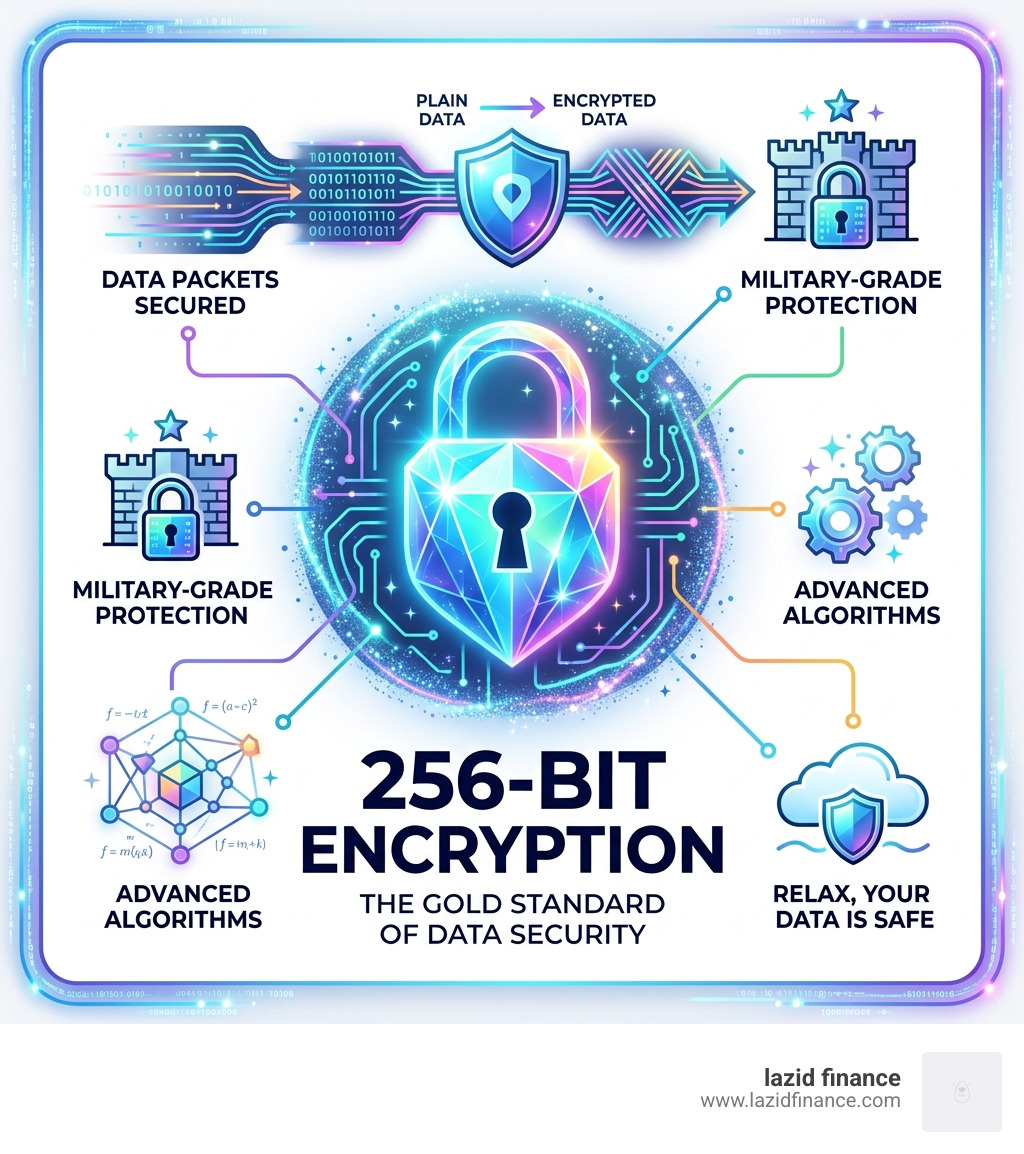
Most reputable apps use 256-bit encryption (the same stuff used by the military and major banks). They also partner with third-party aggregators like Plaid or Mastercard Connect. These services act as a secure bridge; the budgeting app never actually sees or stores your bank login credentials.
Managing Transactions and Data Privacy
If you are still wary of automatic syncing, you aren’t out of luck. Many planners prioritize privacy by not requiring bank connections at all. Instead, you can:
- Manually enter transactions: Great for staying “mindful” of every cent.
- CSV/OFX Imports: Download a file from your bank and upload it to your planner.
- Progressive Web Apps (PWA): Use tools that store data locally or utilize “offline components” to keep your passwords on your own device.
For our global readers, multi-currency platforms are a standout here, tracking over $48 billion across 150+ countries. They support 130+ currencies and 60+ languages, ensuring that no matter where you are or how you choose to connect, your data remains yours.
Frequently Asked Questions about Digital Budgeting
How easy are digital planners for beginners to set up?
Surprisingly easy. Most modern apps feature 15-minute onboarding questionnaires that do the heavy lifting for you. They’ll ask about your income, your rent, and your goals, then automatically build a “starter budget.” Automated categorization also helps; the app learns that “Starbucks” belongs in the “Coffee/Dining” category so you don’t have to label it every time.
Can I use a digital planner without connecting my bank?
Absolutely. Many tools were built specifically for people who prefer manual entry or CSV uploads for privacy reasons. You can even use a digital planner template on an iPad with a stylus if you prefer the “pen and paper” feel with digital convenience.
Do digital planners support multiple currencies?
Yes, but you have to choose the right one. Leading global tools are the leaders here, supporting over 100 currencies. This is vital for expats, digital nomads, or anyone managing accounts in multiple countries.
Conclusion
Taking control of your money isn’t about restriction; it’s about freedom. It’s about making conscious decisions so that your money goes where you want it to go, rather than just “disappearing.”
Whether you choose a high-powered app or a beautifully designed spreadsheet, the best digital budget planner is the one you will actually open every day. At Lazid Finance, we believe in providing intelligent financial tools for mindful choices that help people build better financial habits and make clearer budgeting decisions.
Stop the bleeding. Find your margin. And start building the life you want, one dollar at a time.

