
Stop Guessing and Start Calculating Your Next Big Loan
What a Loan Calculator Actually Does (And Why It Matters)
A loan calculator is a free digital tool that estimates your monthly payment, total interest, and payoff timeline — before you ever talk to a lender.
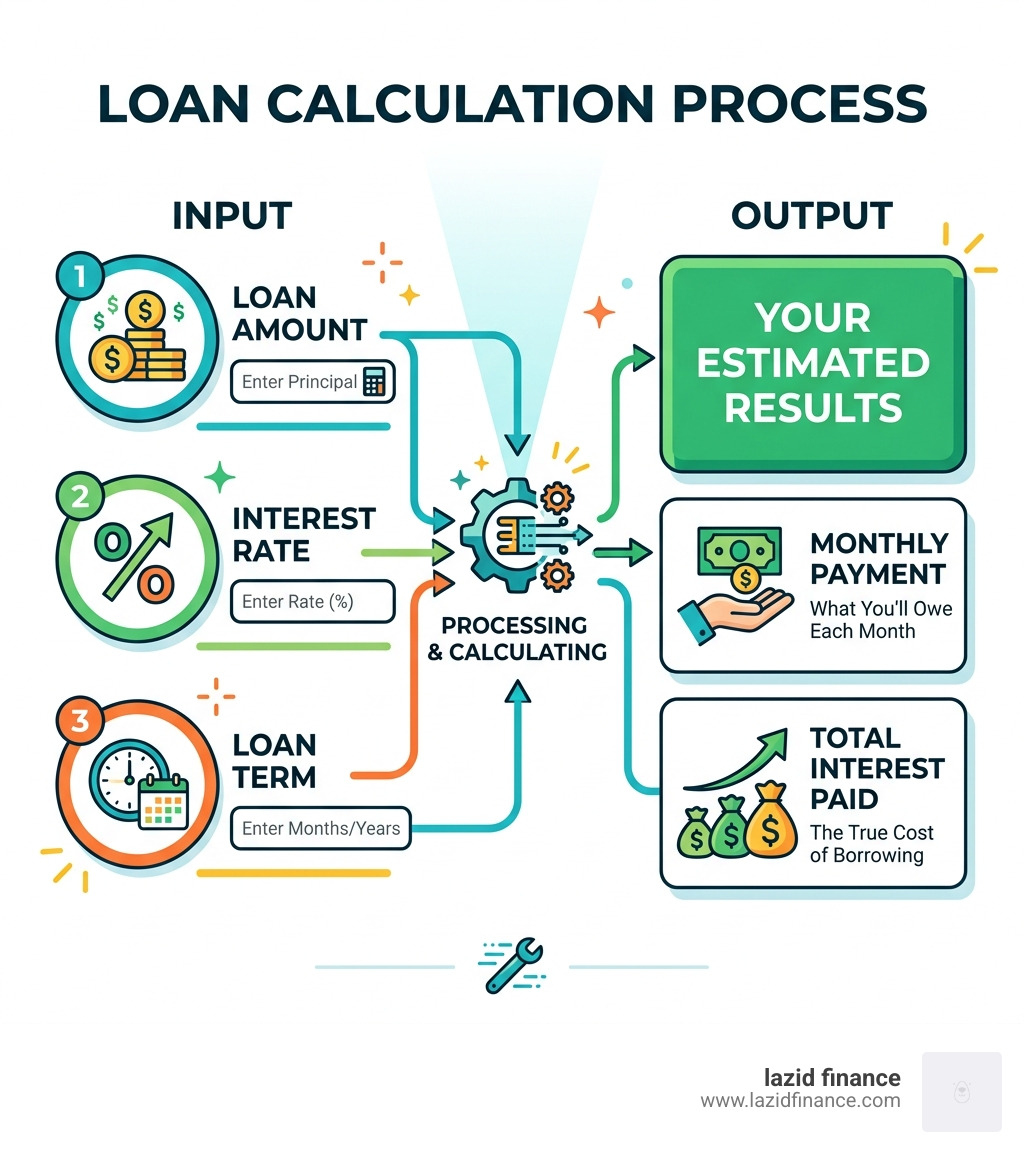
Here’s how to use one in 3 steps:
- Enter your loan amount — the total you plan to borrow
- Enter your interest rate — check current rates from lenders or use an estimate
- Enter your loan term — how many months or years you want to repay
Your results will show:
| Output | What It Tells You |
|---|---|
| Monthly payment | What you’ll owe each month |
| Total interest paid | The true cost of borrowing |
| Amortization schedule | How each payment splits between principal and interest |
| Payoff date | When you’ll be completely debt-free |
Most people guess at what they can afford. They walk into a dealership or a bank, get hit with numbers, and make decisions under pressure.
That’s a stressful way to borrow money — and it often leads to paying way more than you need to.
The smarter move? Run the numbers yourself, first.
Whether you’re planning a car purchase, consolidating debt, or taking out a personal loan, knowing your numbers upfront puts you in control. A borrower with excellent credit might qualify for a rate below 8% on a three-year personal loan, while someone with fair credit could pay close to 20% for the exact same loan. That difference can add up to thousands of dollars — and a loan calculator makes that visible instantly.
Understanding the Mechanics of a Loan Calculator
At its core, a loan calculator is an engine of financial empowerment. It strips away the complex jargon and sales tactics used by lenders, leaving you with the cold, hard facts. When we look at the mechanics, we’re essentially looking at how four main ingredients—the principal amount, interest rate, loan term, and amortization—interact to create your repayment plan.

Most installment loans, such as auto or personal loans, are structured as fixed-rate debt. This means your interest rate stays the same for the entire life of the loan. While this provides predictability for your monthly budget, the way your money is distributed behind the scenes changes every single month through a process called amortization.
In the beginning, your payments are interest-heavy. As you chip away at the principal balance, the amount of interest charged each month decreases because the balance it’s calculated on is smaller. Using digital tools for precision allows us to see this shift in real-time. Instead of wondering why your balance isn’t dropping as fast as you’d like, you can look at the data and see exactly when the “tipping point” occurs—the moment more of your money starts going toward the principal than the interest.
Essential Inputs for Your Loan Calculator
To get the most accurate results, you need to go beyond just the sticker price of what you’re buying. A comprehensive loan calculator should account for the “hidden” variables that change the total amount you actually need to finance.
- Down Payment: This is the cash you put up upfront. Every dollar you pay now is a dollar you don’t have to pay interest on later.
- Trade-in Value: For auto loans, your current vehicle’s value acts like a down payment, reducing the total loan amount.
- Origination Fees: Many personal and student loans include a processing fee. For example, federal student loans often have an origination fee between 1% and 4%. If you need $10,000 in your pocket but the fee is 4%, you actually need to borrow more to cover that cost.
- Sales Tax: Don’t forget that the price of a car or a large purchase usually doesn’t include tax. This is often rolled into the loan.
- Cash Rebates: Sometimes manufacturers offer “cash back” deals. Ensure you subtract these from the total price before calculating.
- Compounding Frequency: This is how often the lender calculates interest (monthly, daily, etc.). Most standard consumer loans compound monthly, matching your payment cycle.
Interpreting Your Results
Once you hit “calculate,” the numbers might feel overwhelming. Let’s break down what you’re actually looking at:
- Monthly Payment: This is your immediate budget impact. If this number makes you sweat, you might need a longer term or a smaller loan.
- Total Interest Paid: This is the “cost” of the loan. It’s the difference between what you borrowed and what you’ll eventually pay back. This is the number we want to keep as low as possible!
- Total Cost of Purchase: This combines the principal, interest, and any fees. It shows you the true price of that $30,000 car once the bank gets their share.
- Amortization Schedule: This is a month-by-month table. It’s the ultimate map for visualizing your debt-free timeline. It shows your remaining balance after every single payment.
How Different Loan Terms Impact Your Wallet
The “term” is simply how long you have to pay the money back. It is the biggest lever you can pull to change your monthly payment, but it comes with a significant catch.
Lenders often try to sell you on a lower monthly payment by extending the term. They might say, “We can get your payment down to $300 a month!” but they don’t mention that they’ve moved you from a 5-year loan to a 7-year loan. While your monthly budget feels better, your long-term savings take a massive hit because interest accrues for two extra years.
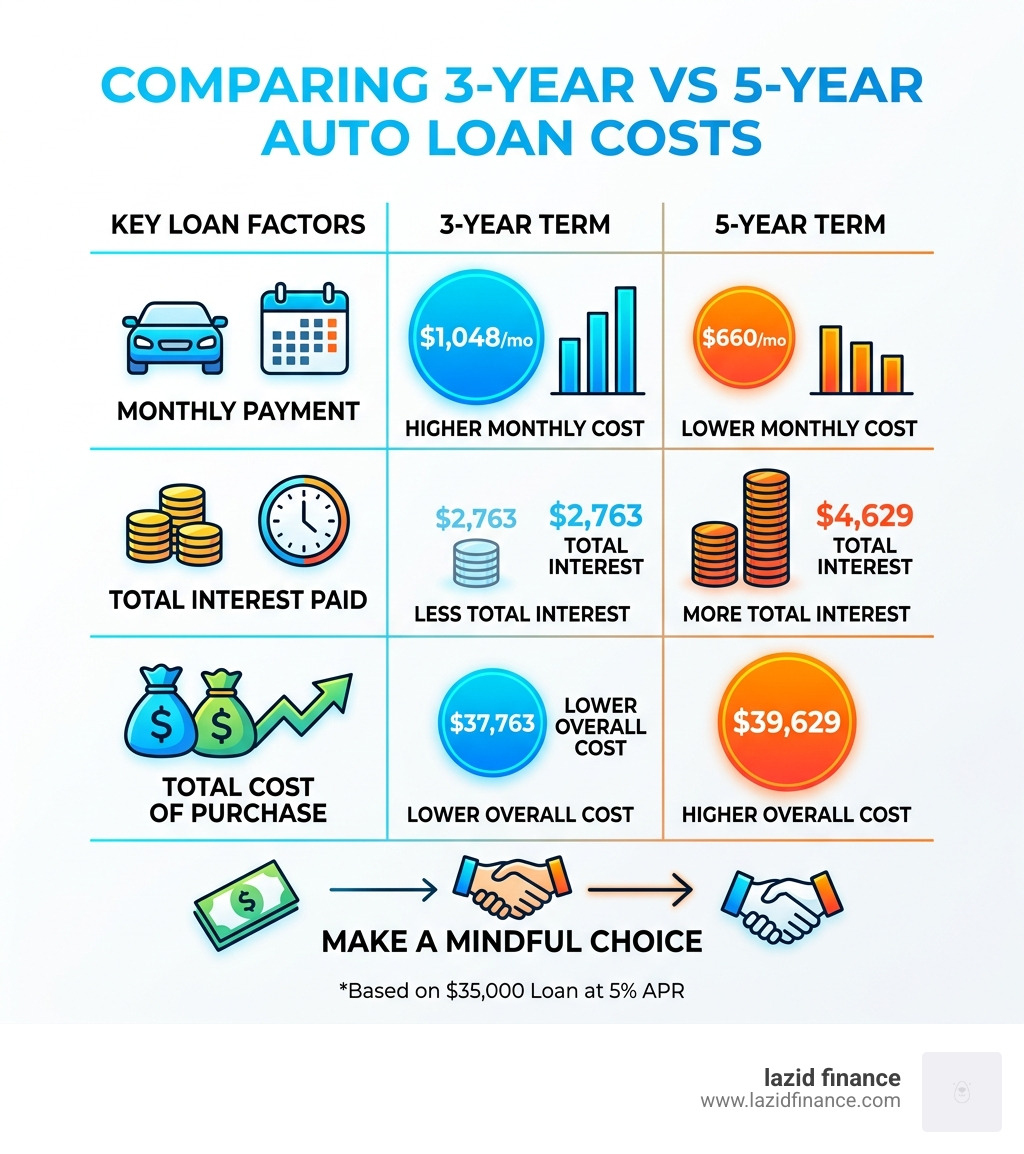
Consider this example for a $35,000 car loan at 5% interest:
- 3-Year Term: You’ll pay roughly $1,048 per month. Total interest over the life of the loan? About $2,763.
- 5-Year Term: Your payment drops to $660 per month—much easier to manage. However, you’ll pay $4,629 in total interest.
By choosing the longer term, you pay nearly $2,000 more for the exact same car. At LaziD Finance, we believe in making mindful choices. Sometimes, a higher monthly payment is the “cheaper” option in the long run. However, if a higher payment pushes your debt-to-income ratio too high, it might be safer to take the longer term and make extra payments when you can.
Simple vs. Amortized Interest in a Loan Calculator
Not all interest is created equal. Understanding the difference is key to using a loan calculator effectively.
Simple Interest is straightforward. It’s calculated only on the principal amount. You’ll often see this with short-term personal loans or specific types of fixed-term financing. The formula is usually Principal x Rate x Time.
Amortized Interest, which is used for most mortgages, auto loans, and student loans, is more complex. Because the interest is calculated based on the current balance each month, your payments are “front-loaded” with interest. In the first year of a 30-year mortgage, almost your entire payment goes to the bank’s profit, not your home’s equity.
A good loan calculator will show you this principal reduction over time. It helps you see how your balance decreases and reminds you that the “nominal interest rate” (the number the bank gives you) is only part of the story.
Factors That Influence Your Interest Rate and Payments
Why does your neighbor get a 5% rate while you’re being quoted 12%? Lenders use a process called risk assessment to determine your rate.
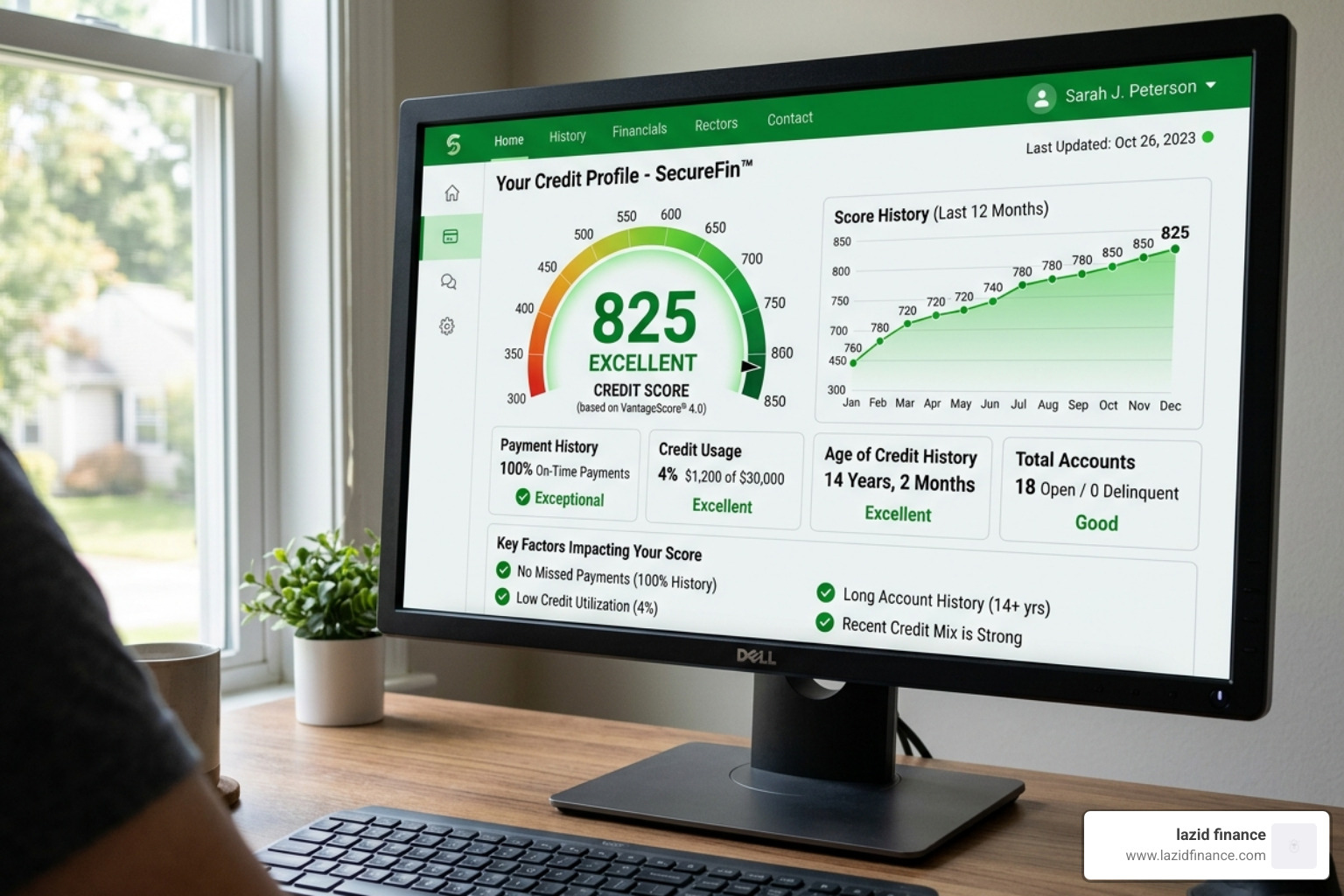
- FICO Score: This is the big one. Most scores range from 300 to 850. According to FICO, the higher your score, the lower your risk in the eyes of the lender. An excellent score can save you tens of thousands of dollars over a lifetime of borrowing.
- Debt-to-Available-Credit Ratio: This makes up about 30% of your credit score. If you have $10,000 in credit limits and you’re using $9,000 of it, lenders worry you’re overextended.
- Secured vs. Unsecured: A secured loan is backed by collateral (like your house or car). If you don’t pay, the lender takes the asset. Because they have a backup, interest rates are usually lower. An unsecured loan (like a personal loan or credit card) has no collateral, so the rates are higher to compensate for the lender’s risk.
- The Five C’s of Credit: Lenders look at Character (your history), Capacity (your income and work history), Capital (your savings), Collateral (assets), and Conditions (the purpose of the loan).
Strategies to Pay Off Your Loan Faster
Once you’ve used a loan calculator to find a payment that fits, your next goal should be to get rid of that debt as fast as possible. Most installment loans today do not have prepayment penalties, meaning you can pay extra without being charged a fee.
- Extra Payments: Even an extra $50 or $100 a month can shave months—or years—off your payoff date. On a $20,000 loan at 4.5% over five years, adding just $100 a month to your payment can save you $500 in interest and end the loan a full year early.
- Lump-Sum Payments: Did you get a tax refund or a bonus at work? Applying that directly to the principal balance has a massive “snowball” effect on an amortized loan.
- Bi-Weekly Schedules: Instead of one monthly payment, pay half the amount every two weeks. Because there are 52 weeks in a year, you’ll end up making 26 half-payments—which equals 13 full monthly payments instead of 12. You won’t even feel the “extra” payment, but your loan will vanish much faster.
If you have questions about how to structure your debt for maximum savings, Contate Nos. We’re here to help you navigate these choices.
Frequently Asked Questions about Loan Calculations
Can I use this for credit card minimum payments?
Generally, no. A standard loan calculator is designed for installment loans with a fixed end date. Credit cards are “revolving debt.” Their interest is calculated daily, and the minimum payment changes as your balance changes. For credit cards, you should use a specific minimum payment calculator to see how long it would take to pay off a balance if you only paid the minimum (hint: it’s usually decades!).
What is the difference between APR and APY?
These two acronyms look similar but serve different purposes.
- APR (Annual Percentage Rate): This is for borrowers. It includes the interest rate plus any lender fees. According to Investopedia, it’s the most accurate way to compare the cost of two different loans.
- APY (Annual Percentage Yield): This is for savers. It accounts for the effect of compounding interest on your savings account or CD.
When you’re using a loan calculator, you’re almost always looking for the APR.
How does my credit score affect my monthly payment?
It affects it by determining your interest rate tier. For example, on a $30,000 car loan:
- Excellent Credit (750+): You might get a 4% rate, resulting in a $552 monthly payment.
- Fair Credit (600-650): You might get a 14% rate, resulting in a $698 monthly payment. That’s a $146 difference every single month just because of a credit score. This is why building your borrowing power is one of the best financial investments you can make.
Conclusion
The path to financial freedom isn’t paved with guesses; it’s built on data. By using a loan calculator, you take the power back from lenders and put it where it belongs: in your hands.
Mindful borrowing means understanding that every percentage point and every extra month of a loan term has a real-world cost. At Lazid Finance, we are committed to providing smart finance solutions tailored for mindful choices. Don’t let a salesperson tell you what you can afford. Run the numbers, find your “sweet spot,” and borrow with confidence.
Ready to take the next step toward your goals? Start your journey with us today and turn your financial dreams into a calculated reality.

