
Stop Stressing and Start Tracking with These Holistic Finance Tools
Your Finances Are More Connected Than You Think
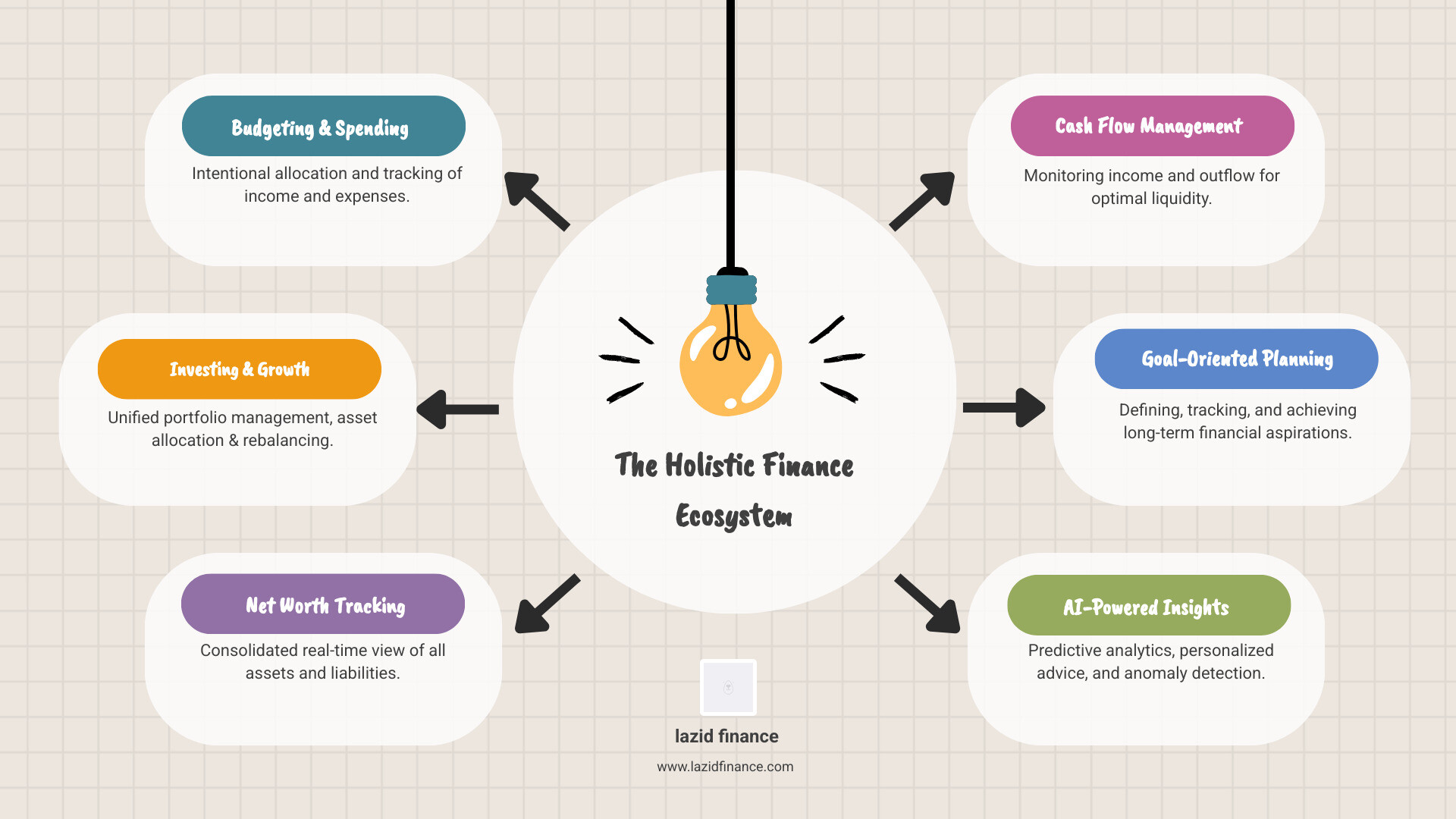
A holistic finance management tool brings together your budgeting, investing, cash flow, net worth, and long-term goals into one unified system — instead of juggling five different apps that never talk to each other.
Modern holistic finance management tools offer a variety of features worth knowing in 2026, ranging from AI-driven financial advisors to unified net worth dashboards and automated spending insights. These systems are designed to provide a single source of truth for your wealth, whether you are focused on intentional spending or complex portfolio tracking.
Most people manage money the way they assemble furniture without instructions — one piece at a time, hoping it all fits together in the end.
You have a savings account here. A brokerage account there. A credit card you track in a spreadsheet. Maybe a crypto wallet you check separately. And somewhere in the back of your mind, a vague sense that none of it adds up to an actual plan.
That disconnect is exactly what holistic finance tools are designed to fix.
More than half of financial decision-makers now rely on non-financial data — like lifestyle factors and operational insights — to make smart money moves. The same principle applies to personal finance. Knowing your bank balance tells you almost nothing. Knowing how your spending habits, investment growth, tax exposure, and life goals interact? That changes everything.
In this roundup, we break down the best features available right now so you can stop stressing and start making confident, connected financial decisions.
Why You Need a Holistic Finance Management Tool in 2026
The financial landscape has shifted dramatically. As we navigate April 2026, the days of checking a single bank balance to gauge financial health are long gone. Today, we deal with fragmented assets: traditional bank accounts, multiple brokerage platforms, cryptocurrency wallets, and even real estate investments.

Traditional vs. Holistic
Traditional financial planning is often “bottom-up” and piecemeal. You might hire an accountant for taxes, a broker for stocks, and use a basic app for budgeting. These professionals rarely talk to each other, leading to a “siloed” view where your left hand doesn’t know what the right hand is doing.
In contrast, a holistic finance management tool utilizes a top-down approach. It focuses on your end goals first—like a “Rich Life” or a specific retirement lifestyle—and then aligns every dollar to support that vision. This evolution mirrors changes in the corporate world, where over 70% of CFOs now have ownership over enterprise data, analytics, and risk. They realize that financial data alone isn’t enough; they need non-financial insights to make informed decisions. We believe you deserve that same level of strategic oversight for your personal wealth.
The Evolution of Holistic Financial Planning
Modern tools have moved beyond static tracking. They now offer integrated planning that connects your current cash flow to your 30-year net worth trajectory. By breaking down the silos between “spending” and “investing,” these platforms ensure that a splurge today is weighed against your ability to retire tomorrow. This is the essence of Holistic Financial Planning—it’s about the big picture, not just the monthly statement.
Defining the Holistic Finance Management Tool
So, what exactly makes a tool “holistic”? It isn’t just a fancy budget app. It is a unified dashboard that acts as a financial operating system.
- Goal-Oriented: Instead of just telling you that you spent $200 on dining, it tells you how that $200 impacts your goal of buying a home in three years.
- Lifestyle Integration: It considers your unique life stage, whether you are a student, a growing family, or a business owner.
- Asset Allocation: It provides a high-fidelity lens into your diversification, showing you exactly how much of your wealth is in real estate, stocks, or cash.
- Net Worth Tracking: It aggregates every asset and liability in real-time, giving you a “single source of truth” for your wealth.
Benefits of a Unified Financial View
When we bring everything into one place, magic happens—or at least, very smart math. You gain access to scenario modeling, allowing you to ask, “What happens if I quit my job to start a business?” or “Can I afford this mortgage if interest rates rise?”
Furthermore, these tools can calculate your personal inflation rate. While the news might report a general inflation figure, your actual costs depend on your specific spending habits. A holistic tool tracks this, along with automated features like tax-loss harvesting and rebalancing, to ensure your portfolio stays healthy without you needing to be a math whiz.
Core Features of a Modern Holistic Finance Management Tool
In 2026, the standard for financial software has been raised. We no longer settle for manual entry; we expect intelligence.
How AI Powers Your Holistic Finance Management Tool
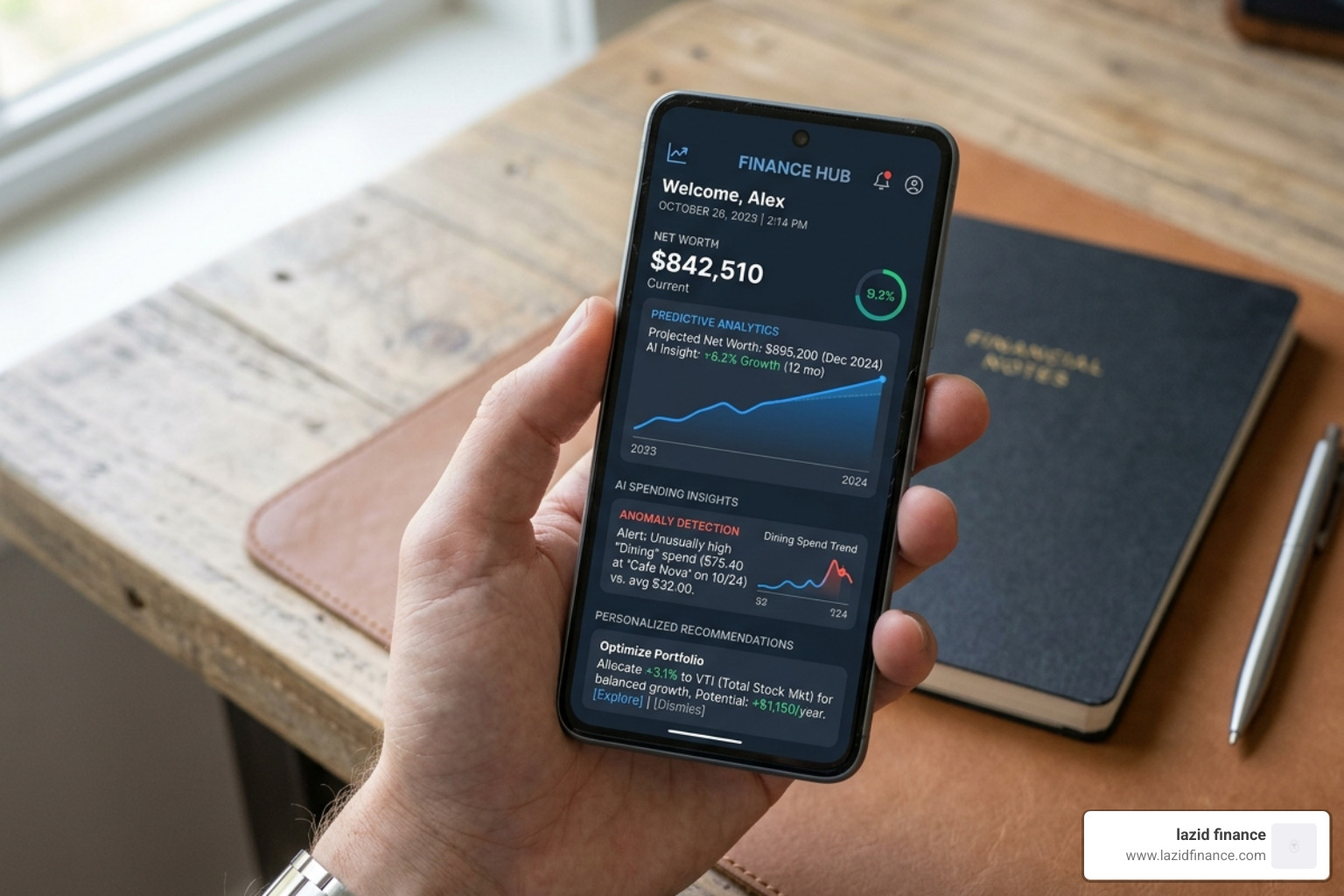
Modern tools leverage AI to provide contextual reasoning. Instead of just displaying a list of transactions, AI layers a “thinking” brain over your data.
- Predictive Analytics: Forecasting your net worth based on current savings rates and market trends.
- Anomaly Detection: Identifying a sudden spike in a utility bill or a subscription price hike before you even notice.
- Semantic Search: Allowing you to ask, “How much did I spend on that trip to Greece last summer?” without needing to remember the exact dates or merchant names.
- Decision Modeling: Providing “affordability analysis” that turns your goals into actionable pathways.
With over 100,000 users already adopting AI-driven platforms, it’s clear that proactive alerts and instant answers are the new baseline for financial peace of mind.
Integrated Tax and Crypto Strategy
A truly holistic finance management tool doesn’t ignore the “hard” stuff. Leading platforms now include Tax Planning Software capabilities. This helps you manage capital gains and prepare for tax season year-round, rather than scrambling in April.
Additionally, with the rise of digital assets, crypto integration is essential. Modern tools now support over 50 blockchains and 100+ exchanges, ensuring your digital assets are tracked right alongside your 401(k).
Security and Privacy Standards in 2026
We know that connecting your entire financial life to one app can feel daunting. That’s why security is now treated as a core feature, not an afterthought. Modern tools utilize:
- Bank-Grade Encryption: AES-256 bit encryption to protect data at rest and in transit.
- Multi-Factor Authentication (MFA): Ensuring that only you can access your dashboard.
- Read-Only Access: Most holistic tools can see your data to analyze it, but they cannot move your money.
- Data Masking: Sensitive information is obscured even within the app’s internal systems.
Choosing the Right Holistic Finance Management Tool for Your Lifestyle
Not every tool is a perfect fit for every person. Your choice should depend on your “financial persona.”
| Persona | Primary Need | Recommended Approach |
|---|---|---|
| Self-Directed Investor | Portfolio depth & tax tracking | Look for tools with advanced brokerage and crypto sync. |
| Multi-Account Household | Unified view & partner access | Prioritize platforms that allow shared accounts and “member filtering.” |
| Small Business Owner | Separating business/personal | Seek tools with cash flow forecasting and expense categorization. |
| High-Earning Family | Complexity management | Consider a “financial operating system” that includes human expert review. |
Factors to Consider Before Subscribing
Before you commit to a subscription, we recommend looking at the “Integration Breadth.” Does the tool connect to the 12,000+ financial institutions supported by major aggregators? Is the user interface “clean” or “cluttered”? Many top-tier tools offer a 7-day or 30-day trial period—use this time to see if the AI insights actually provide value to your daily life.
Limitations of a Holistic Finance Management Tool
While we love these tools, we have to be realistic. Technology isn’t a magic wand.
- Operational Disruption: Over 90% of executives admit they didn’t do enough to manage disruption during major software implementations. Similarly, setting up a holistic tool takes time and a bit of a learning curve.
- Manual Reconciliation: Occasionally, an AI might miscategorize a transaction, requiring a quick manual fix.
- Subscription Fatigue: Adding another monthly fee can be annoying if the tool doesn’t save you more money than it costs.
Balancing Automation with Human Expertise
Even the smartest AI can’t replace the human touch entirely. This is especially true for complex situations like estate planning or navigating a major career change.
The Role of Financial Advisors in a Digital Age
Many people find the most success using a holistic finance management tool in conjunction with a human advisor. A CERTIFIED FINANCIAL PLANNER™ (CFP®) acts as a fiduciary, meaning they are legally obligated to put your interests first.
While the tool provides the “decision-ready data,” the human expert provides the objective implementation and emotional support. Some platforms actually build this into their service, combining automated tracking with regular reviews by real financial experts. This creates a “sustainable rhythm” where you have the clarity of a dashboard and the confidence of a professional’s second pair of eyes.
Frequently Asked Questions about Holistic Finance
What is the difference between traditional and holistic financial planning?
Traditional planning is often “piecemeal”—you look at your budget, your taxes, and your investments as separate buckets. Holistic planning is “top-down.” It integrates all these elements into one uniform system centered around your lifestyle and long-term goals. It’s the difference between buying individual ingredients and having a professional chef prepare a five-course meal.
Are holistic finance management tools safe for connecting all my accounts?
Yes, provided you choose reputable platforms. Leading tools use API-based access and secure data aggregators (like Plaid) to ensure they never actually “see” or “store” your login credentials. With multi-factor authentication and read-only connections, these tools are often more secure than the spreadsheets many people currently use.
Who benefits most from using a holistic financial system?
Anyone with a “complex” financial life. This includes high-earning families managing multiple goals (like college funds and retirement), small business owners who need to separate personal and professional expenses, and active investors who want to track TradFi and Crypto in one place. If you have more than three financial accounts, you would likely benefit from a holistic view.
Conclusion
At Lazid Finance, we believe that money shouldn’t be a source of stress—it should be a tool for a better life. By adopting a holistic finance management tool, you move away from reactive “firefighting” and toward proactive, mindful wealth management.
Whether you choose an AI-heavy platform or a human-supported system, the goal remains the same: financial mastery through clarity. As we move through 2026, the technology is here to help you make smarter, more conscious decisions.

