
A Comprehensive List of Financial Goals for Students Who Want More
Why Every Student Needs a Clear List of Financial Goals Right Now
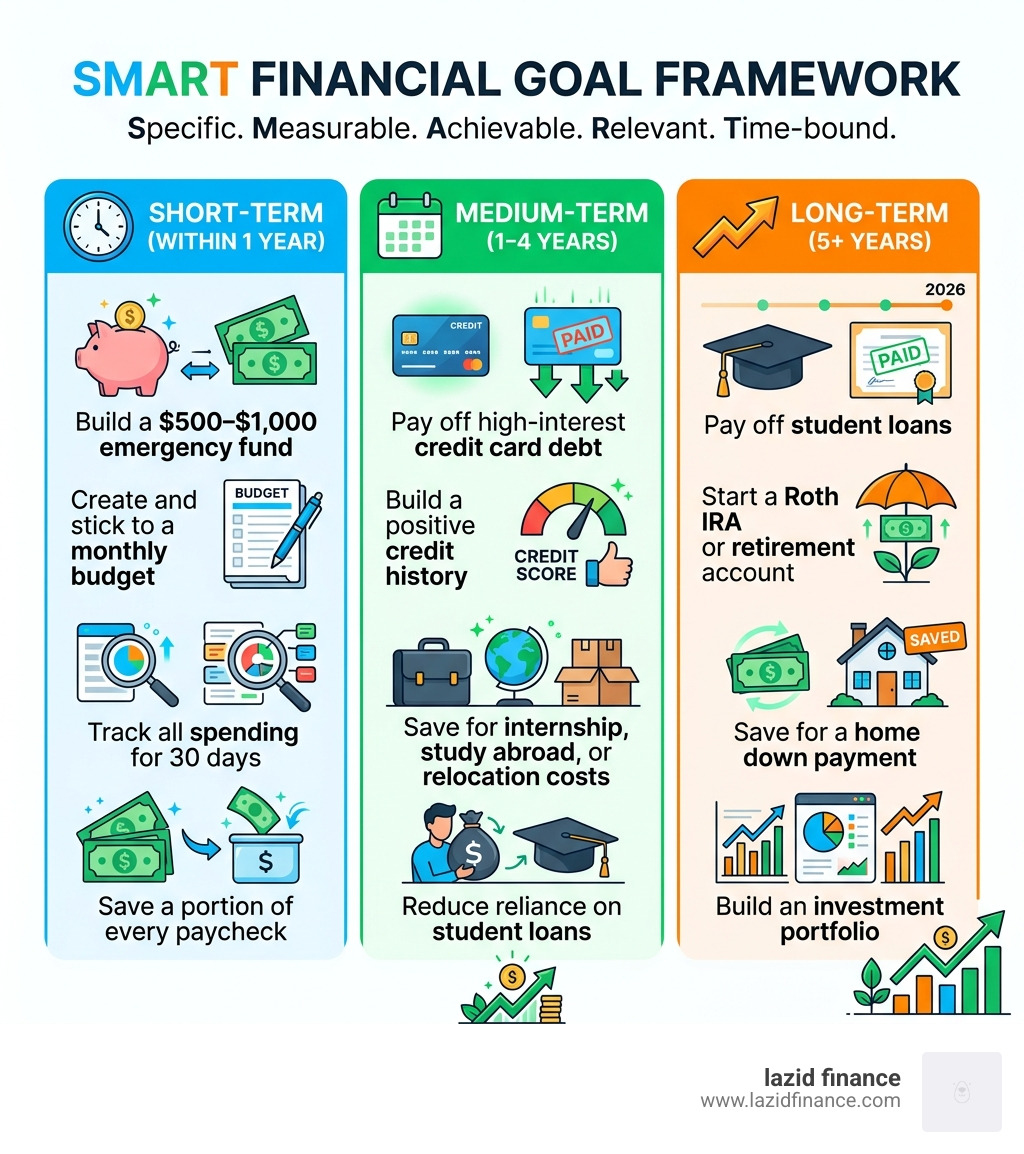
If you’re looking for a list of financial goals for students, here’s a quick overview organized by timeframe:
Short-Term Goals (within 1 year)
- Build a $500–$1,000 emergency fund
- Create and stick to a monthly budget
- Track all spending for 30 days
- Save a portion of every paycheck
Medium-Term Goals (1–4 years)
- Pay off high-interest credit card debt
- Build a positive credit history
- Save for internship, study abroad, or relocation costs
- Reduce reliance on student loans
Long-Term Goals (5+ years)
- Pay off student loans
- Start a Roth IRA or retirement account
- Save for a home down payment
- Build an investment portfolio
Here’s a hard truth: 56% of Americans can’t cover a $1,000 emergency expense out of pocket. Many of them wish someone had given them a clear financial roadmap earlier.
That’s exactly what this guide is.
College is a critical window. The habits you build now — saving, budgeting, managing debt — will follow you for decades. Students who set clear financial goals graduate with 20–30% less debt on average, according to financial literacy research.
You don’t need a finance degree. You don’t need a big income. You just need a starting point and a plan.
This guide breaks down specific, actionable financial goals by timeframe — so you know exactly what to focus on now, what to work toward before graduation, and how to set yourself up for real financial freedom after.
Why Setting Financial Goals is the Ultimate Student Power Move
We often hear that being a “broke student” is just a rite of passage. But at Lazid Finance, we believe that mindful choices today prevent financial headaches tomorrow. Setting a list of financial goals for students isn’t just about numbers; it’s about “Loyalty to Your Dreams.”
When we talk about financial literacy, we’re talking about the power to say “no” to high-interest debt and “yes” to future opportunities. Research shows that students who set goals graduate with significantly less debt. Why? Because goals act as an anchor, helping you navigate the whirlwind of social events and mounting bills.
Beyond just saving money, goal setting is a form of stress management. Knowing you have a plan reduces the “financial noise” in your head, allowing you to focus on what really matters: your education and your personal growth. By checking out resources like 7 Best Financial Goals for Students (Why I Need ‘Em?) – 2026, you can see how early planning creates a foundation for lifelong security.
The Essential List of Financial Goals for Students: Short-Term Wins
Short-term goals are the “quick wins” that build your confidence. These are objectives you can achieve within a year, often within a single semester. They are the building blocks of your financial house.

A great way to start is the 50/30/20 rule. We recommend allocating 50% of your income (from jobs, allowances, or side hustles) to needs, 30% to wants, and 20% to savings and debt repayment. To make this work, you must track your expenses. Whether it’s a spreadsheet or a simple notebook, knowing where every dollar goes for 30 days is eye-opening.
Mastering the List of Financial Goals for Students: The Emergency Fund
The first item on any student’s list should be an emergency fund. Statistic about 56% of Americans? We don’t want you to be part of it. An emergency fund is your “rainy day” buffer for when your laptop dies, your car needs a repair, or you have an unexpected medical bill.
Start small. Don’t feel like you need $5,000 overnight. Aim for $100, then $250, then $500. Eventually, having a $1,000 safety net will make you feel like a financial superhero. It prevents you from reaching for a high-interest credit card when life happens.
Budgeting and Smart Spending Habits
Budgeting isn’t about restriction; it’s about direction. It’s giving your money a job to do. To master this, we need to distinguish between fixed expenses (rent, phone bill) and variable costs (groceries, dining out).
| Category | Examples (The “Needs”) | Examples (The “Wants”) |
|---|---|---|
| Food | Basic groceries, meal prep | Dining out, expensive coffee runs |
| Transport | Bus pass, basic car maintenance | Uber/Lyft for short distances |
| Tech | Required software, repair fund | The newest smartphone model |
| Leisure | Student-discounted gym | High-end boutique fitness classes |
Use student discounts everywhere. Your student ID is essentially a coupon for the world—use it for software, streaming services, and local retailers. We also suggest automating your savings. Set up a recurring transfer of even $10 a week to a separate account. If you don’t see it, you won’t spend it!
Medium-Term Milestones: Bridging the Gap to Graduation
Medium-term goals cover the period from one year up until you toss your cap at graduation. This is where you transition from “surviving” to “thriving.” According to the How to Set Financial Goals While in School: Student Guide – MoneyJournals, this phase is about career readiness and protecting your future self from high-interest traps.
Strategic Debt Management and Credit Building
If you have credit card debt, your medium-term goal is to crush it. High interest rates are the enemy of wealth. However, we do want you to build a credit score. A good credit score makes it easier to rent an apartment or get a car loan later.
Consider a secured credit card or a student-specific card. The goal here is simple: use it for one small thing (like a Netflix subscription), wait for the bill, and pay it off in full every single month. This demonstrates “Integrity in Your Finances” and builds a solid history. You can find more tips on this in 7 Smart Financial Goals for College Students.
Refining Your List of Financial Goals for Students as Graduation Approaches
As graduation nears, your financial needs change. You might need to save for:
- Internship costs: Moving to a new city for a summer.
- Study abroad: Experiences that broaden your horizon but require extra cash.
- Relocation costs: Security deposits and moving trucks for your first “real” job.
- Professional wardrobe: Buying a few key pieces for interviews and office life.
By setting these as specific goals early on, you won’t have to scramble or take out more loans when these opportunities arise.
Long-Term Vision: Building Wealth Beyond the Classroom
Long-term goals are those that will take five years or more to achieve. While they might feel light-years away in 2026, the decisions you make now determine how easily you’ll reach them.
Investing in Your Future Self
The most powerful tool you have is compound interest. It’s the “eighth wonder of the world” because it allows your money to grow on top of itself. Even if you only invest $20 a month into a Roth IRA or a low-cost index fund, starting at age 19 instead of 29 can result in hundreds of thousands of dollars more by retirement.

Micro-investing apps are a great way to start if you have limited funds. The goal is to move from a “consumer mindset” to an “investor mindset.” You aren’t just buying things; you’re buying your future freedom.
Planning for Post-Graduation Independence
What does your life look like five years after college? Maybe you want to buy a home, go to graduate school, or start a business. These require a “Career Fund” or a down payment.
According to Financial Goals for Students: How to Set and Achieve Them, aligning your goals with your personal values is the key to staying motivated. If you value travel, your long-term goal might be a “Dream Vacation Fund.” If you value stability, it’s a mortgage down payment. Whatever it is, write it down. A goal not written down is just a wish.
Overcoming Challenges with a List of Financial Goals for Students
We know it’s not always easy. Students face unique challenges like FOMO (Fear Of Missing Out), irregular income from part-time gigs, and the pressure to keep up with friends.
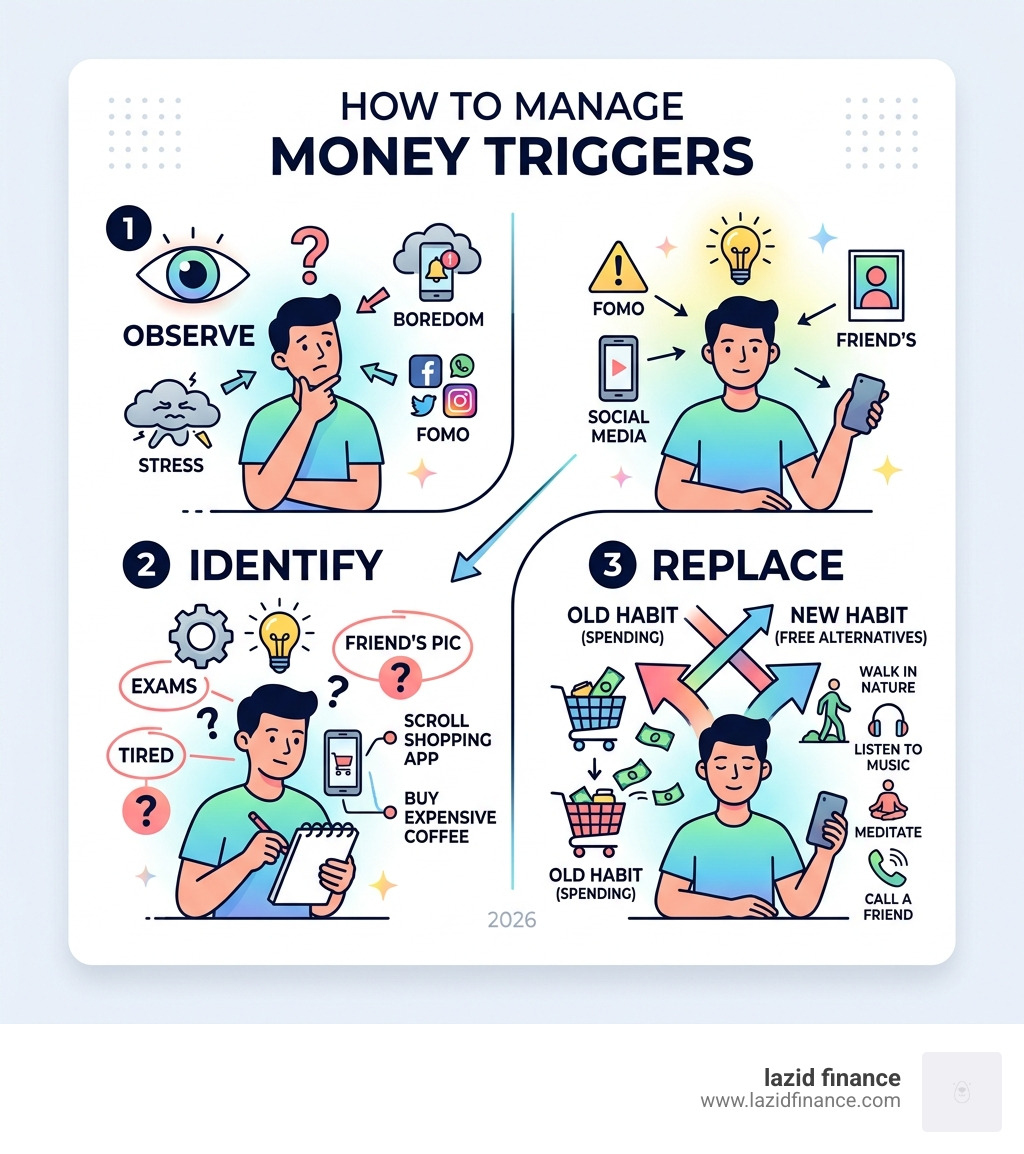
To stay on track, we recommend identifying your “money triggers.” Do you spend money when you’re stressed? Bored? After a long study session? Once you identify the trigger, you can replace the spending habit with something free, like a walk or a chat with a friend.
If your income is irregular, use an “average” budget. Look at what you earned over the last three months and use the lowest amount as your baseline. Any “extra” you earn in a good month goes straight to your savings or debt repayment.
Frequently Asked Questions about Student Financial Goals
What is the best financial goal for a student to start with?
The best starting point is always a small emergency fund and a basic budget. You need to know where your money is going before you can tell it where to go. Aim for a $500 “starter” emergency fund to cover the most common student mishaps.
How can I save money with a limited or irregular income?
The “Pay Yourself First” method is best here. As soon as you get paid, even if it’s just $20 from a tutoring gig, move 10% or 20% to savings immediately. If you wait until the end of the month to see what’s left, the answer will usually be “nothing.”
Will student loans prevent me from reaching my long-term goals?
Not necessarily, but they do require a strategy. By setting a goal to minimize new borrowing and making small payments on interest while still in school, you can significantly reduce the total amount you owe. Students who are proactive about their loans often find they can still save for a home or retirement simultaneously.
Conclusion
Creating a list of financial goals for students is the first step toward a life of mindful choices and financial empowerment. Whether you are building an emergency fund, mastering your first budget, or opening your first investment account, every small step counts.
At Lazid Finance, we provide the intelligent tools you need to make these conscious decisions with confidence. Your time in school is the perfect launchpad for your financial future. Don’t wait until you have a “big” salary to start—start now with what you have.
Start your journey with Lazid Finance and turn your college years into a foundation for lifelong wealth.

