
Mastering the Art of Paying Off Massive Student Loan Balances
The Weight of Six-Figure Student Debt — and How to Break Free From It
If you’re trying to figure out how to pay off large student loan debt, here’s a quick roadmap of the most effective strategies:
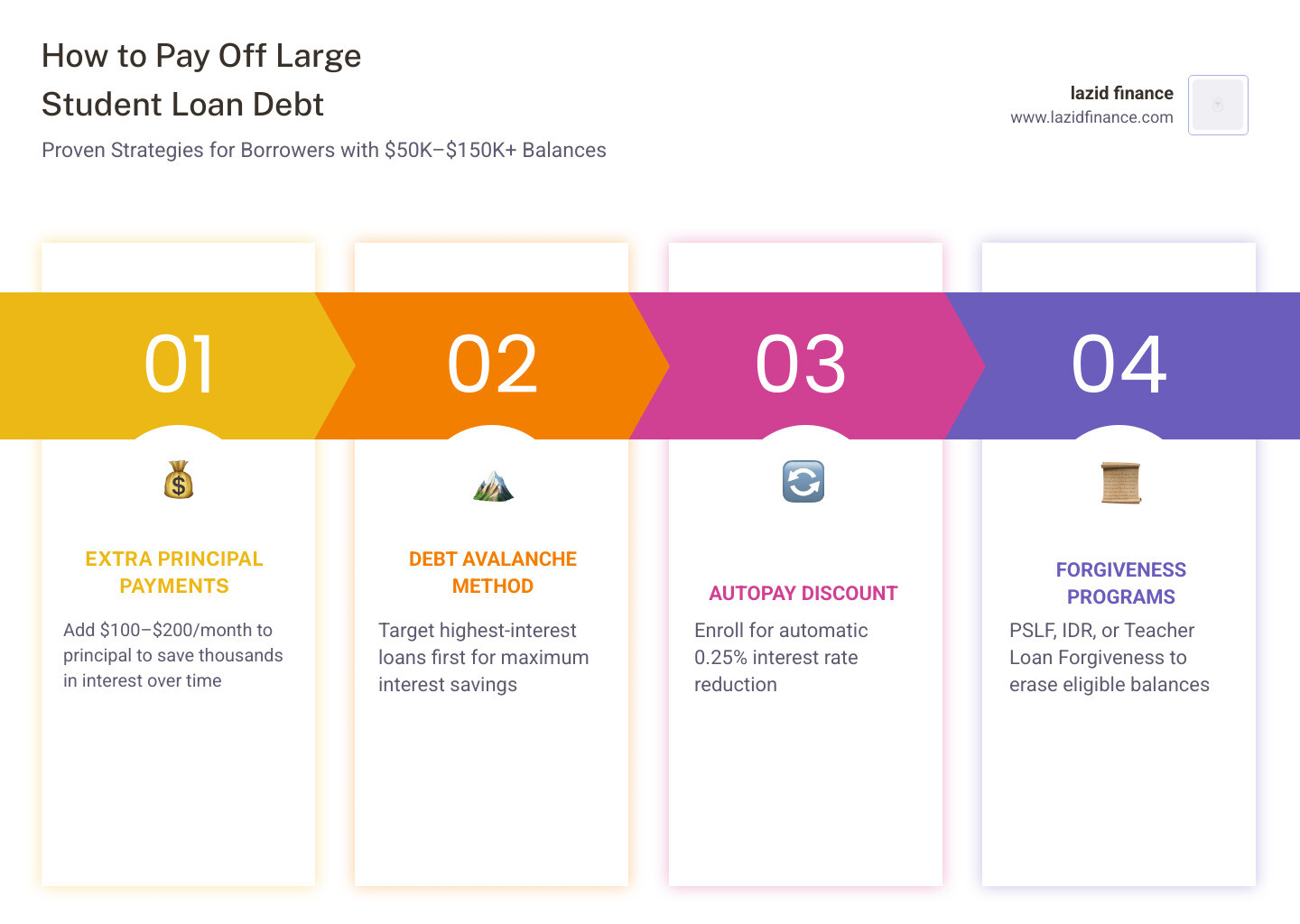
- Make extra principal payments — even $100-$200/month saves thousands in interest
- Use the debt avalanche method — target your highest-interest loan first
- Set up autopay — get a 0.25% interest rate reduction automatically
- Apply windfalls to principal — tax refunds, bonuses, raises
- Explore forgiveness programs — PSLF, Teacher Loan Forgiveness, IDR forgiveness
- Refinance strategically — only if you can drop your rate by 1.5%+ and won’t need federal protections
- Ask your employer — up to $5,250/year in tax-free repayment assistance is available under the SECURE 2.0 Act
As of April 2026, more than 43 million Americans are carrying a collective $1.6 trillion in federal student loan debt. That’s not a typo.
For borrowers with balances in the $50,000 to $150,000+ range, the numbers can feel paralyzing. And it’s not just financial stress — a survey by the American Bar Association’s Young Lawyers Division found that 78% of borrowers with $100,000 to $200,000 in debt reported feeling stressed or anxious about it. Nearly half said it made them feel depressed or hopeless.
But here’s what those statistics don’t tell you: borrowers with large balances actually have more options than most people realize. The right strategy — matched to your loan type, income, and goals — can mean the difference between paying an extra $77,000 in interest or walking away debt-free years ahead of schedule.
The landscape has also shifted significantly. The One Big Beautiful Bill Act (OBBBA), signed in 2025, is reshaping federal repayment options starting July 2026. Knowing how these changes affect you is now part of any smart payoff plan.
This guide walks you through everything — from the math behind your monthly payments to forgiveness programs, refinancing, and when not to aggressively pay down your loans.
Understanding the Math of How to Pay Off Large Student Loan Debt

When we look at a $50,000 or $150,000 balance, the first thing we have to confront is the “daily interest” monster. Student loans are unique because they accrue interest daily. If you have a $35,000 loan at 6.39% interest, you are accruing about $6.13 in interest every single day. Over a month, that’s $184 just to keep the balance from growing.
The real danger for high-balance borrowers is negative amortization. This happens when your monthly payment is so low (common on some older income-driven plans) that it doesn’t even cover the interest. The leftover interest then “capitalizes,” or gets added to your principal, meaning you eventually pay interest on your interest.
To understand Loan Repayment 101, we need to see how these balances behave over time.
| Loan Balance | Interest Rate | Term | Monthly Payment | Total Interest Paid |
|---|---|---|---|---|
| $50,000 | 6.00% | 10 Years | $556 | $16,600 |
| $50,000 | 6.00% | 20 Years | $359 | $36,160 |
| $150,000 | 8.94% (PLUS) | 10 Years | $1,895 | $77,432 |
| $150,000 | 8.94% (PLUS) | 25 Years | $1,253 | $225,900 |
Calculating the Monthly Cost of High-Balance Loans
For many of us, the monthly payment is the biggest hurdle. A $150,000 balance on a standard 10-year plan requires a staggering $1,895 monthly payment. That is often more than a mortgage! Even a $50,000 loan at 6% requires $556 a month.
When we calculate our debt-to-income (DTI) ratio, these numbers can prevent us from qualifying for home loans or car financing. This is why many high-balance borrowers choose to extend their terms to 20 or 25 years—it lowers the monthly payment to a more manageable $359–$420 range for a $50k loan, though it significantly increases the total cost of the loan.
The Impact of Interest Rates on Your Total Payoff
Interest rates are the “silent killer” of wealth. For the 2025-2026 cycle, federal rates range from 5.50% to 8.05%. If you are carrying a $150,000 Direct PLUS loan at 8.94%, you are looking at over $77,000 in interest alone over a decade.
If we can find ways to lower that effective rate—either through autopay discounts or strategic refinancing—we can save tens of thousands of dollars. For instance, a simple 0.25% autopay discount on an $80,000 loan can save nearly $3,000 over a 20-year term.
Proven Strategies for Accelerated Debt Repayment

If your goal is to figure out how to pay off large student loan debt as fast as possible, you need a system. We don’t just want to throw money at the problem; we want to throw it where it hurts the debt the most.
According to research on How to Pay Off Student Loans Fast, the most effective way to gain momentum is through automation and targeting.
Using the Avalanche Method for How to Pay Off Large Student Loan Debt
Mathematically, the Debt Avalanche is the undisputed champion. Here is how we do it:
- List all your loans by interest rate.
- Pay the minimum on everything.
- Direct every extra penny to the loan with the highest interest rate.
By targeting the most expensive debt first, you reduce the “weighted average” of your interest. This saves the most money over time compared to the “Snowball” method (which targets the smallest balance first for psychological wins). While the Snowball is great for motivation, when you’re dealing with $150,000, the Avalanche can save you enough money to buy a new car.
Instructing Your Servicer for Extra Principal Payments
This is a critical step many people miss! When you make an extra payment, your servicer might try to “advance your due date.” This essentially treats your extra money as a pre-payment for next month’s bill, which doesn’t help you save on interest.
We must proactively communicate with our servicer. When you pay extra, include a note or select the option that says: “Apply this payment to the principal balance of [Loan ID] and do not advance my due date.” This ensures your money immediately shrinks the balance that interest is calculated on.
Navigating Federal Forgiveness and the OBBBA Legislation
For those of us with massive balances, forgiveness isn’t just a dream—it’s a strategic necessity. If you owe more than your annual salary, paying the debt in full might not be the smartest financial move.
Leveraging Forgiveness Programs for How to Pay Off Large Student Loan Debt
There are three main paths to federal forgiveness:
- Public Service Loan Forgiveness (PSLF): If you work for a government or non-profit organization, your remaining balance is forgiven tax-free after 120 qualifying payments (10 years). For someone with $150,000 in debt, this is often the most valuable employee benefit in existence.
- Teacher Loan Forgiveness: Offers up to $17,500 in forgiveness for those teaching full-time for five consecutive years in low-income schools.
- Income-Driven Repayment (IDR) Forgiveness: If you aren’t in public service, you can still get forgiveness after 20 or 25 years of payments on an IDR plan.
The OBBBA Shift: The One Big Beautiful Bill Act (OBBBA), effective July 2026, is a game-changer. It introduces the Repayment Assistance Plan (RAP), which will replace many existing IDR plans. Under RAP, payments are capped based on income (as low as 3% for some), and even the lowest-income borrowers will have a $10 minimum payment. Crucially, RAP is designed to prevent balance growth from unpaid interest, which has been a major pain point for high-balance borrowers in the past.
Note: While federal forgiveness is currently tax-free through 2025, some states may treat forgiven amounts as taxable income. Always check your local tax laws as we move through 2026.
Strategic Refinancing and Employer Assistance
Sometimes, the best way to handle how to pay off large student loan debt is to leave the federal system entirely—but you must be careful.
Pros and Cons of Refinancing Six-Figure Debt
Refinancing involves taking out a new loan with a private lender to pay off your old ones.
- The Pro: If you have a high income and a credit score in the 700s or 800s, you might drop your interest rate from 8% to 4%. On a $100,000 loan, that saves you thousands every year.
- The Con: You lose all federal protections. No PSLF, no RAP plan, and no federal deferment if you lose your job.
We generally recommend the 1.5% Rule: Only refinance if you can lower your rate by at least 1.5 percentage points and you have a very stable income. For more on this, check out The Smart Way To Pay Off Student Loans.
Using Employer Benefits
Thanks to the SECURE 2.0 Act, your boss can be your best ally. Employers can now contribute up to $5,250 per year toward your student loans tax-free. About 17% of employers now offer this. If yours doesn’t, it’s worth a conversation with HR. That $5,250 is essentially a “bonus” that goes straight to your principal without you ever seeing a tax bill for it.
When to Prioritize Other Financial Goals Over Debt
It might sound counterintuitive, but sometimes paying off your student loans aggressively is a bad idea. We need to look at our finances mindfully.
Balancing Retirement Savings and Student Loans
At Lazid Finance, we believe in making conscious decisions. Before you put an extra $500 toward a 5% student loan, ask yourself:
- Do I have an emergency fund? You need 3–6 months of expenses in a high-yield savings account first.
- Am I getting my 401(k) match? If your employer matches 50% or 100% of your contributions, that is a guaranteed 50–100% return. Your student loan interest is only 6–8%. Always take the match first.
- Do I have high-interest credit card debt? If you have a credit card at 22% APR, it is a financial emergency. Pay that off before touching your student loans.
If your student loan rate is under 4%, you might actually build more wealth by investing in a diversified index fund (which historically returns 7–10%) than by paying off the debt early.
Frequently Asked Questions about Large Student Debt
Can I pay off $150,000 in student loans in 5 years?
Yes, but it requires a “war-time” budget. At an 8% interest rate, you would need to pay approximately $3,041 per month. This is usually only possible for high-earning professionals (like doctors or lawyers) or those with extremely low living expenses who can dedicate a second income entirely to the debt.
Is student loan interest still tax-deductible in 2026?
Yes. You can still deduct up to $2,500 of student loan interest per year. However, this phases out if your Modified Adjusted Gross Income (MAGI) is between $80,000 and $95,000 (for single filers). It’s an “above-the-line” deduction, meaning you don’t need to itemize to claim it.
Should I consolidate my Parent PLUS loans separately?
Often, yes. Parent PLUS loans are only eligible for the Income-Contingent Repayment (ICR) plan if they are consolidated into a Direct Consolidation Loan. A common strategy is to consolidate them separately from your own student loans to keep the repayment options flexible and potentially qualify for PSLF if the parent works in public service.
Conclusion
Mastering how to pay off large student loan debt isn’t about a single “magic” trick; it’s about using a combination of smart math, federal programs, and consistent habits. Whether you’re navigating the new RAP plan under the OBBBA or using the avalanche method to crush a $150,000 balance, you have the power to change your financial trajectory.
At Lazid Finance, we provide the intelligent financial tools you need for these conscious decisions. Our goal is to help you move from feeling paralyzed by debt to making mindful choices that lead to true financial freedom.
Ready to take control? More info about our services can help you find the right path for your unique journey. Stay mindful, stay consistent, and we’ll see you at the finish line.

